
LEAD ANALYST
Utkarsh Khirodkar is a Lead Market Research Analyst at MetaStat Insight, specializing in market intelligence, technology sector assessments, and competitive strategy.

Global Middle Office Outsourcing Market Size, Share, By Service Type (Trade Processing and Settlement Support, Investment Book of Record and Shadow Accounting, Reconciliation Services, Reference Data, Pricing and Valuation Services, Corporate Actions and Asset Lifecycle Management, Treasury and Collateral Management, Performance Measurement and Attribution, Risk Analytics and Investment Compliance Monitoring, Regulatory and Client Reporting), By End User (Traditional Asset Managers, Hedge Fund Managers, Banks and Broker-Dealers, Private Markets Investment Managers, Insurance Companies, Pension Funds, Wealth Management Firms, Family Offices, Sovereign Wealth Funds), By Enterprise Size (Large Enterprises and Small & Medium Enterprises), By Deployment Type (On-Premise, Cloud-Based and Hybrid), Industry Analysis, Growth, Trends, and Forecast, 2026-2033
Report ID
MSI-5514
Published
October, 2026
Pages
288 Pages
Format
Historical
Base year
Forecast
Forecast period
Report Details
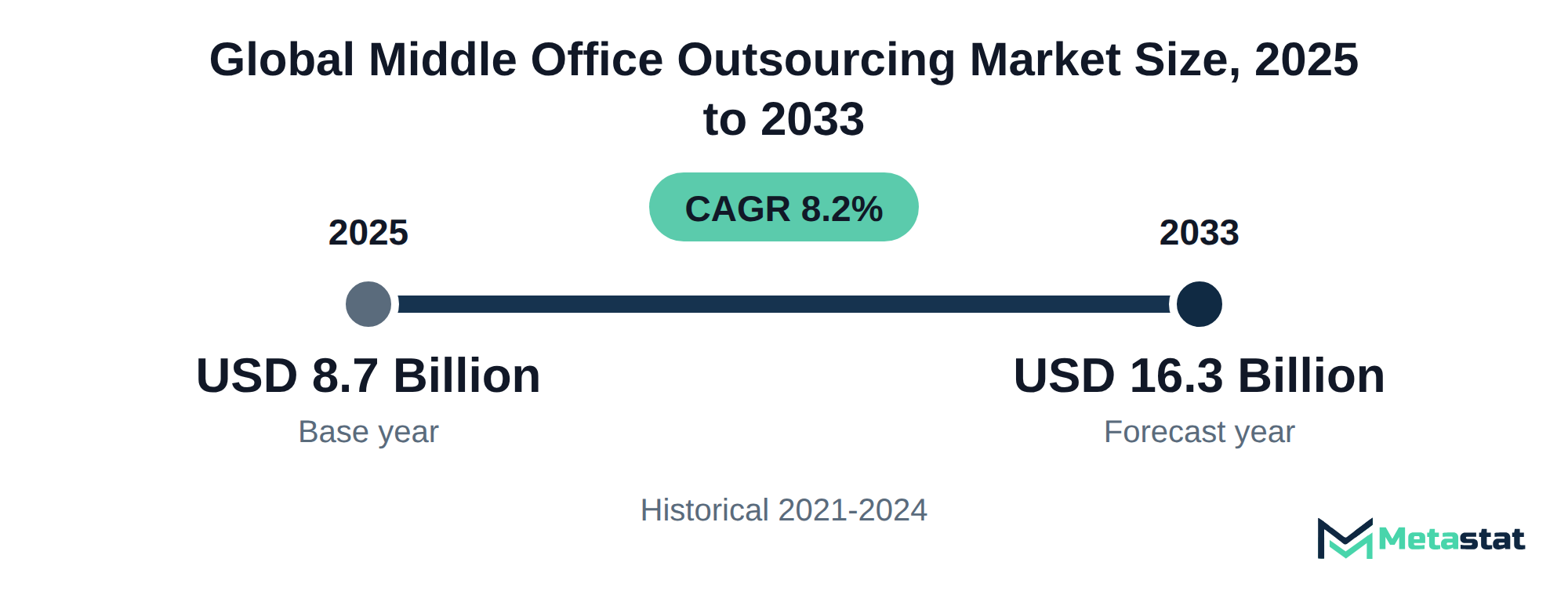
Market Valuation: Valued at $8.7 Billion in 2025, projected to reach $16.3 Billion by 2033 at a 8.2% CAGR.
Dominant Segment: Traditional asset managers lead the market, driven by their need for robust support in trade processing and settlement services. This segment's high value reflects the increasing complexity of investment strategies and regulatory compliance.
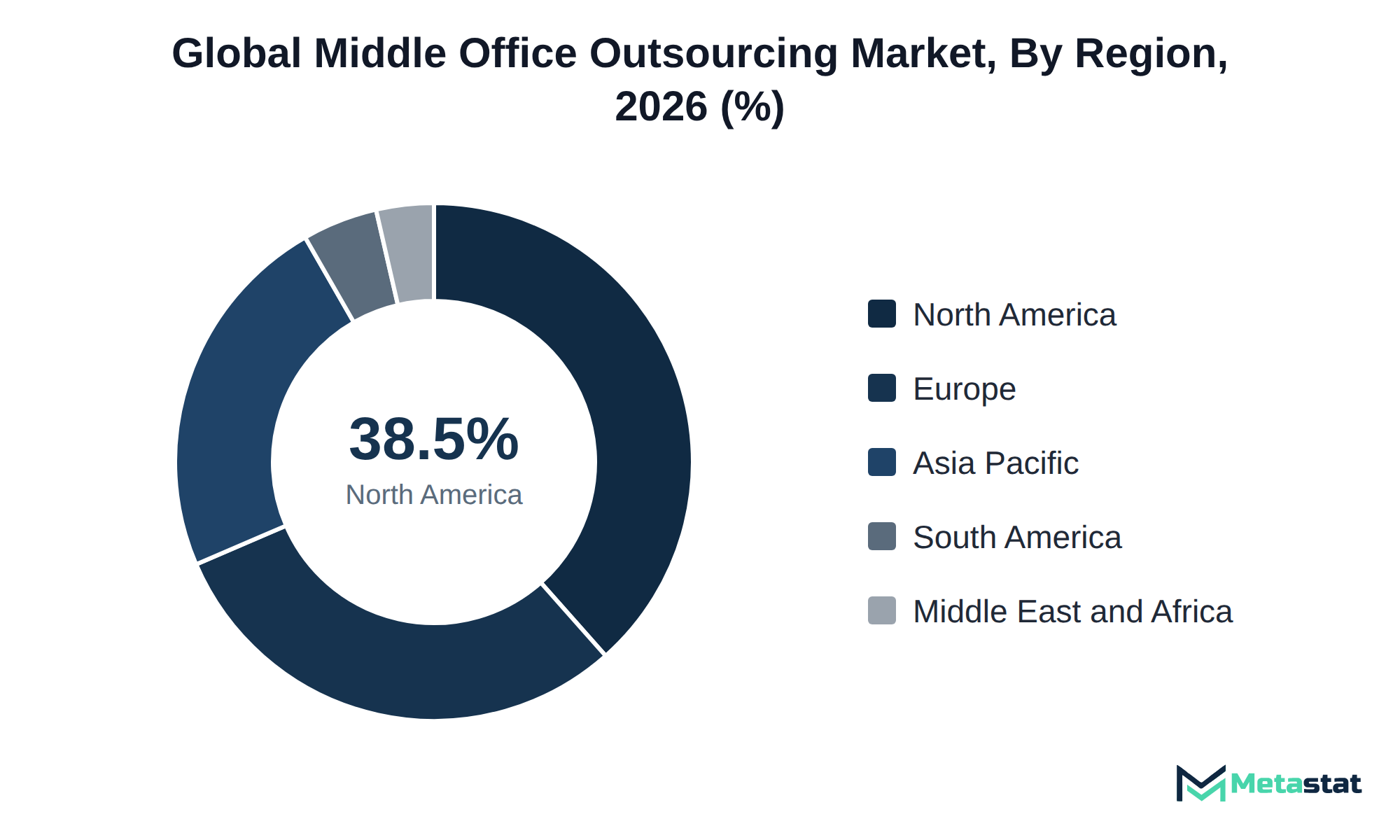
Geographic Lead: North America is the leading region, accounting for 38.5% of the market in 2025, with the US expected to maintain this dominance due to its advanced financial infrastructure and concentration of major financial institutions.
What's Inside: The report provides a comprehensive analysis of the Middle Office Outsourcing market, covering service types, end users, and deployment strategies, along with competitive insights and a forecast window from 2026 to 2033.
Growth Drivers: The market is propelled by the rising demand for cloud-based solutions and reconciliation services, as organizations seek to enhance operational efficiency and ensure compliance with complex regulatory requirements.
Emerging Trends: AI-driven reconciliation and exception management are gaining traction, enhancing operational efficiency by automating processes and reducing human error, reflecting the industry's shift towards technology-driven solutions.
Choose Your License
Global Middle Office Outsourcing Market
The global Middle Office Outsourcing market was valued at USD 8.7 billion in 2025 and is projected to reach USD 16.3 billion by 2033, growing at a CAGR of 8.2% over the forecast period.
The Middle Office Outsourcing market encompasses a range of services designed to support operational processes for financial institutions. Buyers invest in these solutions to enhance efficiency, reduce operational risks, and ensure compliance with regulations. The market serves various end users, including traditional asset managers, hedge fund managers, and banks, each seeking to optimize back-office operations and focus on core competencies.
Growth in the market is driven by the increasing demand for comprehensive financial services, particularly in the investment management sector. Traditional asset managers represent the highest-value segment and need reliable support in trade processing and settlement. North America holds 38.5% of the market in 2025, with the US leading in 2026. This region's dominance reflects its advanced financial infrastructure and high concentration of major financial institutions.
Investment in technology and the shift toward cloud-based solutions significantly contribute to market expansion. The growing need for efficient data management and real-time analytics prompts firms to seek innovative outsourcing solutions. Demand for cloud-based deployments is particularly strong, reflecting a broader trend toward digital transformation across the financial services industry.
The market serves a diverse clientele, including traditional asset managers and hedge fund managers. These buyers invest in middle office outsourcing to enhance operational efficiency, reduce costs, and focus on core competencies. The growing complexity of financial regulations and the demand for accurate data management drive the need for these services. Organizations seeking to streamline their operations find outsourcing middle office functions a strategic approach to achieve these objectives.
Investment book of record and shadow accounting services generate the largest share of revenue within the market. Europe follows closely, contributing 30.1%, while Asia Pacific accounts for 23.2%. The increasing adoption of cloud-based solutions stands out as a key driver of growth, enabling organizations to achieve scalability, flexibility, and efficiency in their operations.
The demand for reconciliation services continues to rise, reflecting the growing importance of accurate and timely financial reporting. Small and medium enterprises embrace these outsourcing solutions to compete effectively in the financial sector. The market's expansion reflects a shift towards integrated solutions that enhance data accuracy and compliance while minimizing operational risks.
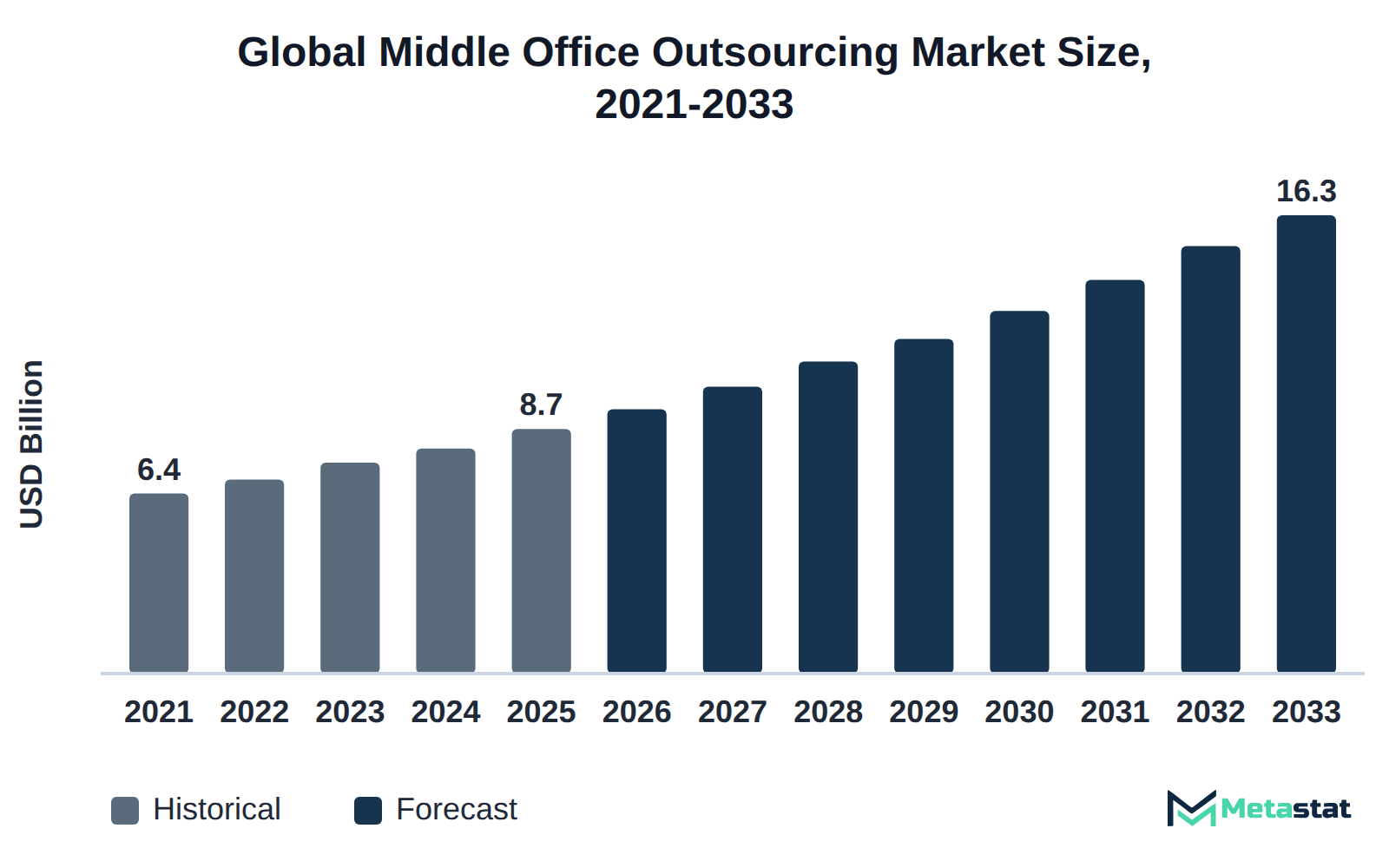
AI-driven reconciliation and exception management represents a significant advancement within the Middle Office Outsourcing market. This technology enhances efficiency by automating complex processes and reducing the potential for human error. The rising demand for accurate financial reporting and compliance further drives this trend. By 2033, the reconciliation services segment is projected to reach USD 2 billion, reflecting growing investments in technology solutions that streamline operations.
AI tools enable firms to handle large volumes of transactions efficiently while maintaining compliance with regulatory requirements. Intelligent automation reduces the time and resources required for reconciliation, allowing firms to focus on strategic activities rather than time-consuming manual processes. Consequently, companies operating in the market benefit from improved accuracy, faster processing times, and enhanced decision-making capabilities.
Cloud-based solutions for Investment Book of Record (IBOR) integration across custodians have gained traction due to their ability to streamline operations and enhance data accessibility. This integration is critical for traditional asset managers and hedge fund managers, who require precise and timely data to make informed decisions. The segment for Investment Book of Record and Shadow Accounting is projected to reach USD 3 billion by 2033, reflecting a compound annual growth rate of 7.9%. This growth highlights the increasing adoption of cloud technologies in the Middle Office Outsourcing market.
Pricing structures for these cloud-based solutions often feature subscription models, allowing buyers to pay based on usage rather than incurring large upfront costs. This flexibility facilitates integration with existing systems and assists in scaling operations while business needs evolve. Buyers frequently assess contract terms to ensure alignment with their operational goals, focusing on factors including service level agreements and data security. Competitive pricing and dependable service offerings position cloud-based IBOR solutions favorably in the market.
The shift toward cloud-based infrastructures presents substantial commercial advantages. By minimizing operational costs and enhancing efficiency, organizations reallocate resources to strategic initiatives. This approach contributes positively to overall growth within the Middle Office Outsourcing market, leading to increased investment in innovative technologies.
In middle office outsourcing, treasury and collateral services matter to hedge fund managers, who often face unique operational challenges in managing liquidity and risk. Wealth management firms and asset managers rely on effective treasury functions to optimize capital usage while navigating complex regulatory environments.
Hedge fund managers particularly benefit from outsourcing treasury and collateral management functions, enabling them to focus on core investment strategies and enhance operational efficiency. This segment's growth, with a projected CAGR of 9.1% for services related to reference data, pricing, and valuation, reflects the increasing complexity of financial markets and the necessity for specialized expertise. By outsourcing these services, hedge funds mitigate risks associated with collateral management and streamline operations, leading to improved performance and competitiveness in the market.
The cost of middle office outsourcing for asset managers varies depending on the services provided and the size of the enterprise. For instance, traditional asset managers are expected to see costs increase from USD 2.8 billion in 2026 to USD 4.5 billion by 2033, reflecting a compound annual growth rate of 7.2%. This increase highlights the growing reliance on outsourced services to improve operational efficiency and regulatory compliance.
Investment in middle office outsourcing is often driven by the need to enhance service offerings while managing operational costs effectively. Major asset managers recognize that outsourcing functions, including trade processing and settlement support, reduce in-house burdens and enable better focus on core competencies. This strategic move is projected to yield substantial benefits, including improved transaction speed and accuracy, which are critical in the highly competitive market.
Understanding the costs associated with middle office outsourcing is essential for asset managers aiming to optimize their operational frameworks and maintain a competitive edge. Firms that invest in these services are better placed to respond to market demands and improve service delivery and client satisfaction.
Financial institutions experience heightened operational complexity due to increasing regulatory requirements and evolving client demands. Traditional asset managers, hedge fund managers, and private market investment managers actively seek more efficient solutions to enhance operational capabilities. The growing intricacies of investment strategies and the need for real-time data analytics encourage these buyers to invest in outsourcing services. This trend results in increased volumes of transactions requiring support, translating into a significant rise in the Middle Office Outsourcing market. Enhanced operational efficiency and cost management through outsourcing enable firms to allocate resources more effectively and improve client satisfaction.
Investment Book of Record (IBOR) integration contributes substantially to operational efficiency within the Middle Office Outsourcing market. Enhanced data management practices allow financial institutions to streamline operations and achieve better compliance with regulatory standards. Leading players in the market focus on delivering solutions that provide real-time data access and reporting capabilities. This improvement in service delivery reduces manual intervention and minimizes errors, enhancing overall accuracy in trade processing and settlement support. Investment managers, including hedge funds and traditional asset managers, increasingly adopt these integrated solutions to address the growing complexities of asset management. The projected growth of 7.9% in the IBOR segment from 2026 to 2033 reflects rising demand for efficient data handling processes. Players in the market continue to innovate and refine their offerings, ensuring that financial institutions benefit from advancements in technology and automation. The strategic shift toward IBOR integration is a critical driver in the Middle Office Outsourcing market.
Price sensitivity among smaller enterprises significantly influences demand within the Middle Office Outsourcing market. Small and medium enterprises, often operating under tighter budgets, experience challenges when considering outsourcing solutions that involve substantial initial investments. This situation leads to slower uptake of these services, affecting their operational efficiency and competitiveness. The reluctance to adopt stems from concerns over long-term costs versus perceived short-term savings. Smaller firms typically require assurance that the benefits of outsourcing, including improved processes and specialized expertise, justify the financial outlay. Without adequate pricing models or flexible service options, adoption rates in this segment decline, resulting in reduced market penetration. Over time, the inability to engage with outsourcing solutions restricts growth opportunities for these enterprises, limiting their capacity to scale operations effectively. The current economic environment further exacerbates this situation, with high cost pressures influencing purchasing decisions across the market.
Costs associated with attracting and retaining skilled professionals represent a significant challenge within the Middle Office Outsourcing market. Suppliers face increased competition for top talent, leading to higher labor costs that affect profitability. The demand for specialized knowledge in areas including reconciliation, trade processing, and compliance further compounds this issue, limiting the pool of available qualified candidates. The push for digital transformation escalates this challenge, requiring firms to invest considerably in ongoing training and development.
In response, many suppliers implement strategies focused on improving employee value propositions. This includes offering competitive salaries, benefits, and flexible working arrangements to attract talent. Investing in technology-driven solutions that automate certain processes reduces reliance on manual labor and mitigates labor costs. By optimizing operational efficiencies through technology, suppliers redirect resources toward talent development and retention, ensuring sustainable service delivery in the market.
Investment firms increasingly seek reconciliation services to improve operational efficiency and enhance compliance measures. This service type is projected to experience strong growth within the Middle Office Outsourcing market, driven by rising transaction volumes and complex financial instruments. Reconciliation services offer essential support in aligning financial records and ensuring data accuracy, which are critical for investment managers facing stringent regulatory scrutiny. The segment exhibits a compound annual growth rate (CAGR) of 9.1%, reflecting the increasing importance of precise data management in financial operations. Traditional asset managers and hedge fund managers are the primary buyers, with their demand influenced by the need for accurate and timely reporting. This focus on reconciliation aligns with broader trends in the financial services sector, emphasizing the necessity for transparency and risk mitigation. The market's forward trajectory indicates significant opportunities for service providers specializing in this area, positioning them to capitalize on the growing need for enhanced reconciliation capabilities.
The Global Middle Office Outsourcing market is segmented based on Service Type, End User, Enterprise Size, and Deployment Type.
Valued at USD 2.1 billion in 2026 and projected to reach USD 3.4 billion by 2033, the Trade Processing and Settlement Support segment exhibits a CAGR of 7.2% during the forecast period. This segment supports financial institutions by streamlining transaction processes and ensuring accurate settlement of trades, proving essential for traditional asset managers and banks. The increasing complexity of financial transactions and heightened regulatory scrutiny drive demand for these services. Compared to other segments, Trade Processing and Settlement Support experiences moderate growth, focusing on improving operational efficiency. The segment's growth outpaces that of Reconciliation Services, which faces stiffer competition. Investment in advanced technologies within this segment enhances service delivery, positioning it favorably amid evolving market demands.
This segment provides crucial support for investment firms, facilitating accurate tracking and reporting of asset valuations and transactions. Traditional asset managers and hedge fund managers primarily employ this segment to enhance operational efficiency and regulatory compliance. Increased regulatory scrutiny drives demand for robust accounting practices and transparency in reporting. Compared to other services, this segment demonstrates higher growth potential, fueled by a CAGR of 7.9%, which surpasses the growth rates of several related segments. The focus on precise accounting and the growing complexity of investment portfolios further distinguish this segment, presenting unique challenges and opportunities that shape the overall dynamics of the market.
This segment ensures accuracy and consistency in financial records, particularly for institutions including banks, asset managers, and hedge funds. Strong demand from financial institutions seeking to enhance compliance and operational efficiency drives growth in this segment. The projected compound annual growth rate (CAGR) of 9.1% reflects the increasing importance of accurate financial data management. Compared to other service types, Reconciliation Services demonstrates higher growth potential due to rising complexity in regulatory requirements and the need for real-time data verification. This segment distinguishes itself with a focus on precise data comparison, presenting unique challenges and opportunities compared to slower-growing segments including Trade Processing and Settlement Support.
Valued at USD 2.1 billion in 2026, the Reference Data, Pricing and Valuation Services segment is projected to grow at a CAGR of 9.1% during the forecast period. This segment provides essential data and analytics for pricing financial instruments and ensuring accurate valuations, primarily used by asset managers, banks, and hedge funds. The increasing emphasis on regulatory compliance and transparency in financial transactions drives demand for these services. This segment's growth outpaces others including Trade Processing and Settlement Support, which exhibit a CAGR of 7.2%. Financial institutions rely heavily on accurate reference data to enhance operational efficiency and mitigate risks associated with pricing inaccuracies, distinguishing this segment's critical role within the overall market.
Corporate Actions and Asset Lifecycle Management encompasses processes that facilitate the management of corporate actions, including dividends, mergers, and acquisitions, alongside asset lifecycle management. Financial institutions, including hedge fund managers and traditional asset managers, employ these services to enhance operational efficiency and ensure compliance with complex regulatory requirements. Growth in this segment correlates with the increasing complexity of financial markets and the necessity for precise tracking of corporate actions. Regulatory compliance pressures drive demand, compelling firms to seek reliable solutions. Compared to other service types, this segment experiences significant growth driven by the need for accuracy and timeliness in managing corporate events, distinguishing it in the market. Increased regulatory scrutiny intensifies the focus on accurate reporting and compliance, further emphasizing the importance of this service segment.
Treasury and collateral management involves the oversight and administration of liquidity and risk for financial institutions, ensuring that assets are effectively managed to meet obligations. This service is crucial for hedge funds and traditional asset managers, focusing on optimizing capital utilization and safeguarding against market fluctuations. Demand for this segment is driven by the requirement for enhanced risk management and compliance with regulatory standards. Compared to other service types, treasury and collateral management attracts higher prices due to its complexity and the specialized expertise required. The growing emphasis on regulatory compliance increases pressure on firms to adopt advanced treasury management systems, distinguishing this segment with a different set of challenges and opportunities relative to others in the market.
Performance Measurement and Attribution involves evaluating the effectiveness of investment strategies and asset performance over time. This service is used primarily by traditional asset managers, hedge fund managers, and private markets investment managers, who require detailed insights into their investment outcomes. Demand grows due to increasing focus on accountability and transparency in investment performance. The segment stands out from others due to its higher growth rate, driven by a robust emphasis on data analytics and performance reporting. Unlike other service types, which cater more to operational efficiency or regulatory compliance, Performance Measurement and Attribution targets specific insights for investment decision-making, enhancing the strategic planning of firms. This nuanced focus attracts investment firms seeking to refine their performance evaluation processes, contributing to a dynamic environment within the Middle Office Outsourcing market.
Risk Analytics and Investment Compliance Monitoring focuses on assessing and managing risks associated with investment strategies while ensuring compliance with regulatory requirements. This segment serves traditional asset managers, hedge fund managers, and banks, providing them with critical insights into potential risk exposures and compliance challenges. Demand within this segment is driven by increasing regulatory scrutiny that financial institutions face, pushing them to adopt more sophisticated risk management tools. The segment differentiates itself from others through its significant emphasis on compliance analytics, which is essential for mitigating risks and avoiding costly regulatory penalties. With higher stakes involved in compliance, this segment tends to command higher service prices compared to others that focus more on operational efficiencies. Such dynamics reflect the growing complexity of investment management in the evolving market.
Regulatory and Client Reporting encompasses vital compliance and reporting functions that financial institutions undertake to meet regulatory obligations and ensure transparency. This segment primarily serves banks, hedge fund managers, and traditional asset managers, facilitating adherence to evolving regulations and client reporting requirements. Increasing regulatory scrutiny drives demand for robust regulatory reporting platforms, compelling firms to invest in services that streamline compliance. Unlike other segments, this segment experiences significant growth, attributable to heightened regulatory pressures, while facing distinct challenges related to the complexity of compliance requirements. Financial institutions prioritize investment in this area to mitigate risks related to regulatory penalties and enhance client trust in their operations. The market shows potential for expansion driven by institutions adapting to the dynamic regulatory landscape.
Traditional asset managers primarily apply middle office outsourcing for trade processing, settlement support, and compliance reporting, aiming to streamline operations and enhance efficiency. The segment experiences robust demand driven by the increasing complexity of investment strategies and a heightened focus on regulatory compliance. Unlike hedge fund managers, who exhibit a higher growth rate of 9.1%, traditional asset managers face distinct operational challenges that require tailored services. This divergence in growth rates highlights differing operational requirements among various end-user groups, influencing their strategies and engagement with the market. The market is expected to evolve, reflecting the necessity for these firms to adapt to changing operational landscapes.
Hedge Fund Managers segment is estimated to reach USD 3.8 billion by 2033, at a CAGR of 9.1% during the forecast period. This segment serves investment firms that actively manage large portfolios and require sophisticated middle office functions to support trading and compliance activities. The strong growth in this segment reflects increasing demand for advanced analytical tools and operational support driven by the complexity of investment strategies. Hedge fund managers benefit from improved efficiency in trade processing, risk management, and regulatory compliance, differentiating them from other end users, including traditional asset managers, which exhibit a slower growth rate of 7.2% CAGR. The market's focus on technology integration and automation further enhances service offerings, driving higher performance standards and cost effectiveness.
Valued at USD 2.2 billion by 2033, the Banks and Broker-Dealers segment serves key financial institutions seeking specialized outsourcing solutions to enhance operational efficiency. This segment focuses on providing services that facilitate trade processing, settlement, and regulatory compliance for banks and broker-dealers. The increasing demand for regulatory adherence and the complexity of financial transactions drives growth in this segment. Compared to other segments, the Banks and Broker-Dealers segment exhibits a moderate growth rate, influenced by the need for skilled manpower and technology investment. Overall market growth is expected to reach USD 16.3 billion by 2033, creating competitive pressure that stimulates innovations in service offerings to maintain client loyalty and operational effectiveness.
Private Markets Investment Managers segment is projected to grow at a CAGR of 10.7% during the forecast period. This segment includes investment firms focusing on private equity, real estate, and venture capital, often relying on middle office outsourcing to improve operations and compliance. Factors driving growth include increasing allocations to private markets and the complexity of managing diverse investment portfolios. This segment stands out due to its higher growth rate compared to Traditional Asset Managers and Hedge Fund Managers, which are projected to grow at CAGRs of 7.2% and 9.1% respectively. The demand for specialized reporting and compliance solutions tailored to private market strategies supports this growth, addressing unique regulatory challenges inherent to these investment types. The market is expected to see increasing engagement from Private Markets Investment Managers seeking to enhance efficiency and manage risk effectively.
Insurance companies employ middle office outsourcing for various operational functions, including risk management, regulatory compliance, and data processing. This segment is crucial for firms aiming to streamline operations and enhance data accuracy while remaining compliant with evolving regulations. One driving force in this segment stems from the increasing complexity of regulatory requirements, necessitating robust compliance and reporting capabilities. Insurance companies face unique challenges, including managing vast amounts of data and mitigating operational risks. Compared to other segments in the market, insurance companies prioritize specialized services tailored to their specific needs, influencing their adoption of outsourcing solutions. These firms operate in a landscape that demands precision and compliance, differentiating them from traditional asset managers and banks, which focus more on investment management and trading activities. The market adapts to these specialized demands, attracting service providers that cater specifically to insurance companies.
Pension funds represent a key category in the Middle Office Outsourcing market, focusing on the management of investment assets for retirement and other long-term savings. These funds require robust reporting and compliance mechanisms to adhere to regulatory standards while optimizing investment strategies. Demand for services in this segment has been influenced by increasing regulatory pressures and the need for transparency in investment processes. The segment features unique challenges related to balancing costs and ensuring compliance, with pension funds navigating complex regulatory environments. Compared to other segments, this category exhibits slower growth, reflecting the conservative nature of pension fund managers who prioritize stability and risk management over aggressive expansion strategies. The focus on long-term investment performance differentiates pension funds from other end users, including hedge fund managers, who typically pursue higher-risk strategies for potentially higher returns.
Wealth management firms represent a specialized category focusing on providing financial services and investment management tailored for high-net-worth individuals and families. These firms engage middle office outsourcing to enhance efficiency, streamline operations, and ensure compliance with regulatory requirements. The growing demand for personalized investment strategies drives this segment's expansion. Key factors influencing this area include increasing regulatory pressures and the necessity for robust risk management practices. Compared to other buyer groups, wealth management firms experience higher growth potential, reflecting industry trends that favor customized services. This segment exhibits faster growth than traditional asset managers, driven by a heightened focus on personalized financial solutions. The market is expected to evolve, necessitating adaptability and innovation to meet client expectations.
Family offices focus on managing the wealth and investments of high-net-worth families, offering tailored financial and administrative services. These entities engage in middle office outsourcing for investment management, tax planning, and estate management. A significant driving force influencing this segment involves the increasing complexity of financial regulations, which necessitates expert compliance and reporting solutions. This complexity increases the demand for specialized services that ensure adherence to legal and regulatory standards. Family offices differ from traditional asset managers in terms of their client base, often requiring more personalized services and strategies to align with family-specific financial goals. While traditional asset managers typically serve a broader audience, family offices focus on bespoke solutions that cater directly to the unique needs of wealthy families, impacting market dynamics.
Sovereign Wealth Funds comprise investment funds owned by countries, focusing on managing national savings for the purpose of investment. These funds are critical for governments seeking long-term financial stability and returns on surplus revenues. Clients in this segment include governments and state-owned enterprises. The increasing emphasis on diversification of investment portfolios drives demand for advanced middle office services. These funds seek to enhance operational efficiency and ensure compliance with regulatory standards. Compared to other segments, including Traditional Asset Managers and Hedge Fund Managers, Sovereign Wealth Funds feature larger transaction volumes but face unique challenges related to regulatory scrutiny and the management of diverse asset classes. This segment's growth trajectory differs from others, with distinct operational requirements shaping its approach to outsourcing solutions in the Middle Office Outsourcing market.
Comprising endowments and foundations, this segment holds significance in the financial ecosystem. Entities within this group require specialized support for investment management, compliance, and financial reporting. The segment experiences growth driven by a heightened focus on sustainability and social responsibility, influencing how these institutions allocate their assets. Unlike traditional asset managers or hedge fund managers, the operational requirements differ significantly, focusing more on long-term financial stability rather than high-frequency trading strategies. While specific financial figures for this segment remain undisclosed, its unique buyer profile and evolving investment strategies contribute to its distinctive position in the market. The Middle Office Outsourcing market is expected to expand, with various sub-segments adapting to the changing demands of their respective client bases.
Large enterprises engage in middle office outsourcing to streamline various operational functions, including trade processing and settlement support, investment book of record maintenance, and reconciliation services. The demand for enhanced operational efficiency and cost reduction drives growth in this segment, particularly among traditional asset managers and hedge fund managers. Compared to small and medium enterprises, large enterprises often engage in more complex operations, leading to a higher demand for sophisticated outsourcing solutions. This segment's growth trajectory is slower than that of small and medium enterprises, which is estimated at a CAGR of 9.6%, reflecting distinct market dynamics and varied requirements within the Middle Office Outsourcing market.
Small & Medium Enterprises segment is estimated to reach USD 6.9 billion by 2033, at a CAGR of 9.6% during the forecast period. This segment focuses on delivering essential middle office functions to smaller financial entities, enabling them to maintain operational efficiency and compliance. The increasing reliance on technology and the need for cost-effective solutions drive adoption in this market, with many firms transitioning from manual processes to automated solutions. Small and medium enterprises differ from larger counterparts by focusing on more streamlined services, often at lower costs. This segment experiences faster growth compared to large enterprises, which are projected to grow at a CAGR of 7.2%. Enhanced service offerings, including cloud services for SMEs, further contribute to the expansion of this segment, allowing firms to adapt to evolving market demands and maintain competitiveness.
Valued at USD 4.2 billion in 2026, the On-Premise segment is projected to reach USD 5.7 billion by 2033, at a CAGR of 4.6% during the forecast period. This segment finds utility among large enterprises, particularly in sectors requiring stringent data security and compliance protocols. The demand for on-premise solutions stems from a desire for greater control over data management and infrastructure. Compared to cloud-based options, which achieve a higher CAGR of 11.2%, the On-Premise segment experiences slower growth due to higher initial costs associated with hardware investments and maintenance. Businesses prioritize the customization and integration capabilities of on-premise systems, which often align better with existing IT frameworks. Ongoing investment in regulatory compliance further increases demand for on-premise solutions, as organizations seek to mitigate risks associated with data breaches and non-compliance. In the Middle Office Outsourcing market, this segment continues to cater to enterprises that require robust and secure operational frameworks.
Cloud-Based segment is estimated to reach USD 7.5 billion by 2033, at a CAGR of 11.2% during the forecast period. This segment facilitates efficient data storage and processing for various financial functions, serving end users including traditional asset managers, hedge fund managers, and banks. The increasing demand for flexible and scalable solutions drives this segment's growth, with businesses seeking to enhance operational efficiency and reduce infrastructure costs. Compared to on-premise solutions, which grow at a CAGR of 4.6%, the Cloud-Based segment demonstrates a significantly higher growth rate. Factors contributing to this trend include advancements in cloud technology and a shift in preference toward remote accessibility and collaborative work environments. This shift influences investment strategies and operational frameworks across the market, emphasizing the importance of cloud-based solutions in the evolving financial landscape.
Hybrid deployment type is expected to reach USD 3.1 billion by 2033. This segment offers a combination of on-premise and cloud-based solutions, catering to organizations seeking flexibility in their middle office operations. Hybrid deployments appeal to banks and broker-dealers, hedge fund managers, and traditional asset managers who prioritize both control and scalability. The increasing emphasis on data security alongside regulatory compliance drives the adoption of hybrid models. The segment experiences a robust CAGR of 11.2%, outperforming several other deployment types in the market. This growth reflects rising demand for scalable, efficient, and secure outsourcing solutions, differentiating hybrid services from purely on-premise or cloud-based options. Firms adapting to changing technological landscapes find hybrid deployment effectively meets diverse operational needs while contributing to overall growth in the Middle Office Outsourcing market.
Based on geography, the Global Middle Office Outsourcing market is divided into North America, Europe, Asia-Pacific, South America, Middle East, and Africa.
The North American Middle Office Outsourcing market benefits from a robust presence of financial institutions, with a significant focus on traditional asset managers and hedge fund managers. These sectors drive demand for specialized outsourcing solutions, enabling firms to enhance operational efficiency and maintain regulatory compliance. The region features a strong regulatory framework that influences outsourcing practices, contributing to a well-established financial services infrastructure. North America is projected to reach USD 6 billion by the end of 2033, reflecting steady growth in various service segments. The market operates with a share of 38.5% in 2025, demonstrating its dominance and relevance within the broader global landscape.
Europe holds a 30.1% share of the Middle Office Outsourcing market in 2025. The region is characterized by a strong presence of traditional asset managers, hedge fund managers, and banks and broker-dealers, all driving demand for specialized outsourcing solutions. Regulatory frameworks across major countries, including Germany, France, and the UK, influence operational practices. The need for compliance with evolving regulations necessitates advanced outsourcing capabilities. Countries like Russia and Italy contribute to a diverse market landscape, offering unique challenges and opportunities for service providers. By 2033, Europe is projected to maintain its crucial role in the overall market growth, reflecting an increasing demand for efficient and compliant middle office services.
Asia-Pacific accounts for 23.2% of the global market in 2025. Key demand arises from traditional asset managers and hedge fund managers who seek to optimize operations and enhance performance metrics. The region benefits from a rapidly growing financial technology sector, driving the adoption of innovative middle office outsourcing solutions. Countries like China and India emerge as major players, drawing on large-scale investments in financial services infrastructure. A rise in regulatory compliance requirements further increases demand for specialized outsourcing services. In the market, cloud-based deployment options gain traction, enhancing flexibility and scalability for enterprises. The projected growth in this region highlights the strategic importance of tailored middle office solutions to meet diverse client needs.
In South America, traditional asset managers and hedge fund managers primarily drive demand in the Middle Office Outsourcing market, seeking efficient solutions for trade processing and settlement support. Brazil and Argentina stand out as key players, with increasing adoption of outsourcing services contributing to market growth. The region experiences distinct infrastructure challenges, particularly in technology adoption and regulatory compliance, which influence operational efficiency. These challenges create opportunities for providers to enhance service offerings tailored to local needs. Market value in South America reflects a significant portion of the global market share in 2025. The competitive environment continues to evolve, reflecting broader trends in financial services and investment management.
The Middle Office Outsourcing market in the Middle East and Africa demonstrates significant potential driven by the growing presence of financial institutions in countries like Saudi Arabia, UAE, and South Africa. Demand for outsourcing services stems from traditional asset managers and banks seeking to streamline operations and enhance efficiency. Infrastructure development in financial technology supports the transition towards outsourcing solutions, enabling firms to focus on core competencies while using specialized services. The market share for this region is expected to reach 3.6% in 2025, reflecting growing confidence in outsourcing among local financial players. Investment in advanced technologies and compliance with international standards further influences market dynamics, positioning the region for gradual growth in the coming years.
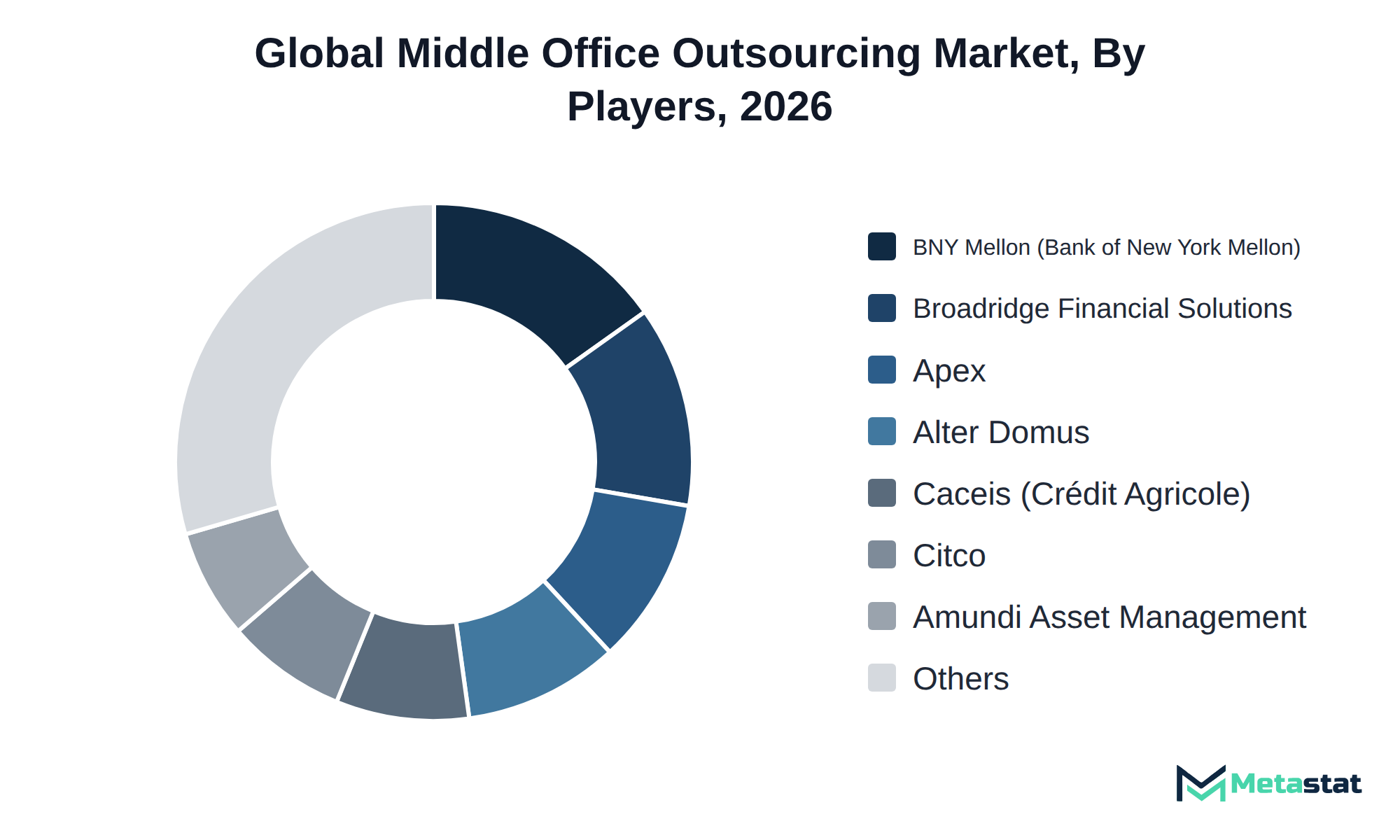
Companies in the Middle Office Outsourcing market employ various competitive strategies focusing on service types and buyer preferences. Firms differentiate themselves through the range of services offered, pricing structures, and customization of solutions to meet specific client needs.
Traditional Asset Managers and Hedge Fund Managers prioritize tailored services and pricing models that enhance operational efficiency. For instance, BNY Mellon emphasizes comprehensive solutions in trade processing and settlement support, while Alter Domus focuses on investment book of record and shadow accounting services. Pricing transparency and service reliability rank highly among buyer considerations in this segment.
Buyers select providers based on several factors, including certification, service flexibility, and the overall ecosystem of support offered. Citigroup Inc. and HSBC Holdings plc excel in delivering cloud-based deployment solutions that cater to both large enterprises and small and medium enterprises, reflecting strong demand for scalable options. The ongoing emphasis on risk analytics and regulatory reporting further shapes competitive positioning, influencing investment decisions across the market.
Key developments driving Middle Office Outsourcing market growth include rising demand for cloud-based deployment types and the expansion of services including investment book of record and shadow accounting. The shift towards cloud-based solutions is anticipated to enhance operational efficiency and reduce costs for various end users, particularly traditional asset managers and hedge fund managers, who increasingly seek scalable and flexible solutions.
The market’s growth trajectory relies heavily on the ability of suppliers to innovate and adapt to the evolving needs of clients. Enhanced reconciliation services and reference data, pricing and valuation services are expected to attract investments, further propelling adoption across regions including North America and Europe. However, economic volatility and regulatory changes present risks that could hinder growth. Disruptions in financial markets lead to reduced spending on outsourcing services, particularly among banks and broker-dealers. Addressing these challenges will be critical for achieving the projected market size.
By Service Type: Trade Processing and Settlement Support, Investment Book of Record and Shadow Accounting, Reconciliation Services, Reference Data, Pricing and Valuation Services, Corporate Actions and Asset Lifecycle Management, Treasury and Collateral Management, Performance Measurement and Attribution, Risk Analytics and Investment Compliance Monitoring, Regulatory and Client Reporting
By End User: Traditional Asset Managers, Hedge Fund Managers, Banks and Broker-Dealers, Private Markets Investment Managers, Insurance Companies, Pension Funds, Wealth Management Firms, Family Offices, Sovereign Wealth Funds, Others (Endowments, Foundations)
By Enterprise Size: Large Enterprises, Small & Medium Enterprises
By Deployment Type: On-Premise, Cloud-Based, Hybrid
The report strategically identifies and profiles the key market players and analyses their core competencies in each sub-segment of the Middle Office Outsourcing market.
Report Attributes | Details |
Study Period | 2021-2033 |
Base Year | 2025 |
Estimated Year | 2026 |
Forecast Period | 2026-2033 |
Historical Period | 2021-2025 |
Growth Rate | CAGR 8.2% from 2026 to 2033 |
Revenue Unit | USD billion |
Segmentation | By Service Type, End User, Enterprise Size, Deployment Type, and Region |
By Region | North America (By Service Type, End User, Enterprise Size, Deployment Type, and Country)
|
Europe (By Service Type, End User, Enterprise Size, Deployment Type, and Country)
| |
Asia Pacific (By Service Type, End User, Enterprise Size, Deployment Type, and Country)
| |
South America (By Service Type, End User, Enterprise Size, Deployment Type, and Country)
| |
Middle East and Africa (By Service Type, End User, Enterprise Size, Deployment Type, and Country)
|
Find answers to common questions about this report
The Middle Office Outsourcing market size was valued at USD 8.7 billion in 2025.
The market is projected to grow at a CAGR of 8.2% during the forecast period from 2026 to 2033.
The North America Middle Office Outsourcing market size is estimated to reach USD 6 billion by 2033.
The leading segment in the Middle Office Outsourcing market is Trade Processing and Settlement Support, with a projected value of USD 3.4 billion by 2033. This segment surpasses others in terms of growth potential and revenue generation.
Key drivers for the Middle Office Outsourcing market include heightened operational complexity due to increasing regulatory requirements and evolving client demands. The rising demand for reconciliation services, driven by transaction volumes and complex financial instruments, supports market growth.
North America holds the dominant share of the Middle Office Outsourcing market, with a figure of USD 6 billion projected for 2033, representing 38.5 percent of the total market. This region's significant share highlights its leading position compared to other regions.
Price sensitivity among smaller enterprises significantly influences demand, leading to slower uptake of outsourcing solutions. Costs associated with attracting and retaining skilled professionals represent a significant challenge, as competition for top talent drives up labor costs and affects profitability.
The strategic shift toward Investment Book of Record (IBOR) integration enhances operational efficiency and compliance for financial institutions. the increasing demand for reconciliation services, driven by rising transaction volumes and complex financial instruments, supports adoption in the Middle Office Outsourcing market.
The Middle Office Outsourcing market is estimated to reach a valuation of USD 16.3 billion by 2033.
Key players operating in the Middle Office Outsourcing market include Alter Domus, Amundi Asset Management, Apex Group Ltd., BNP Paribas S.A., BNY Mellon (Bank of New York Mellon), Citigroup Inc., and State Street Corporation.
The analysts below cover Banking & Finance research at Metastat Insights.
LEAD ANALYST
Utkarsh Khirodkar is a Lead Market Research Analyst at MetaStat Insight, specializing in market intelligence, technology sector assessments, and competitive strategy.

PRINCIPAL CONSULTANT - ENTERPRISE AI & EMERGING TECHNOLOGIES
Banking & Finance · Electronics and Semiconductor · Energy and Power · Healthcare IT · Information & Technology · Professional Services
Vijay Gunti is a Principal Consultant at MetaStat Insight, bringing over two decades of experience across enterprise digital transformation, technology strategy, and intelligent systems.
Replacing petrochemical surfactants with bio-based alternatives requires realistic timelines on industrial precision fermentation scaling. The market research broke down commercialization timelines, feedstock sugar price sensitivities, and regional cosmetic ingredient regulatory approvals in Europe and East Asia. That supplier readiness mapping gave our formulations team reliable context when comparing renewable chemical sourcing roadmaps.
Tracking ceramic matrix composite adoption in high-bypass aero engines requires strict attention to material qualification cycles and FAA airworthiness testing milestones. The MetaStat Insight team provided a detailed timeline of silicon carbide fiber manufacturing capacity and commercial foundry lead times. Having clear visibility into upstream thermal barrier coating supply helped us stress-test our long-term component procurement strategy.
Transitioning ultra-class mining haul trucks to alternative power requires concrete data on remote hydrogen refueling infrastructure economics. The report evaluated megawatt-scale electrolyzer installation expenses, onsite storage safety mandates, and heavy-duty fuel cell stack degradation under continuous duty cycles. That technical rigor helped our engineers benchmark realistic total operating cost horizons for off-highway fleet decarbonization.
Explore related market intelligence reports worth reading alongside this one.