
LEAD ANALYST
Utkarsh Khirodkar is a Lead Market Research Analyst at MetaStat Insight, specializing in market intelligence, technology sector assessments, and competitive strategy.

Global Supply Chain Strategy and Operations Consulting Market Size, Share, By Service Type (Supply Chain Strategy & Operating Model, Procurement & Strategic Sourcing Transformation, S&OP / IBP, Demand Planning & Inventory Optimization, Logistics and Distribution & Network Optimization, Manufacturing & Operations Excellence, Supply Chain Risk, Resilience & Sustainability, Digital Supply Chain, AI, Control Tower & Analytics), By Consulting Delivery Model (Strategy Advisory and Transformation & Implementation Consulting, Technology Enablement / SCM Platform Consulting, Managed Supply Chain Operations, Analytics-as-a-Service / Control Tower Support), By End-use Industry (Manufacturing & Industrial, Retail & Consumer Goods, Automotive & Mobility, Healthcare & Pharmaceuticals, Energy & Utilities, Transportation, Logistics & 3PL, Technology, Electronics & Semiconductors, Public Sector & Infrastructure), By Enterprise Type (Large Enterprises and Multinational Corporations, Mid-market Enterprises, Private Equity Portfolio Companies, Public Utilities & Regulated Enterprises), Industry Analysis, Growth, Trends, and Forecast, 2026-2033
Report ID
MSI-5609
Published
October, 2026
Pages
308 Pages
Format
Historical
Base year
Forecast
Forecast period
Report Details
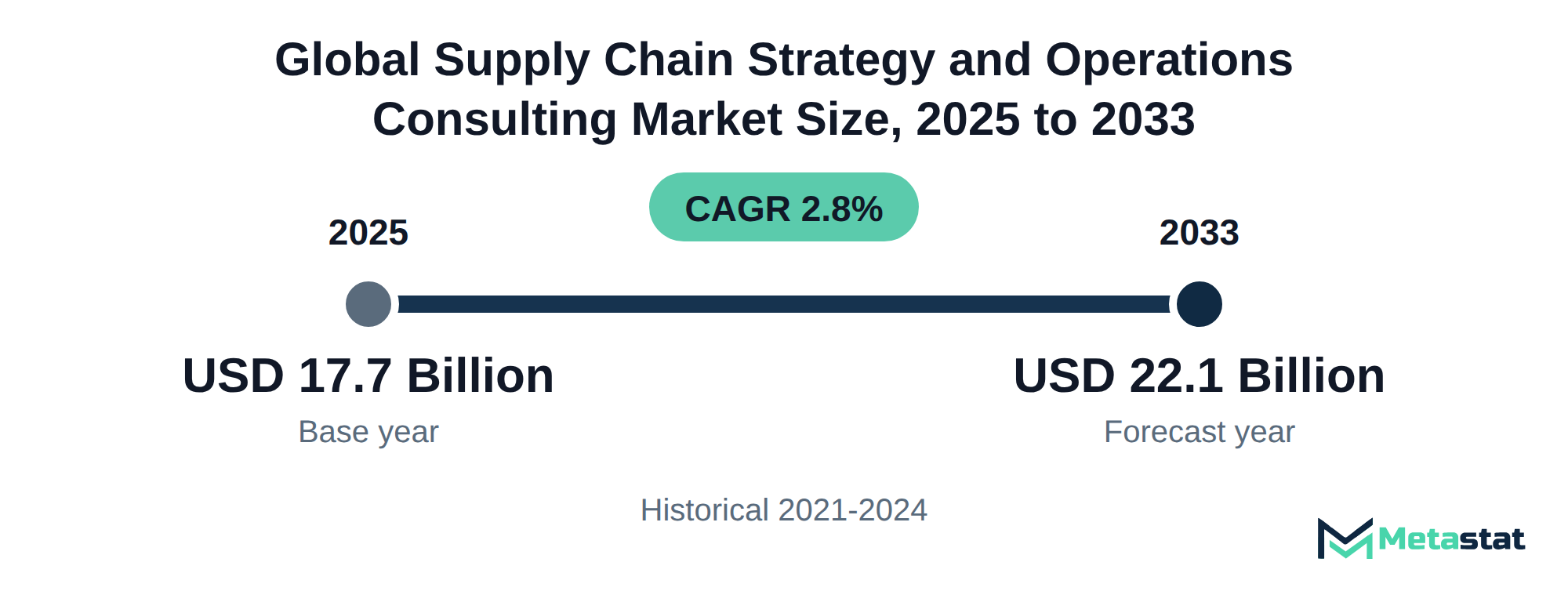
Market Valuation: Valued at $17.7 Billion in 2025, projected to reach $22.1 Billion by 2033 at a 2.8% CAGR.
Dominant Segment: The Transformation & Implementation Consulting segment leads the market, driven by the urgent need for organizations to enhance operational capabilities and align strategies with business objectives.
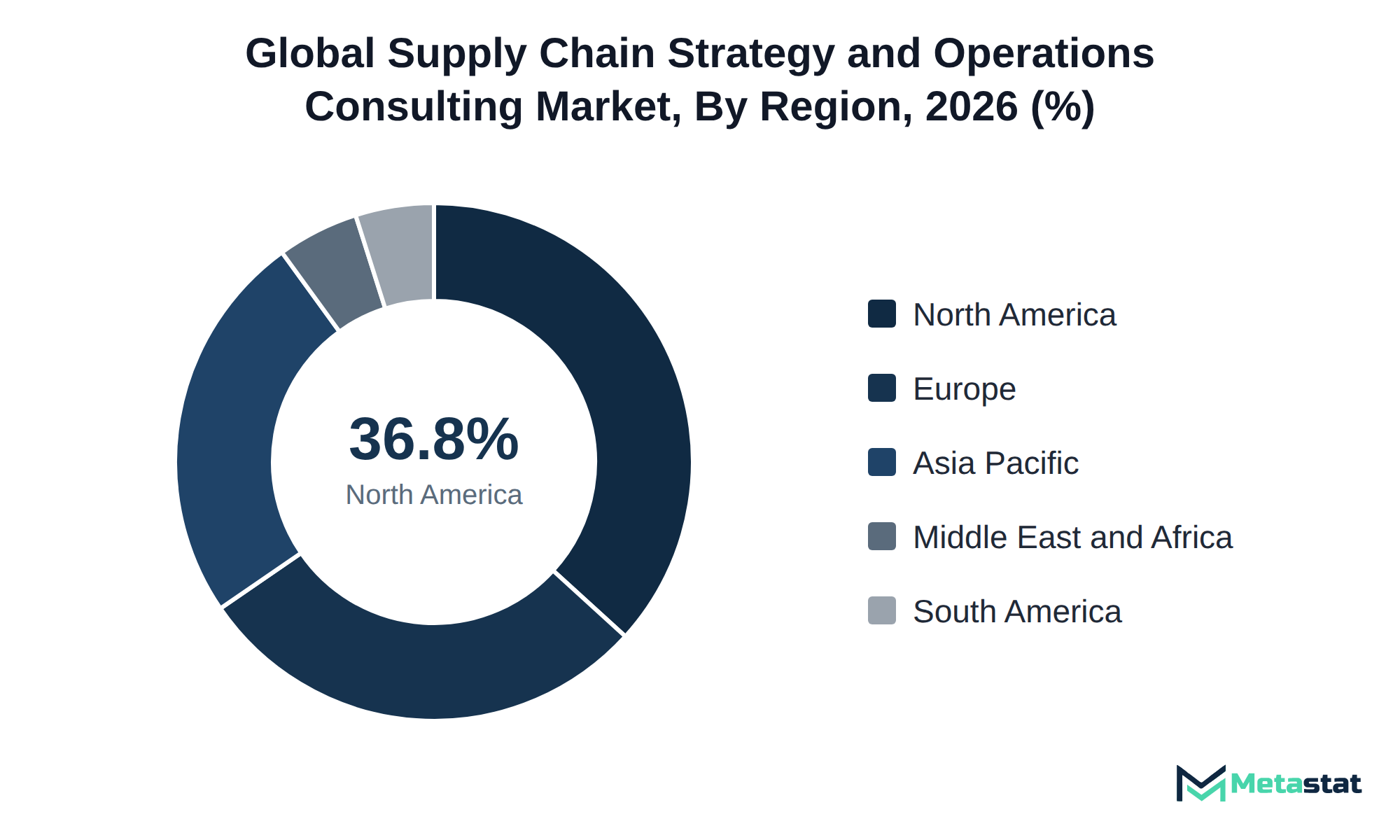
Geographic Lead: North America is the leading region, holding 36.8% of the market in 2025, with the US projected to maintain its dominance due to strong economic conditions and a focus on digital transformation.
What's Inside: The report provides a comprehensive analysis of market dynamics, competitive landscape, and detailed forecasts from 2026 to 2033, covering various service types, delivery models, and end-use industries.
Growth in Healthcare and Pharmaceuticals: The healthcare and pharmaceuticals sector shows significant growth potential, with a projected CAGR of 4.9% as companies seek optimized supply chain strategies to improve efficiency and compliance.
Digitalization of Supply Chain Operation: The increasing adoption of digital technologies, such as IoT and cloud computing, is enhancing supply chain efficiency, driving organizations to seek expert guidance for effective digital transformation.
Choose Your License
Global Supply Chain Strategy and Operations Consulting Market
The global Supply Chain Strategy and Operations Consulting market was valued at USD 17.7 billion in 2025 and is projected to reach USD 22.1 billion by 2033, growing at a CAGR of 2.8% over the forecast period.
The Supply Chain Strategy and Operations Consulting market encompasses a range of services that enhance supply chain efficiency, strategy formulation, and operational improvement. Organizations invest in these services to optimize processes, reduce costs, and improve overall performance. The need for effective supply chain management has intensified, driven by globalization, technological advancements, and evolving consumer expectations.
Growth in the market is propelled by factors including increasing demand for digital transformation and the implementation of advanced analytics in supply chain operations. North America holds 36.8% of the market in 2025, with the US leading in 2026. The segment representing the highest value within the market is the Transformation & Implementation Consulting segment, which focuses on executing strategies that enhance operational capabilities and align with business objectives.
Regional dynamics illustrate varying levels of engagement in supply chain consulting. Europe and Asia Pacific follow North America, holding 28.7% and 24.6% of the market, respectively. The increasing emphasis on sustainability and risk management in supply chains contributes to the market's expansion, reflecting a clear shift in priorities among organizations across various industries.
Services in the Supply Chain Strategy and Operations Consulting market help optimize supply chain frameworks and improve operational effectiveness. Buyers invest in these consulting services to achieve strategic alignment, improve procurement processes, and implement advanced planning methodologies. These investments result in increased competitiveness and the ability to respond effectively to market dynamics.
Growth in the market is driven by the rising importance of supply chain resilience, particularly in the face of global disruptions. The segment providing Procurement & Strategic Sourcing Transformation exhibits the highest value within the market. This region benefits from solid economic conditions and a strong focus on digital transformation initiatives across various industries.
The demand for effective supply chain strategies is further propelled by the growing need for operational excellence within organizations. Increased investments in technology enablement and analytics within consulting practices enhance decision-making capabilities for enterprises. The ongoing evolution of supply chain management allows companies to adapt to changing consumer behaviors and market conditions.
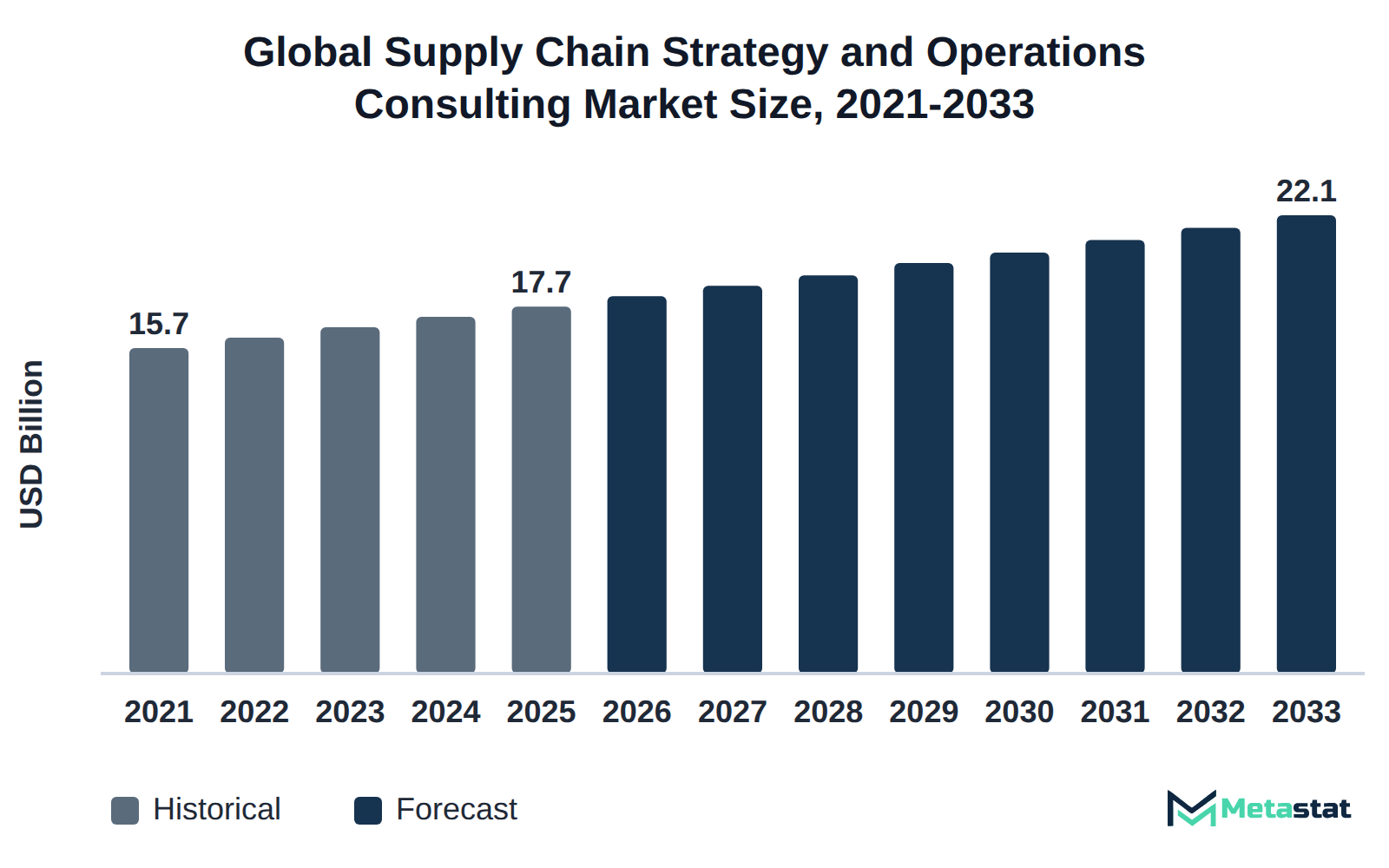
The integration of enterprise artificial intelligence into supply chain planning significantly transforms the dynamics of the Supply Chain Strategy and Operations Consulting market. This shift drives a transition from traditional advisory roles toward more implementation-focused strategies. The growing reliance on technology enablement improves decision-making processes and enhances operational efficiency. In particular, the segment offering Technology Enablement / SCM Platform Consulting is projected to reach USD 5.3 billion by 2033, highlighting escalating demand for such solutions.
Organizations increasingly seek advanced analytical capabilities to optimize their supply chain operations, resulting in higher efficiency and responsiveness to market changes. Implementing AI solutions supports the development of predictive analytics, enabling firms to forecast demand accurately and manage inventory levels effectively. This growing demand for technology integration in supply chain management drives consulting firms to adapt their service offerings, emphasizing implementation alongside strategic advisory.
The commercial implications of this shift are profound. Companies that invest in AI-enabled supply chain planning often experience enhanced agility and reduced operational costs, contributing to sustainable competitive advantages. While the market evolves, firms equipped to provide implementation support alongside strategic consulting are likely to gain a stronger foothold in the Supply Chain Strategy and Operations Consulting market.
Supply chain network redesign is essential for companies transitioning to nearshoring and diversifying suppliers. A significant trend in the Supply Chain Strategy and Operations Consulting market indicates that organizations increasingly prioritize agility and flexibility in their supply chains. This transformation stems from disruptions experienced during recent global events, prompting companies to rethink their operational models.
In response to these shifts, buyers seek flexible pricing and contract models that align with their specific needs. For instance, transformation and implementation consulting services, projected to reach USD 6.8 billion by 2033, illustrate the growing demand for tailored solutions that address unique business challenges. This growth highlights the necessity for consulting firms to offer diverse pricing structures, including value-based pricing or outcome-based contracts, that ensure alignment between client expectations and consultant deliverables.
The trend towards managed supply chain operations indicates a willingness among buyers to invest in long-term partnerships rather than one-off consulting engagements. By developing these relationships, consulting firms enhance their service offerings while securing a more predictable revenue stream. Consequently, the Supply Chain Strategy and Operations Consulting market experiences a shift towards collaborative models that prioritize shared success and mutual accountability.
Inventory Optimization and Cost-to-Serve Analytics represent critical components in the Supply Chain Strategy and Operations Consulting market, particularly for retail and consumer goods sectors. These sectors exhibit distinct needs for managing their inventory efficiently while ensuring service levels meet customer demands. Effective inventory optimization strategies enhance the ability to respond to market fluctuations, which is essential for maintaining customer satisfaction and operational efficiency.
In 2023, the retail and consumer goods sector in the market is projected to reach USD 3.8 billion by 2033, reflecting a compound annual growth rate of 2.2%. This growth highlights the need to implement sound inventory management frameworks and cost-to-serve analytics, which help align inventory levels with demand patterns. By applying these strategies, companies minimize excess stock and reduce carrying costs, which directly affects profitability.
Integrating analytics into operations allows organizations to enhance decision-making processes, driving efficiencies across supply chains. This capability enables businesses to identify cost-saving opportunities and optimize resource allocation, addressing the unique challenges they face. Firms positioned within the retail and consumer goods sectors achieve sustainable growth while navigating complex supply chain dynamics in the evolving market.
Businesses gauge return on investment (ROI) from Supply Chain Strategy and Operations Consulting by analyzing tangible improvements in operational efficiency and cost savings. For instance, the market emphasizes the significance of Transformation & Implementation Consulting, which is projected to achieve a value of USD 6.8 billion by 2033, reflecting a compound annual growth rate (CAGR) of 1.8%. This segment focuses on enhancing existing supply chain processes, implementing new technologies, and optimizing overall operations.
By partnering with consulting firms that specialize in this area, organizations often report reduced expenses and expedited delivery times. Such enhancements directly impact profit margins and customer satisfaction, contributing to a favorable ROI. Organizations that invest in technology enablement for supply chain management expect operational benefits that extend beyond financial metrics, including improved data insights and decision-making capabilities.
Ultimately, the effective measurement of ROI in the Supply Chain Strategy and Operations Consulting market hinges upon establishing clear performance indicators and continuously monitoring improvements. By aligning consulting efforts with strategic business goals, companies achieve measurable success and ensure that their investments yield substantial returns.
Rising environmental awareness drives companies to adopt sustainable practices within their supply chains. Organizations aiming to enhance their environmental, social, and governance (ESG) performance emphasize sustainability in procurement and logistics operations. This shift reflects a broader commitment to corporate responsibility, influencing purchasing decisions across various industries, including manufacturing and retail. Companies increasingly prioritize sustainable sourcing and operations, leading to heightened demand for consulting services, including ESG consulting, that align with these objectives. The Supply Chain Strategy and Operations Consulting market is projected to reach USD 22.1 billion by 2033, reflecting a growing need for expertise in sustainable supply chain practices. Organizations seek to enhance their competitive advantage through sustainability initiatives, resulting in significant growth in consulting services that support these transformations.
The digitalization of supply chain operations enhances efficiency and responsiveness to market dynamics. Companies increasingly implement technologies including cloud computing, IoT, and blockchain to improve visibility and collaboration across their supply chains. This integration optimizes inventory management and demand forecasting and enables real-time data analysis, which supports informed decision-making. Industries including manufacturing, retail, and healthcare adopt these technologies to streamline operations and reduce costs. The shift towards digital solutions results in improved agility, allowing businesses to respond swiftly to disruptions or changing consumer preferences. Consequently, the market grows as organizations seek expert guidance on digital transformation and on using advanced technologies. Investments in training and development ensure that professionals in this domain stay current with technological advancements, further enhancing their role in supporting organizations through this transition.
Price sensitivity among buyers significantly restricts market growth, specifically affecting mid-market enterprises and private equity portfolio companies. These segments face challenges in allocating sufficient budgets for consulting services, resulting in slower uptake of Supply Chain Strategy and Operations Consulting market solutions. Cost-related concerns often lead to smaller orders and delayed decision-making, undermining the potential benefits from enhanced supply chain strategies. Financial constraints faced by these buyers hinder their ability to invest in effective supply chain transformations and operational improvements. Consequently, demand for consulting services reflects a cautious approach, leading to a preference for incremental changes rather than broad strategies. Buyers in these segments prioritize cost-effective solutions that provide immediate value, limiting their engagement with higher-end consulting offerings that promise extensive operational enhancements. This dynamic creates a barrier to achieving optimal supply chain efficiency and effectiveness, ultimately constraining overall market expansion.
Profitability in the Supply Chain Strategy and Operations Consulting market faces significant challenges due to margin pressure. Clients demand full-scope services while expecting competitive pricing, which reduces margins for consulting firms. Rising operational costs, particularly talent acquisition and retention, contribute to this pressure. Providers respond by focusing on efficiency improvements and investing in technology to streamline service delivery, thereby reducing costs without compromising quality. Firms explore innovative pricing models, including value-based pricing, to align their offerings with client expectations while maintaining profitability.
These strategic adjustments address the financial strain on consulting firms while enhancing service value for clients. Maintaining competitiveness within the market requires ongoing adaptation to economic conditions and client demands. Consequently, firms seek growth through targeted investments and strategic partnerships, positioning themselves to better manage margin challenges.
The healthcare and pharmaceuticals sector represents a significant opportunity within the market, driven by increasing demand for efficiency and cost-effectiveness in healthcare supply chain management. The segment's compound annual growth rate (CAGR) of 4.9% highlights its potential for growth, reflecting the urgent need for optimized supply chain strategies. Companies in this industry increasingly require tailored consulting services that address regulatory compliance, inventory management, and distribution challenges. Solutions focused on streamlining operations reduce costs and enhance service delivery, directly benefiting patient outcomes.
Consulting firms targeting this sector are positioned to capture substantial revenue through specialized offerings in supply chain risk, resilience, and sustainability. The growing emphasis on digital supply chain integration supports opportunities in this segment, aligning with advancements in technology and analytics. With healthcare expenditures rising globally, an increasing number of enterprises seek expertise in navigating complex supply chain environments, highlighting the value of consulting services in this critical industry.
The Global Supply Chain Strategy and Operations Consulting market is segmented based on Service Type, Consulting Delivery Model, End-use Industry, and Enterprise Type.
Supply Chain Strategy & Operating Model segment is valued at USD 3.9 billion in 2026 and is projected to reach USD 4.2 billion by 2033, at a CAGR of 1% during the forecast period. Organizations apply this segment to enhance strategic alignment and operational effectiveness across their supply chains. Demand for streamlined operations significantly influences this area, reflecting the necessity for businesses to adapt to evolving market conditions. This segment demonstrates a slower growth trajectory compared to others in the market, including Procurement & Strategic Sourcing Transformation, which shows a CAGR of 1.5%. The focus on strategy development distinguishes this segment, appealing to larger enterprises seeking full-scope solutions tailored to complex supply chain environments. Steady interest drives the market, resulting from ongoing transformation initiatives across various industries, including manufacturing and retail.
Procurement & Strategic Sourcing Transformation segment is estimated to reach USD 3.5 billion by 2033, at a CAGR of 1.5% during the forecast period. This segment focuses on enhancing procurement processes and optimizing strategic sourcing to drive cost efficiency and improve supplier relationships. Organizations, particularly in manufacturing and retail, use these services to streamline their procurement operations and adapt to changing market conditions. The segment experiences growth due to increasing pressure on companies to reduce costs and enhance supplier collaboration. Compared to other segments, this area is characterized by a moderate growth rate, with a CAGR of 1.5%, lower than the anticipated growth for Logistics, Distribution & Network Optimization. Organizations engaged in this segment benefit from targeted strategies that align procurement processes with overall business objectives, providing a competitive edge in the market.
S&OP / IBP, Demand Planning & Inventory Optimization segment is expected to reach USD 3.8 billion by 2033. This segment focuses on aligning supply and demand through integrated business planning, allowing organizations to optimize inventory levels and enhance overall operational efficiency. Enterprises in the manufacturing, retail, and healthcare sectors increasingly adopt these services to navigate complexities in demand forecasting and inventory management. The rising emphasis on data-driven decision-making drives this segment, with businesses seeking to use analytics for improved planning accuracy. Unlike other segments, S&OP / IBP shows faster growth, driven by a CAGR of 4.9%, reflecting a growing recognition of its value in maintaining competitive advantage. Other segments, including Logistics, Distribution & Network Optimization, experience slower growth due to reliance on established practices rather than innovative methodologies.
Logistics, Distribution & Network Optimization segment is projected to grow at a CAGR of 2% during the forecast period. This segment focuses on refining logistics processes, enhancing distribution efficiency, and optimizing network configurations. Key users include large enterprises and multinational corporations, which rely on these services to streamline operations and reduce costs. Increasing consumer demands for faster delivery times significantly influence this segment. In contrast to other segments in its group, this area experiences slower growth compared to the Procurement & Strategic Sourcing Transformation segment, valued at USD 3.5 billion by 2033, which grows at a CAGR of 1.5%. The demand for advanced analytics and digital solutions further differentiates this segment, creating a distinct trajectory within the broader market.
Manufacturing & Operations Excellence focuses on enhancing productivity and efficiency in manufacturing processes and overall operational management. This segment attracts organizations aiming to streamline operations, reduce waste, and optimize resources. The automotive and industrial sectors primarily engage these services, driven by the demand for improved operational performance and cost-efficiency. Increasing competition and the need for technological advancements drive this segment's growth trajectory. Compared to other segments within the market, Manufacturing & Operations Excellence experiences moderate growth, reflecting stable demand patterns. Firms seeking to remain competitive prioritize investments in operational excellence, positioning this segment as critical for entities striving for enhanced productivity. Due to its emphasis on process improvement, it differs from segments concentrating on strategic sourcing or technology enablement, which experience faster growth due to emerging technologies.
Supply Chain Risk, Resilience & Sustainability focuses on helping organizations assess vulnerabilities and enhance their supply chains through sustainable practices. Companies engage this segment to fortify their operations against disruptions, ensuring resilience in volatile markets. Increased regulatory pressure around sustainability and growing consumer demand for environmentally friendly practices drive the development of this segment. Unlike other services in the market, this segment draws particular attention from industries facing significant sustainability challenges, including manufacturing and retail, which prioritize compliance and consumer preferences. Interest in integrating risk management frameworks into supply chain strategies distinguishes this segment, positioning it for greater relevance amid shifting market expectations. The strong emphasis on sustainability across sectors places this segment in a leading position for strategic initiatives, confirming its importance in supply chain management.
Digital Supply Chain, AI, Control Tower & Analytics involves advanced technologies to enhance supply chain performance. Businesses apply this segment to improve decision-making capabilities, streamline operations, and gain insights through data analytics. The growing emphasis on digital transformation drives adoption among industries including manufacturing, retail, and logistics. A key demand force stems from the increasing need for real-time data visibility and predictive analytics to navigate market complexities effectively. Compared to other segments, this area stands out with a focus on technological integration, positioning itself for significant growth opportunities. Buyers in this segment frequently seek solutions that provide competitive advantages through enhanced operational efficiency and responsiveness to market conditions. The supply chain strategy and operations consulting market reflects a shift toward innovative approaches that use data-driven insights, further enhancing the role of digital technologies in shaping future supply chain dynamics.
Strategy Advisory segment is valued at USD 4.2 billion in 2026 and is projected to reach USD 4.4 billion by 2033, at a CAGR of 0.6% during the forecast period. This segment primarily serves organizations seeking strategy consulting guidance on decisions related to supply chain management, including operational efficiencies and competitive positioning. Factors influencing this segment include the necessity for companies to adapt their strategies to evolving market demands and the increasing complexity of global supply chains. Compared to other segments, including Transformation & Implementation Consulting, which exhibits a higher CAGR of 1.8%, Strategy Advisory demonstrates steadier growth. Clients in this segment prioritize strategic outcomes over immediate operational changes, resulting in this segment attracting larger enterprises that require bespoke advisory services tailored to their unique challenges. While the market progresses, demand for comprehensive strategic assessments continues to drive the growth of the Strategy Advisory segment.
This segment assists enterprises in effectively executing supply chain strategies and implementing new operational processes. Organizations across various industries, including manufacturing and retail, engage consultants for tailored solutions that enhance performance and operational efficiency. Demand for this segment is driven by the urgency to adapt to evolving market conditions, necessitating organizational transformations to improve agility. Compared to other consulting delivery models, this segment experiences slower growth, with a higher CAGR of 1.8% compared to Strategy Advisory, which grows at 0.6%. Transformation & Implementation Consulting prioritizes hands-on guidance over strategic advisory, catering to clients seeking immediate operational improvements. The emphasis on implementation aligns with the market trends toward increasing efficiency and effectiveness in supply chain operations.
This segment emphasizes the integration of technology solutions and platforms to enhance supply chain operations and provide strategic advantages to organizations. Companies across various industries engage these consulting services to implement advanced technologies, improve data analytics capabilities, and optimize supply chain processes. Demand for this segment is driven by increasing investments in digital transformation and the growing importance of data-driven decision-making. In comparison to the other consulting delivery models, this segment displays a higher growth trajectory, reflecting the necessity for businesses to adapt to evolving technological landscapes. The segment's focus on technology enables firms to streamline operations and achieve greater efficiencies, distinguishing it from consulting approaches that prioritize traditional strategy or implementation methods. The market continues to evolve, reinforcing the significance of technology enablement in shaping supply chain strategies.
Managed Supply Chain Operations segment is projected to grow at a CAGR of 3.6% during the forecast period. This segment focuses on optimizing supply chain processes through effective management and operational strategies. Organizations apply managed supply chain operations to enhance efficiency, reduce costs, and improve service delivery. Key industry players offering these services include large enterprises and multinational corporations seeking to streamline operations and gain competitive advantages. Driving factors include the increasing complexity of supply chains and the need for organizations to adapt to dynamic market conditions. Compared to other consulting delivery models, managed supply chain operations exhibit higher growth potential, supported by a growing trend toward outsourcing supply chain functions to specialized firms. This segment differentiates itself by catering to specific operational needs, positioning itself as a critical component in the overall Supply Chain Strategy and Operations Consulting market.
Analytics-as-a-Service / Control Tower Support involves applying data analytics and control tower functionalities to enhance visibility and decision-making in supply chain operations. Organizations adopt this service to improve operational efficiency, optimize resource allocation, and respond proactively to disruptions. Growing complexity in supply chains drives demand for advanced analytics capabilities, enabling firms to gain insights from data and make informed decisions. This segment differs from others within the Consulting Delivery Model, focusing specifically on technology-driven solutions rather than traditional consulting approaches. The emphasis on data analytics aligns with broader trends in supply chain management, reflecting an increased reliance on data for strategic decision-making. Such a focus attracts diverse clients, including large enterprises seeking to enhance their analytics capabilities and mid-market companies aiming to use technology for competitive advantage. The increasing importance of real-time data analytics reinforces its position as a critical component of the Supply Chain Strategy and Operations Consulting market.
The Manufacturing & Industrial segment is valued at USD 4.3 billion in 2026 and is projected to reach USD 4.6 billion by 2033, at a CAGR of 1.2% during the forecast period. This segment serves manufacturers and industrial companies aiming to optimize operations and enhance product delivery. Growth is driven by increasing automation and the integration of advanced technologies, which promote efficiency and reduce operational costs. Compared to other segments, the Manufacturing & Industrial segment exhibits a slower growth rate, reflecting established practices and gradual adoption of innovations. In contrast, sectors including Retail & Consumer Goods experience faster rates of change, supported by shifting consumer preferences and market dynamics. The demand for enhanced supply chain strategies within this segment contributes to the overall landscape of the Supply Chain Strategy and Operations Consulting market.
This segment serves various stakeholders, including retailers and consumer goods manufacturers, seeking strategic insights to optimize their supply chains. Increasing consumer demand for faster delivery and enhanced service levels drives growth in this segment. Companies within this sector prioritize flexibility and responsiveness to market changes, differentiating themselves from other segments that focus more on cost-saving measures or operational efficiencies. Compared to segments like Manufacturing & Industrial, which has a CAGR of 1.2%, the Retail & Consumer Goods segment demonstrates stronger growth potential, reflecting the dynamic nature of consumer preferences and the importance of agility in supply chain operations. The market continues to evolve, emphasizing the significance of data-driven decision-making and technology integration.
The Automotive & Mobility segment is expected to reach USD 2.7 billion by 2033. This segment serves various stakeholders, including automobile manufacturers, suppliers, and service providers, seeking to optimize their supply chains and enhance operational efficiency. The demand for advanced technologies, including electric vehicles and autonomous driving, drives transformation within this sector, requiring firms to adapt quickly to changing market dynamics. Compared to other segments, the Automotive & Mobility segment experiences a faster growth trajectory, fueled by increasing consumer preferences for sustainability and innovation. The anticipated annual growth rate reflects the sector's strategic importance in the larger Supply Chain Strategy and Operations Consulting market, where competition intensifies to meet evolving customer expectations and regulatory demands.
The Healthcare & Pharmaceuticals segment is projected to grow at a CAGR of 4.9% during the forecast period. This segment is critical for healthcare providers and pharmaceutical companies seeking to enhance operational efficiency and improve patient outcomes through effective supply chain strategies. Two primary drivers for growth in this sector include increasing regulatory pressures and rising demand for advanced healthcare solutions. Organizations in this segment face unique challenges, including complex compliance requirements and the necessity for rapid responsiveness to market changes. This area experiences a higher growth rate due to the ongoing transformation in healthcare delivery and the increasing importance of supply chain agility. The demand for innovative solutions in the healthcare and pharmaceuticals sector continues to shape the development of the Supply Chain Strategy and Operations Consulting market.
Energy & Utilities involves the management of resources necessary for energy production and distribution, focusing on enhancing operational efficiency and regulatory compliance. This segment serves energy producers, utility companies, and other stakeholders in the energy sector who aim to improve their supply chain processes. Increasing regulatory pressures and the shift towards renewable energy sources drive demand within this segment. Compared to other end-use industries including Manufacturing & Industrial or Retail & Consumer Goods, Energy & Utilities experiences unique challenges including the integration of innovative technologies and the need for sustainable practices. These factors differentiate it further, influencing the competitive landscape and shaping consulting strategies in the Supply Chain Strategy and Operations Consulting market.
Transportation, Logistics & 3PL encompasses the management and coordination of goods movement across various transportation modes and warehouse facilities. Organizations involved in this sub-segment, including carriers and third-party logistics providers, rely on effective strategies to optimize supply chain flows. The growing emphasis on e-commerce and fast delivery times drives investment in transportation and logistics solutions. Increased competition among companies pushes them to streamline operations and enhance service offerings to meet customer expectations. Compared to other segments, this sub-segment experiences unique challenges, including fluctuating fuel prices and regulatory changes affecting transportation costs. This area differs from segments focused on fixed operational strategies, highlighting the need for agility in adapting to market conditions. The Supply Chain Strategy and Operations Consulting market benefits from the ongoing evolution and investment in this critical area of supply chain management.
The Technology, Electronics & Semiconductors segment serves high-tech industries, focusing on optimizing supply chain operations through advanced strategies and processes. Organizations operating in this sector engage consulting services to enhance their efficiencies, manage complex supply chains, and address rapid technological advancements. Significant demand drivers include the increasing need for innovation and reliance on just-in-time manufacturing practices. This segment distinguishes itself through a heightened emphasis on digital transformation compared to others, often requiring substantial investments in technology and analytics. This focus on technology integration supports more agile responses to market fluctuations, appealing to enterprises that prioritize technological superiority. The Supply Chain Strategy and Operations Consulting market reflects growing awareness of these needs, leading to increased investment and competition among consulting firms.
This segment serves organizations in the public sector and infrastructure, focusing on enhancing supply chain efficiency within government agencies and public service entities. Demand for effective resource management and project delivery drives interest in consulting services tailored to this sector. Investments in infrastructure development and modernization projects require adaptive supply chain strategies to ensure timely completion and optimal resource utilization. Compared to other segments, this area experiences relatively slower growth, driven by the stringent regulatory landscape and budgetary constraints faced by public sector organizations. The market shows a growing emphasis on sustainability initiatives, aligning with global trends for responsible governance and infrastructure development. Public sector consulting and advisory services navigate complex political environments, which influences the selection of service providers and approaches to project execution. The Supply Chain Strategy and Operations Consulting market continues to evolve, reflecting changing priorities and expectations within public sector operations.
Large Enterprises segment is valued at USD 6 billion in 2026 and is projected to reach USD 6.6 billion by 2033, at a CAGR of 1.4% during the forecast period. This segment supports organizations in optimizing their supply chains, focusing on efficiency and strategic alignment. Large enterprises typically seek advanced consulting services to navigate complex market dynamics and improve operational performance. Factors driving this segment include increasing demand for digital transformation and the rising need for sustainable practices within supply chains. Compared to other segments, this group experiences slower growth due to established practices and the higher cost of implementing comprehensive supply chain solutions. The Supply Chain Strategy and Operations Consulting market reflects these trends, indicating that large enterprises continue to invest in bespoke consulting services to maintain a competitive edge and enhance supply chain resilience.
Multinational Corporations segment is estimated to reach USD 6 billion by 2033, at a CAGR of 2.4% during the forecast period. This segment serves large businesses operating in multiple countries, focusing on optimizing complex supply chain networks to enhance efficiency and drive growth. Key drivers for this segment include increasing globalization and the need for organizations to adapt to varying market demands across regions. Compared to other segments, this one experiences slower growth, reflecting the challenges associated with managing intricate multinational operations. Client needs in this segment revolve around strategic sourcing, risk management, and compliance with local regulations, often leading to higher advisory fees, resulting in a distinct pricing structure within the market. The focus on sustainability and digital transformation further influences demand, positioning it differently from other enterprise types.
The Mid-market Enterprises segment is expected to reach USD 5.1 billion by 2033. This segment typically serves businesses that fall between small companies and large corporations, focusing on enhancing operational efficiency and strategic planning. The increasing demand for tailored consulting services drives growth, aligning with unique operational challenges faced by mid-sized firms. These organizations seek to optimize supply chain processes through innovative solutions that accommodate their specific needs, contrasting with larger enterprises that pursue broader strategic initiatives. In terms of growth, this segment shows a CAGR of 4.2%, indicating a more dynamic expansion compared to other enterprise types. Given its distinct buyer profile, mid-market enterprises prioritize cost-effective strategies that directly address their operational limitations, further distinguishing this segment within the Supply Chain Strategy and Operations Consulting market.
Private Equity Portfolio Companies segment is projected to grow at a CAGR of 4.2% during the forecast period. This segment attracts investment from private equity firms focusing on enhancing operational efficiencies and strategic growth. These companies rely on consulting services to optimize supply chain processes, improve cost structures, and manage risks effectively. Key drivers include increasing competition in portfolio management and the necessity for improved supply chain resilience. This segment exhibits faster growth compared to other enterprise types, reflecting heightened demand for specialized consulting services aimed at maximizing value from investments. Private Equity Portfolio Companies prioritize tailored solutions, distinguishing their needs from those of larger corporations and mid-market enterprises, which pursue broader, less specialized strategies. The Supply Chain Strategy and Operations Consulting market continues to evolve, catering to the unique requirements of these dynamic companies.
Public Utilities & Regulated Enterprises serves entities that provide essential services including water, electricity, and natural gas, focusing on operational efficiency and compliance with government regulations. These organizations prioritize strategic consulting to adapt to evolving regulatory frameworks and enhance service delivery. Demand for consulting services in this segment is driven by increasing regulatory pressures and the need for modernization of infrastructure to enhance service reliability. Unlike other segments, this one experiences slower growth due to stringent regulations and longer project timelines. The market exhibits a unique buyer profile, where procurement decisions often involve public sector considerations, differing from private enterprises seeking swift returns on investment. The Supply Chain Strategy and Operations Consulting market addresses specific challenges faced by public utilities, emphasizing the importance of strategic planning in a highly regulated environment.
Based on geography, the Global Supply Chain Strategy and Operations Consulting market is divided into North America, Europe, Asia-Pacific, South America, Middle East, and Africa.
In North America, notable growth in the Supply Chain Strategy and Operations Consulting market stems from strong demand in the manufacturing and industrial sectors. The region benefits from advanced infrastructure and technology adoption, which enhance operational efficiency in various industries, including healthcare and retail. The projected value of the market reaches USD 7.5 billion by the end of 2033. With a 36.8% share of the global market in 2025, North America positions itself as a leading region in driving innovative supply chain solutions. Increased investment in digital transformation initiatives further supports growth in consulting services, enabling companies to optimize processes and improve strategic sourcing. The emphasis on sustainability and risk management drives companies to seek consulting services for developing resilient supply chains.
Europe holds a 28.7% share of the global Supply Chain Strategy and Operations Consulting market in 2025. The manufacturing and industrial sectors in countries including Germany, France, and the UK drive demand, propelled by a focus on operational efficiency and technological advancements. The region prioritizes sustainability and compliance, influenced by regulatory frameworks that emphasize environmental impact. The ongoing digital transformation across industries drives the adoption of innovative consulting services, enhancing competitive positioning. This climate enables organizations to streamline operations and adapt to evolving market conditions effectively. Investment in advanced technologies, particularly in logistics and supply chain optimization, supports growth and reinforces Europe's stature in the market.
Asia-Pacific represents a significant portion of the Supply Chain Strategy and Operations Consulting market, accounting for 24.6% of the global share in 2025. The region's rapid industrialization, especially in countries like China and India, drives demand for consulting services focused on optimizing supply chain operations. In addition, the increasing emphasis on digital transformation across various industries, including manufacturing and retail, enhances the demand for advanced supply chain strategies. Countries including Japan and South Korea make strong investments in technology enablement, further supporting market growth. Environmental regulations and sustainability initiatives influence consulting engagements, pushing companies to adopt resilient practices. The ongoing expansion of e-commerce in the Southeast Asia region stimulates the need for effective logistics and distribution networks, contributing to overall market dynamics.
In South America, the market reflects a growing interest in sectors including manufacturing and retail, driven by expanding consumer bases in Brazil and Argentina. The region's share of the global market in 2025 reaches 4.9%, indicating opportunities for strategic investments. Infrastructure improvements and increased digitalization efforts enhance the operational landscape. Companies operating within the market seek to optimize sourcing and supply chain strategies, responding to competitive pressures. An increasing focus on sustainability and resilience in supply chains shapes procurement strategies. The evolving economic climate encourages organizations to seek consulting services that address efficiency and effectiveness in their supply chain operations.
The region demonstrates a growing interest in the Supply Chain Strategy and Operations Consulting market, driven by a focus on enhancing operational efficiencies across various sectors. Industries including manufacturing and retail seek to optimize their supply chain processes to remain competitive. In Saudi Arabia and the UAE, investments in infrastructure and technology adoption facilitate this optimization. South Africa's growing emphasis on resilience and sustainability in supply chains, including freight and logistics, highlights the unique challenges faced in the region. The market in the Middle East and Africa holds a 5.1% share of the global market in 2025. Demand for consulting services in this region is expected to expand as businesses implement new strategies to adapt to evolving market conditions.
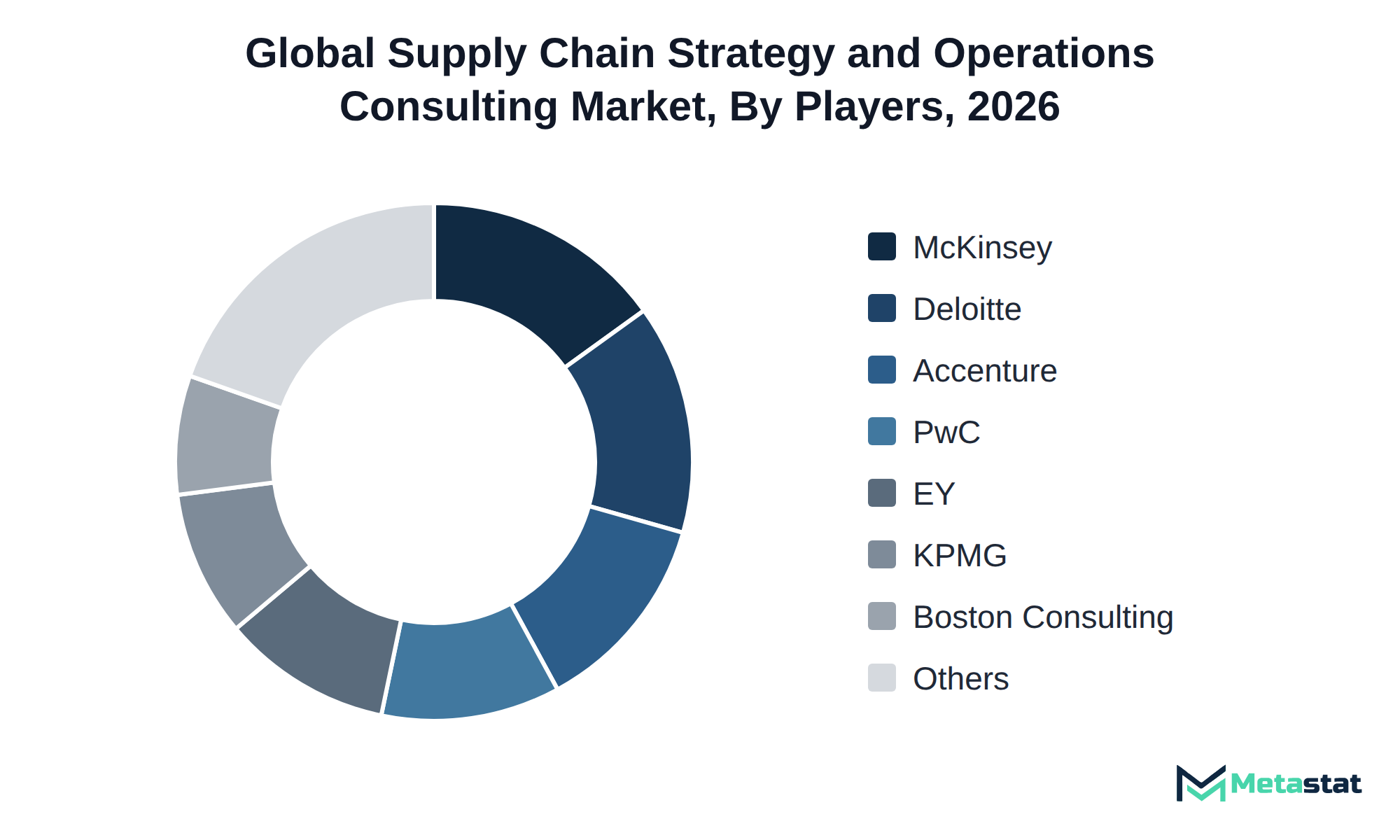
The Supply Chain Strategy and Operations Consulting market features a diverse group of companies competing across various service types and consulting delivery models. Key players include Accenture, Deloitte, McKinsey & Company, and Boston Consulting Group, each focusing on distinct areas within the market. Accenture specializes in technology enablement and digital transformation. McKinsey & Company emphasizes strategic advisory services. Deloitte engages in transformation and implementation consulting, supporting enterprises in executing complex supply chain strategies.
Buyers evaluate options based on factors including pricing, customization, and the provider's ecosystem. Companies that offer tailored solutions and demonstrate strong capabilities in technology integration attract larger enterprises. KPMG and EY highlight their strengths in managed supply chain operations, appealing to clients seeking comprehensive support. The competitive landscape remains dynamic, influenced by emerging technologies and evolving buyer preferences within the Supply Chain Strategy and Operations Consulting market.
Achieving this growth relies on several factors within the Supply Chain Strategy and Operations Consulting market. Increased adoption of technology enablement and supply chain management platform consulting will significantly contribute to revenue growth, particularly in the Asia Pacific region, where companies are investing heavily in digital transformation initiatives. Transformation and implementation consulting services will support operational improvements, especially in the manufacturing and industrial sectors, which are adjusting to evolving market demands.
However, several risks could impede this growth trajectory. Economic fluctuations in North America and Europe could lead to reduced spending on consulting services, impacting overall market performance. If businesses face uncertainties regarding supply chain resilience and sustainability, investment in these areas will decline, hindering the market's ability to reach the projected USD 22.1 billion by 2033. Balancing these developments against inherent risks will determine the market's future trajectory.
By Service Type: Supply Chain Strategy & Operating Model, Procurement & Strategic Sourcing Transformation, S&OP / IBP, Demand Planning & Inventory Optimization, Logistics, Distribution & Network Optimization, Manufacturing & Operations Excellence, Supply Chain Risk, Resilience & Sustainability, Digital Supply Chain, AI, Control Tower & Analytics
By Consulting Delivery Model: Strategy Advisory, Transformation & Implementation Consulting, Technology Enablement / SCM Platform Consulting, Managed Supply Chain Operations, Analytics-as-a-Service / Control Tower Support
By End-use Industry: Manufacturing & Industrial, Retail & Consumer Goods, Automotive & Mobility, Healthcare & Pharmaceuticals, Energy & Utilities, Transportation, Logistics & 3PL, Technology, Electronics & Semiconductors, Public Sector & Infrastructure
By Enterprise Type: Large Enterprises, Multinational Corporations, Mid-market Enterprises, Private Equity Portfolio Companies, Public Utilities & Regulated Enterprises
The report strategically identifies and profiles the key market players and analyses their core competencies in each sub-segment of the Supply Chain Strategy and Operations Consulting market.
Report Attributes | Details |
Study Period | 2021-2033 |
Base Year | 2025 |
Estimated Year | 2026 |
Forecast Period | 2026-2033 |
Historical Period | 2021-2025 |
Growth Rate | CAGR 2.8% from 2026 to 2033 |
Revenue Unit | USD billion |
Segmentation | By Service Type, Consulting Delivery Model, End-use Industry, Enterprise Type, and Region |
By Region | North America (By Service Type, Consulting Delivery Model, End-use Industry, Enterprise Type, and Country)
|
Europe (By Service Type, Consulting Delivery Model, End-use Industry, Enterprise Type, and Country)
| |
Asia Pacific (By Service Type, Consulting Delivery Model, End-use Industry, Enterprise Type, and Country)
| |
South America (By Service Type, Consulting Delivery Model, End-use Industry, Enterprise Type, and Country)
| |
Middle East and Africa (By Service Type, Consulting Delivery Model, End-use Industry, Enterprise Type, and Country)
|
Find answers to common questions about this report
The Supply Chain Strategy and Operations Consulting market size was valued at USD 17.7 billion in 2025.
The market is projected to grow at a CAGR of 2.8% during the forecast period from 2026 to 2033.
The North America Supply Chain Strategy and Operations Consulting market size is estimated to reach USD 7.5 billion by 2033.
The leading segment in the Supply Chain Strategy and Operations Consulting market is Transformation & Implementation Consulting, projected to reach USD 6.8 billion by 2033. This segment surpasses others in terms of anticipated value growth.
Rising environmental awareness drives companies to adopt sustainable practices within their supply chains. The digitalization of supply chain operations enhances efficiency and responsiveness to market dynamics.
North America holds the dominant share of the Supply Chain Strategy and Operations Consulting market, with a value of USD 7.5 billion projected for 2033. This region accounts for 36.8 percent of the total market share.
Price sensitivity among buyers significantly restricts market growth, particularly affecting mid-market enterprises and private equity portfolio companies. Financial constraints hinder these buyers' ability to invest in comprehensive supply chain transformations and operational improvements, leading to a preference for incremental changes rather than complete strategies.
Several factors favor adoption in the healthcare and pharmaceuticals sector, including rising demand for efficiency, cost-effectiveness, and tailored consulting services that address regulatory compliance and inventory management challenges. Enhanced service delivery and improved patient outcomes drive organizations to seek expertise in optimizing supply chain strategies.
The Supply Chain Strategy and Operations Consulting market is estimated to reach a valuation of USD 22.1 billion by 2033.
Key players operating in the Supply Chain Strategy and Operations Consulting market include Accenture, Deloitte, McKinsey & Company, PwC, EY, KPMG, and Boston Consulting Group.
The analysts below cover Professional Services research at Metastat Insights.
LEAD ANALYST
Utkarsh Khirodkar is a Lead Market Research Analyst at MetaStat Insight, specializing in market intelligence, technology sector assessments, and competitive strategy.

PRINCIPAL CONSULTANT - ENTERPRISE AI & EMERGING TECHNOLOGIES
Banking & Finance · Electronics and Semiconductor · Energy and Power · Healthcare IT · Information & Technology · Professional Services
Vijay Gunti is a Principal Consultant at MetaStat Insight, bringing over two decades of experience across enterprise digital transformation, technology strategy, and intelligent systems.

PRINCIPAL CONSULTANT - QUALITY SYSTEMS & COMPLIANCE
Electronics and Semiconductor · Machinery & Equipment · Professional Services
Omkar Phadtare is an Industry Consultant at MetaStat Insight, specializing in quality systems, regulatory compliance, and standards benchmarking to drive data-driven market intelligence and strategic industry research.

LEAD CONSULTANT - COMMUNICATION, TELECOM, AND IT
Electronics and Semiconductor · Information & Technology · Machinery & Equipment · Professional Services
Ravindra Sathe Consultants for Communication, Telecom, and IT at MetaStat Insight. He leads the firm's industry research initiatives across telecommunications infrastructure, digital connectivity, enterprise networking, and emerging information technology domains.
Evaluating sensor fusion reliability across harsh operating environments can be tricky without field-validated data. The study on agricultural autonomous guidance systems clearly separated stereo vision setups from automotive-grade solid-state LiDAR. We appreciated the regional infrastructure analysis, specifically around RTK network density across North America and South America. During our follow-up consultation, the MetaStat Insight team walked through tier-two perception software partnerships, giving our engineering leads a practical basis for vendor shortlisting.
Analyzing the transition from natural gas to green hydrogen in iron ore reduction requires realistic infrastructure timelines. Meta stat insight supplied a detailed regional assessment of DRI plant conversion costs and scrap metal availability in North America and Western Europe. Their report carefully examined pellet quality specs and electrical grid access constraints without making oversimplified market assumptions. The research material served as a practical reference during internal technology roadmap discussions.
Integrating zero-trust access controls across legacy electronic health record systems involves complex compliance overhead. Team produced an analysis that clearly separated identity governance and administration tools from privileged access management platforms. Their evaluation of HIPAA and GDPR compliance features across cloud native solutions gave our architecture group clear baseline criteria. The custom data request regarding biometric authentication adoption in hospital networks was returned promptly with clear documentation.
Explore related market intelligence reports worth reading alongside this one.