
LEAD ANALYST
Utkarsh Khirodkar is a Lead Market Research Analyst at MetaStat Insight, specializing in market intelligence, technology sector assessments, and competitive strategy.

US Hosting Infrastructure Services Market Size, Share, By Service Type (Public Cloud Infrastructure & Platform Hosting, Hosted Private Cloud, Dedicated Server Hosting, VPS Hosting and Shared Web Hosting), By Management Model (Customer-Managed Hosting and Provider-Managed Hosting), By Organization Size (Large Enterprises and Small & Medium-Sized Enterprises), By End-Use Industry (IT & Telecommunications, BFSI, Retail & E-commerce, Healthcare & Life Sciences, Government & Defense, Manufacturing, Media & Entertainment, Energy & Utilities, Transportation & Logistics), Industry Analysis, Growth, Trends, and Forecast, 2026-2033
Report ID
MSI-5626
Published
October, 2026
Pages
265 Pages
Format
Historical
Base year
Forecast
Forecast period
Report Details
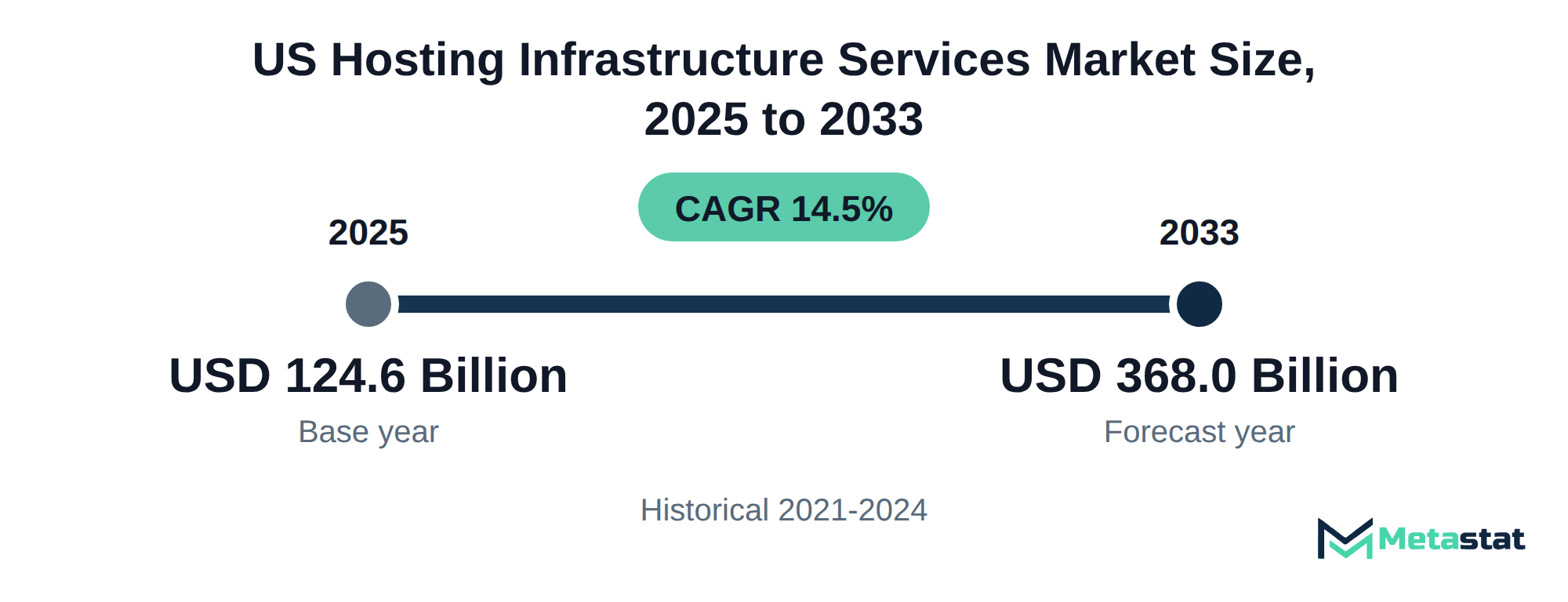
Market Valuation: Valued at $124.6 Billion in 2025, projected to reach $368 Billion by 2033 at a 14.5% CAGR.
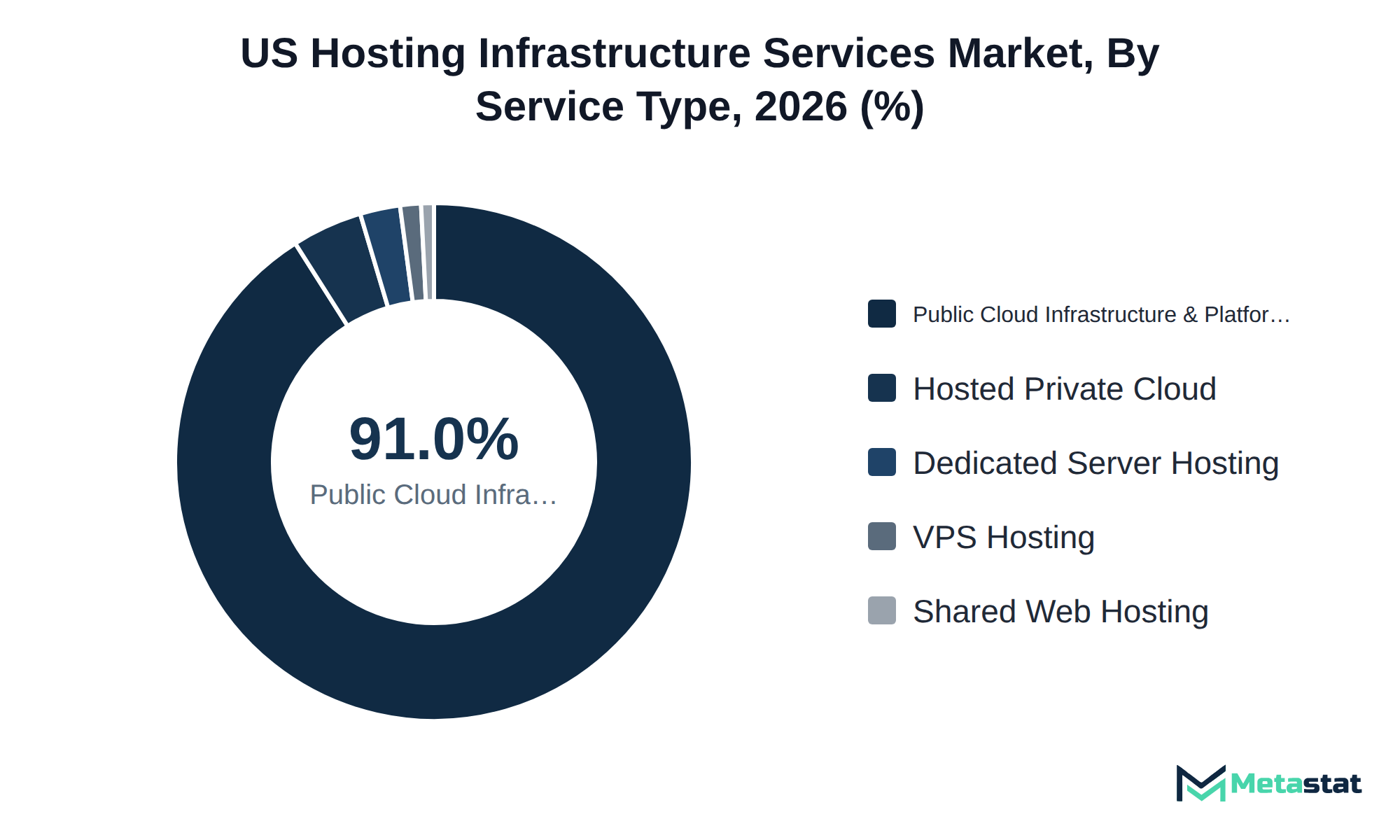
Dominant Segment: Public Cloud Infrastructure and Platform Hosting leads the US Hosting Infrastructure Services market, driven by the growing adoption of cloud-based solutions that enhance operational efficiency and cost savings.
Geographic Lead: North America holds the largest share of the market, supported by a mature technological infrastructure and a high concentration of service providers catering to diverse organizational needs.
What's Inside: This report provides a comprehensive analysis of market segmentation by service type, management model, organization size, and end-use industry, along with competitive insights and future forecasts.
Growth Drivers: Key growth drivers include the increasing need for data security and compliance across industries, as well as the rising demand for scalable hosting solutions to manage extensive data workloads.
Market Trends: Emerging trends such as the repatriation of private cloud solutions and the integration of cloud-native technologies are reshaping procurement strategies and enhancing hosting capabilities.
Choose Your License
US Hosting Infrastructure Services Market
The US Hosting Infrastructure Services market was valued at USD 124.6 billion in 2025 and is projected to reach USD 368 billion by 2033, growing at a CAGR of 14.5% over the forecast period.
The US Hosting Infrastructure Services market covers solutions that provide essential computing resources and support for organizations across sectors. Buyers invest in these services to enhance their operational efficiency, scalability, and overall performance. The increasing reliance on digital technologies drives the demand for hosting services, ensuring that organizations remain competitive in their respective sectors.
Growth in the market is fueled by several factors, including the rising adoption of cloud-based solutions, which facilitate flexibility and cost savings for businesses. Public Cloud Infrastructure and Platform Hosting represents the most significant segment within the market, reflecting the shift toward cloud solutions among enterprises of all sizes. North America holds the largest share of the market, driven by a mature technological infrastructure and a high concentration of service providers.
One of the main growth drivers stems from the increasing need for data security and compliance within various industries, which aligns with wider cybersecurity requirements. Organizations seek hosting solutions that meet regulatory requirements while protecting sensitive information. This heightened focus on security continues to drive investments in hosting infrastructure services, reinforcing the market's expansion potential.
The US Hosting Infrastructure Services market addresses the growing demand for reliable and scalable digital infrastructure, crucial for organizations across multiple sectors. Buyers invest in these services to enhance operational efficiency, ensure data security, and support the increasing complexity of their IT environments. The shift towards digital transformation prompts organizations to seek advanced hosting solutions that align with their strategic goals and operational requirements.
Growth in the market is driven by the rapid adoption of public cloud infrastructure, which stands out as the segment with the most value. This segment is projected to expand significantly, reflecting a strong trend towards flexible and cost-effective hosting solutions. North America currently holds the largest share of the market, but competition from emerging regions continues to intensify and reshape service offerings.
One primary growth driver stems from the increasing need for organizations to manage vast amounts of data efficiently. This requirement pushes businesses to seek hosting solutions that accommodate data storage and provide the necessary computational power for big data analytics and other advanced applications. The continued expansion of this market creates opportunities for service providers to innovate and enhance their offerings.
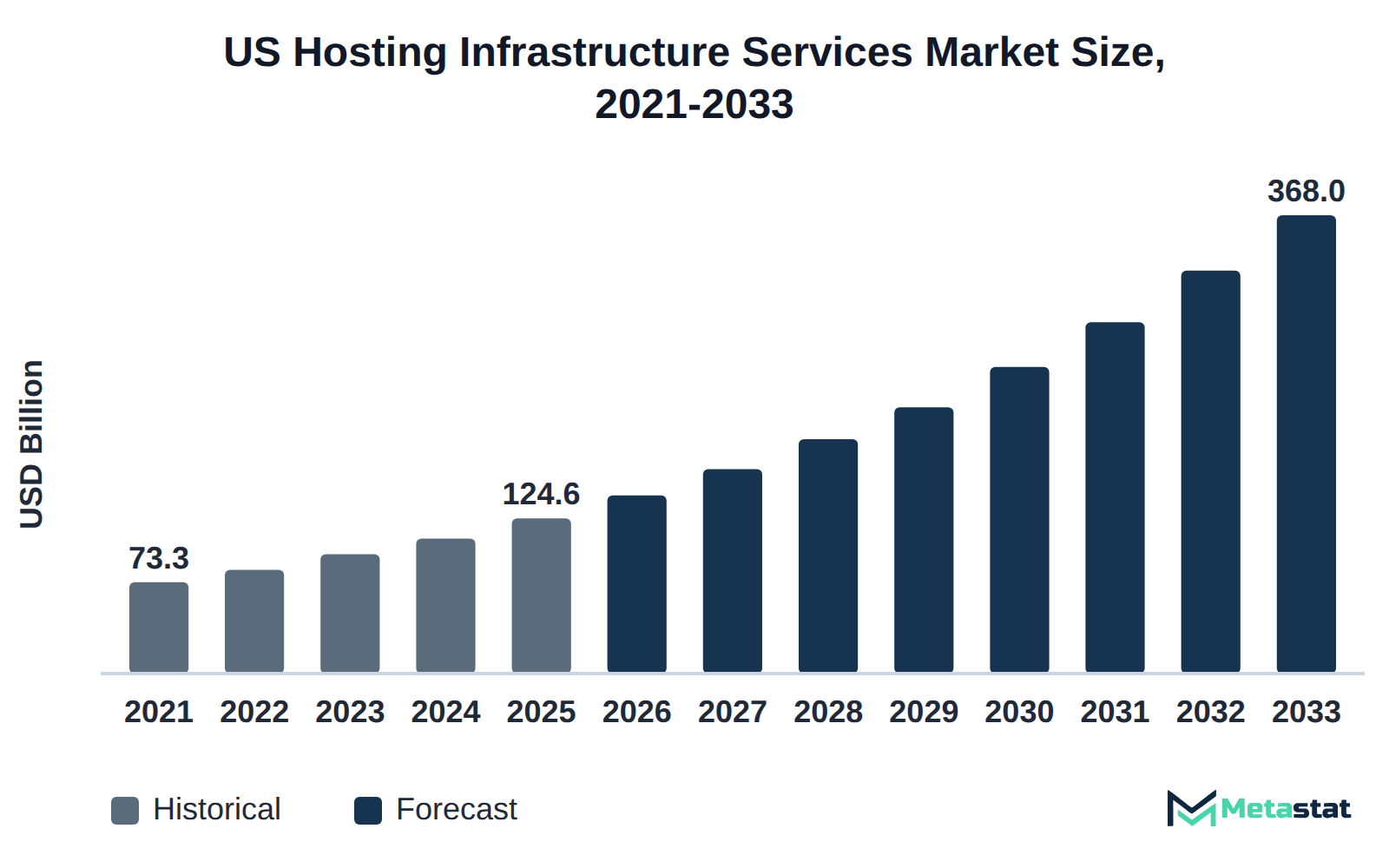
The expansion of GPU cloud capacity significantly influences procurement strategies within the US Hosting Infrastructure Services market. This technology enables businesses to access advanced computing power without the burden of maintaining physical hardware. Public cloud infrastructure and platform hosting is projected to rise from USD 131.1 billion in 2026 to USD 350.4 billion by 2033. This growth highlights a shift toward using GPU resources for high-performance tasks.
Organizations focusing on data-intensive applications, including enterprise artificial intelligence and machine learning, increasingly require the capabilities offered by GPU cloud solutions. The projected compound annual growth rate of 15.1% for this service type reflects a growing recognition of its value among enterprises seeking to enhance operational efficiency while minimizing costs. By integrating GPU capabilities, businesses streamline resource allocation, reduce time-to-market, and improve their competitive edge.
These developments highlight the necessity for procurement teams to adapt strategies, prioritizing partnerships with leading providers that excel in GPU cloud offerings. Organizations that align their procurement practices with this technological shift achieve significant gains in performance and scalability.
Buyers increasingly prioritize pricing models that align with their unique operational requirements in the US Hosting Infrastructure Services market. A notable trend involves the repatriation of private cloud solutions, where organizations seek greater control over their data and compliance with regulatory standards. This shift drives demand for dedicated servers tailored to specific enterprise workloads, which offer enhanced security and performance compared to traditional shared hosting options.
The Customer-Managed Hosting segment illustrates this trend, with an expected value increase from USD 87.4 billion in 2026 to USD 207.9 billion by 2033, reflecting a compound annual growth rate of 13.2%. This growth indicates that enterprises recognize the importance of customized solutions and are moving towards dedicated infrastructure to ensure compliance and operational efficiency.
The shift towards dedicated servers creates competitive pricing and contract negotiation opportunities, enabling enterprises to secure favorable terms. The adoption of these models provides organizations with flexibility in resource allocation, ultimately enhancing their ability to respond to market demands and regulatory changes. Such developments improve overall market dynamics, positioning buyers to benefit from tailored solutions and improved service delivery.
Cloud egress charges are a significant consideration for organizations using managed hosting solutions. These costs arise when transferring data from a cloud provider's infrastructure, impacting overall expenditures for businesses, especially those in data-intensive sectors. In the US Hosting Infrastructure Services market, the anticipated growth of Public Cloud Infrastructure and Platform Hosting is projected to reach USD 350.4 billion by 2033, driven by the increasing reliance on cloud services. This rapid expansion highlights the importance of understanding egress charges, which substantially affect operational budgets.
Buyers in industries including IT and Telecommunications, which are expected to grow from USD 44.1 billion in 2026 to USD 119.3 billion in 2033, face unique challenges. They require a careful analysis of their cloud usage patterns, particularly concerning data transfers that incur egress fees. Organizations exploring reserved capacity options find that bundling resources leads to cost efficiencies, ultimately enhancing their competitive edge in the market. Understanding these financial implications enables companies to optimize their cloud strategies and allocate resources effectively.
Choosing the right hosting infrastructure model is crucial for U.S. enterprises looking to optimize their workloads. Public Cloud Infrastructure and Platform Hosting has emerged as the most favorable choice, driven by its flexibility and scalability. This segment is projected to grow from USD 131.1 billion in 2026 to USD 350.4 billion by 2033, reflecting a compound annual growth rate (CAGR) of 15.1%. This substantial growth indicates a strong preference among enterprises for solutions that offer rapid deployment and resource allocation.
Large enterprises are increasingly shifting towards provider-managed hosting solutions, which are expected to reach a value of USD 160.2 billion by 2033. This model allows organizations to focus on their core competencies while outsourcing the management of their hosting infrastructure. The anticipated shift towards such managed solutions highlights the importance of streamlined operations, enabling businesses to improve efficiency and reduce overhead costs.
Investing in the right hosting infrastructure model significantly impacts operational effectiveness and overall business growth. The US Hosting Infrastructure Services market offers a variety of options, but aligning the chosen model with specific organizational needs remains essential for maximizing the return on investment.
The rise in digital transformation initiatives among large enterprises significantly drives spending on hosting infrastructure. Companies increasingly prioritize scalable solutions to accommodate growing data workloads and application demands. This shift in buyer behavior results in heightened demand for public cloud infrastructure and platform hosting services, which is projected to expand from USD 131.1 billion in 2026 to USD 350.4 billion by 2033, reflecting a compound annual growth rate of 15.1%. This surge in cloud service adoption leads to increased investment in hosting options, enhancing operational efficiency and supporting business agility. The US Hosting Infrastructure Services market continues to evolve, fueled by advancements in technology and an imperative for enhanced performance across various industries.
Rising investments in digital infrastructure
Growing investments in digital infrastructure among small and medium-sized enterprises generate increased demand for hosting services. The expansion of these businesses into online platforms requires reliable and cost-effective hosting solutions, driving expenditure in the market. Small and medium-sized enterprises, seeking to optimize their operational capabilities, increasingly shift towards public cloud solutions. This transition supports scalability and flexibility in resource management. The US Hosting Infrastructure Services market experiences significant growth, expected to reach USD 368 billion by 2033, reflecting the impact of rising investments in digital infrastructure.
The integration of cloud-native technologies significantly enhances the performance and scalability of hosting infrastructure. The adoption of microservices, containers, and serverless architectures streamlines the development and deployment of applications, facilitating faster response times and improved resource utilization. Organizations increasingly embrace these technologies due to their capacity to optimize costs while enabling rapid innovation across various sectors.
In the US Hosting Infrastructure Services market, businesses use these advancements to improve operational efficiency and meet digital transformation demands. The shift towards cloud-native solutions reflects a broader trend toward agility and flexibility, enabling organizations to quickly adapt to changing market conditions and customer expectations. This transformation increases competition among service providers, driving investment in advanced infrastructure and capabilities.
Overall, the incorporation of cloud-native technologies supports the market's growth trajectory, enhancing the value proposition for organizations seeking efficient and scalable hosting solutions.
Price sensitivity among small and medium-sized enterprises presents a significant restraint within the US Hosting Infrastructure Services market. Budget constraints often result in smaller order sizes and delayed upgrades to advanced infrastructure solutions. These organizations prioritize cost-effective hosting options, which restrict their access to more robust and efficient services. Consequently, many enterprises opt for entry-level solutions that do not fully meet their evolving needs. This trend limits the overall growth trajectory of the market, with businesses that delay investments in higher-quality services experiencing operational inefficiencies that hinder their competitive edge. The need for cost-effective solutions creates challenges for hosting service providers, who balance affordability with the delivery of comprehensive features. Overall, heightened price sensitivity among this buyer group contributes to slower market growth and adoption rates, potentially stalling advancements in hosting infrastructure technology.
Talent shortages present a significant challenge for hosting service providers within the market. The increasing complexity of hosting solutions requires highly skilled professionals, particularly in areas including cloud architecture, cybersecurity, and data management. Competing demands for qualified talent across various sectors result in heightened competition for recruitment, driving up labor costs.
To navigate these challenges, companies are investing in training programs and partnerships with educational institutions to cultivate a skilled workforce. Several providers emphasize retention strategies, focusing on enhancing employee engagement and satisfaction to mitigate turnover. Increased operational expenses related to talent acquisition and retention directly impact profit margins, compelling organizations to optimize service offerings and improve efficiency.
Addressing talent shortages will influence the growth trajectory of the US Hosting Infrastructure Services market, affecting service delivery capabilities and competitive positioning.
The public cloud infrastructure and platform hosting segment is projected to experience significant growth, driven by increasing demand for scalable and flexible hosting solutions. This trend highlights strong interest from various sectors seeking efficient resource management and cost-effective solutions. Large enterprises particularly emphasize adopting public cloud services to enhance operational efficiency and facilitate digital transformation efforts. The market supports this demand through diverse service offerings tailored to meet the specific needs of organizations, ultimately expanding their capabilities and improving service delivery. Investments in this segment are expected to rise sharply, positioning public cloud infrastructure as a critical component for businesses adopting advanced technologies and maintaining competitive advantages.
The US Hosting Infrastructure Services market is segmented based on Service Type, Management Model, Organization Size, and End-Use Industry.
This segment is primarily used by organizations seeking scalable and flexible hosting solutions, including large enterprises and small to medium-sized businesses. Increasing digital transformation initiatives across sectors drive the demand for cloud-based services, enabling businesses to enhance operational efficiency and reduce infrastructure costs. Unlike other service types, including Hosted Private Cloud or Dedicated Server Hosting, Public Cloud Infrastructure & Platform Hosting exhibits faster growth due to its ability to support diverse applications and workloads. The growing emphasis on cost-effective and on-demand resources further drives this segment's expansion, positioning it as a critical player in the US Hosting Infrastructure Services market.
Hosted Private Cloud segment is estimated to reach USD 9.1 billion by 2033, at a CAGR of 6.6% during the forecast period. This segment serves organizations seeking dedicated resources and enhanced security without the overhead of a fully private cloud. Industries including healthcare and finance increasingly rely on hosted private cloud solutions to handle sensitive data while ensuring compliance with regulations. The primary driver for this segment stems from rising demand for data protection and customization, particularly among enterprises with stringent security requirements. Compared to other service types, hosted private cloud experiences slower growth due to higher costs and specific buyer needs, positioning it differently within the market. Its appeal lies in offering a balance between scalability and control, which suits organizations that prioritize data privacy while still wanting the advantages of cloud technologies.
Dedicated Server Hosting segment is expected to reach USD 4.3 billion by 2033. This hosting solution provides dedicated resources tailored for organizations requiring enhanced performance and security, particularly in regulated industries. Large enterprises and service providers often employ dedicated servers for critical applications, driven by compliance and security mandates. The segment exhibits slower growth compared to other service types, with a CAGR of 6.6%. Organizations opting for Dedicated Server Hosting prioritize control and customization, which distinguishes it from Public Cloud Infrastructure, typically favored for its scalability and flexibility. While the demand for dedicated servers persists, the market's evolution reflects a shift towards integrated cloud solutions, which offer rapid deployment and cost advantages, influencing overall growth dynamics. The market adapts to meet the unique demands of various industries, maintaining its relevance in a competitive landscape.
VPS Hosting is projected to grow at a CAGR of 6.6% during the forecast period. This service type provides virtual private servers, enabling users to have dedicated resources and greater control over their hosting environments. Businesses, especially small and medium-sized enterprises, frequently use VPS Hosting to achieve a balance between cost and performance. The rising demand for scalable and efficient hosting solutions drives growth in this segment. Compared to other service types, VPS Hosting offers a more affordable option than dedicated server hosting, which targets larger enterprises with higher budgets. Its growth remains steady, supported by the increasing need for flexible hosting solutions that accommodate fluctuating workloads and resource requirements. The demand for VPS Hosting reflects broader trends in the IT landscape, where organizations seek to optimize performance while managing costs effectively.
Shared Web Hosting provides organizations with a cost-effective solution to host their websites and applications on shared servers. This segment particularly attracts small businesses, personal users, and startups, which prioritize affordability and ease of use. Demand for Shared Web Hosting is driven by the increasing number of small enterprises seeking to establish an online presence without incurring high infrastructure costs. Unlike dedicated server or private cloud solutions, Shared Web Hosting typically offers lower prices but comes with limited resources and performance capabilities. This segment experiences slower growth compared to other service types like Public Cloud Infrastructure, reflecting reliance on budget-sensitive customers who prioritize basic hosting needs over advanced features. Competition in this segment remains fierce, pushing providers to enhance service offerings while keeping costs low.
This segment serves organizations requiring full control over their hosting environment, allowing customization and configuration tailored to specific business needs. Large enterprises predominantly adopt this model, driven by the need for compliance and security. The segment distinguishes itself with a higher growth rate compared to other management models, aided by increasing investments in IT infrastructure and expertise. The focus on data privacy regulations and the need for tailored solutions contribute to heightened demand. Organizations increasingly prioritize dedicated resources and management flexibility, influencing spending patterns within the market.
Provider-Managed Hosting segment is estimated to reach USD 160.2 billion by 2033, at a CAGR of 16.3% during the forecast period. This service model offers organizations a comprehensive hosting solution managed by the service provider, covering infrastructure management, maintenance, and support. Companies across various sectors, particularly large enterprises, leverage this model for enhanced security, scalability, and reduced operational burdens. Growth in this segment is driven by increasing demand for outsourcing IT management, enabling firms to focus on core business activities. Compared to Customer-Managed Hosting, which is projected to grow at a CAGR of 13.2%, Provider-Managed Hosting shows faster growth, attracting organizations that prioritize resilience and reliable support. The market sees substantial interest from industries including IT & Telecommunications and BFSI, where operational efficiency and stringent compliance requirements significantly influence hosting decisions.
The Large Enterprises segment is valued at USD 107.5 billion in 2026 and is projected to reach USD 267.2 billion by 2033, at a CAGR of 13.9% during the forecast period. This segment primarily serves large organizations focused on robust and scalable hosting solutions to support extensive operations across various sectors. Demand for advanced hosting services is propelled by the need for digital transformation and enhanced operational efficiency. Large enterprises often seek customized solutions, differentiating this segment from small and medium-sized enterprises, which typically engage with more standardized offerings. The growth trajectory of this segment surpasses that of smaller organizations, driven by higher budgets and the necessity for specialized services that handle large-scale online operations. Overall, the Large Enterprises segment significantly contributes to the US Hosting Infrastructure Services market, emphasizing the importance of tailored solutions to meet complex business requirements.
Small & Medium-Sized Enterprises segment is estimated to reach USD 100.8 billion by 2033, at a CAGR of 16.1% during the forecast period. This segment caters to businesses that require flexible and affordable hosting solutions to support their digital presence and operational needs. Demand for such services rises due to the increasing reliance on cloud-based applications and the necessity to maintain competitive advantages through technology. Price sensitivity influences purchasing decisions, making cost-effective solutions essential for this segment. Unlike larger enterprises, which often invest heavily in dedicated or customer-managed solutions, small and medium-sized enterprises frequently opt for more scalable and manageable hosting options. The growth of this segment reflects a robust trajectory, highlighting the market's shifting focus towards accommodating smaller organizations.
IT & Telecommunications segment is valued at USD 44.1 billion in 2026 and is projected to reach USD 119.3 billion by 2033, at a CAGR of 15.3% during the forecast period. This segment primarily serves businesses that rely on secure and scalable hosting solutions to manage their data and applications. The increasing demand for high-speed connectivity and data processing capabilities drives the growth of this segment, with larger enterprises seeking robust infrastructure to support their operations. Compared to other segments, IT & Telecommunications demonstrates a faster growth rate, driven by the need for advanced technology and cloud services. The transition to cloud computing and the adoption of 5G technology further enhance demand. This positions the segment as a key player in the US Hosting Infrastructure Services market and reflects changing dynamics of digital communication and service delivery.
BFSI segment is estimated to reach USD 58 billion by 2033, at a CAGR of 13.6% during the forecast period. This segment caters to financial institutions, including banks, insurance companies, and investment firms, providing critical infrastructure for secure transactions, data management, and compliance with regulatory standards. Strong demand for enhanced security measures and the implementation of digital banking services drive growth in this segment. Compared to other segments, the BFSI segment experiences a distinctive growth pattern, driven by stringent regulatory requirements and the necessity for advanced cybersecurity solutions. The emphasis on cloud solutions in BFSI highlights a commitment to digital transformation while balancing challenges related to regulatory compliance and data protection. This segment reflects a faster growth trajectory compared to traditional hosting services, indicating its significant role in the evolving landscape of financial services.
The Retail & E-commerce segment is expected to reach USD 39.9 billion by 2033. This segment primarily serves online retailers and e-commerce platforms, providing the necessary infrastructure for hosting websites, managing transactions, and ensuring customer data security. The rapid shift towards online shopping drives demand for reliable hosting solutions, driven by increasing consumer reliance on digital channels. Businesses seek to enhance user experience through improved site performance and uptime, contributing to the segment's growth. Compared to other segments, Retail & E-commerce experiences a relatively higher growth trajectory, with significant investments in hosting infrastructure to keep up with market demands. This segment benefits from innovations in payment processing technology and enhanced cybersecurity measures, which help to build consumer trust and streamline operations. The emphasis on data analytics for customer insights further distinguishes this segment from others in the market.
The Healthcare & Life Sciences segment is projected to grow at a CAGR of 16.6% during the forecast period. This segment supports medical research, patient management, and healthcare analytics, serving hospitals, clinics, and pharmaceutical companies. The increasing demand for secure and compliant data storage significantly drives growth in this area, with providers enhancing their offerings to meet regulatory requirements, including HIPAA. Organizations within this sector often require specialized solutions that differ from those in other segments, reflecting a higher emphasis on data security and compliance. The estimated growth rate surpasses that of several other segments, reinforcing the importance of tailored features to accommodate the unique demands of the healthcare sector. The market continues to evolve with technological advancements, creating new opportunities for innovation and efficiency.
Government & Defense encompasses various public organizations and agencies responsible for national security and public safety. This segment relies on secure and reliable hosting solutions to manage sensitive data and support mission-critical applications. The growing emphasis on cybersecurity drives demand for advanced hosting services tailored to meet stringent compliance and regulatory standards associated with government operations. Unlike other segments, this area often experiences slower growth due to the complex procurement processes and budget constraints typical in government agencies. Providers offering tailored solutions for this sector work within intricate regulations while maintaining the highest levels of data security and operational integrity. The US Hosting Infrastructure Services market reflects this unique dynamic, where the relationship between security requirements and technological innovation shapes demand for hosting services tailored to government and defense applications.
Manufacturing relies heavily on hosting infrastructure services to support operations, data management, and supply chain efficiency. Companies in this sector use these services for data storage, application hosting, and productivity gains through improved IT capabilities. Growth in this segment is driven primarily by the need for digital transformation and automation, which push manufacturers to adopt advanced technologies. Unlike other segments, manufacturing typically faces unique challenges related to operational technology integration and data security. This sector's growth trajectory is influenced by the increasing adoption of Industry 4.0 practices, emphasizing smart manufacturing and interconnected systems. Compared to segments including IT & Telecommunications, manufacturing experiences a slower growth rate, reflecting its complex transition from traditional practices to modern, integrated solutions. The market acknowledges these dynamics, positioning the manufacturing sub-segment strategically within the US Hosting Infrastructure Services market.
The Media & Entertainment segment delivers content-driven services that require hosting infrastructure to manage high traffic volumes, streaming services, and digital content distribution. This segment serves clients such as streaming services, gaming companies, and content creators, all of which demand efficient and reliable hosting solutions. Rapid advancements in technology, particularly in high-definition streaming and interactive content, drive significant demand for enhanced hosting capabilities. While other segments focus on traditional data management, Media & Entertainment thrives on innovation, focusing on advanced technologies to deliver content seamlessly. Strong competition among service providers pushes prices down, making state-of-the-art services more accessible. This segment's growth trajectory is distinct, emphasizing agility and performance, with organizations striving to capture consumer attention in a saturated marketplace. Overall, the segment's dynamic nature and reliance on technology differentiate it from the other segments in the market.
Energy & Utilities is essential in the management and distribution of energy resources, including electricity, gas, and water. This segment primarily serves utility companies and energy providers, which rely on robust hosting infrastructure to enhance operational efficiency and improve service delivery. Growth in this area is driven by the increasing demand for renewable energy solutions and the digital transformation of utilities seeking to integrate advanced analytics and smart grid technologies. This segment differentiates itself from others due to its unique regulatory environment and a focus on reliability and security, often involving higher costs for specialized infrastructure. A significant emphasis on compliance with environmental regulations and the need for sustainable solutions influences technology adoption, setting Energy & Utilities apart from other segments within the US Hosting Infrastructure Services market.
Transportation & Logistics connects goods and services across various regions, ensuring timely and efficient delivery. Organizations within this segment rely heavily on hosting infrastructure services to optimize supply chain management, track shipments, and manage inventory. The increasing demand for real-time data analytics and improved customer experiences drives growth in this area. The shift towards automation and digitalization further drives the adoption of advanced technologies, enhancing operational efficiency. Compared to other segments, Transportation & Logistics exhibits unique characteristics, driven by specific buyer needs and technological advancements. This segment is projected to expand rapidly, aligning with broader trends in e-commerce and global trade, which necessitate robust hosting solutions to manage increased data traffic and operational demands. Growth in this segment significantly contributes to the overall evolution of the US Hosting Infrastructure Services market.
This sub-segment encompasses various industries including education, professional services, and hospitality, which frequently employ hosting infrastructure services to enhance operational efficiency and support online functionalities. Educational institutions leverage these services for e-learning platforms and data management, while professional services firms employ the infrastructure to ensure the secure handling of client data. The hospitality industry benefits from robust hosting solutions to manage reservations and customer relations effectively. A growing emphasis on digital transformation drives demand within this sub-segment, propelling organizations to adopt advanced hosting solutions that offer scalability and reliability. Compared to other segments, this sub-segment experiences slower growth due to budget constraints within educational institutions and the highly competitive nature of professional services. Nonetheless, the ongoing shift towards digitalization presents opportunities for innovation and adaptation in service delivery, positioning these industries strategically within the US Hosting Infrastructure Services market.
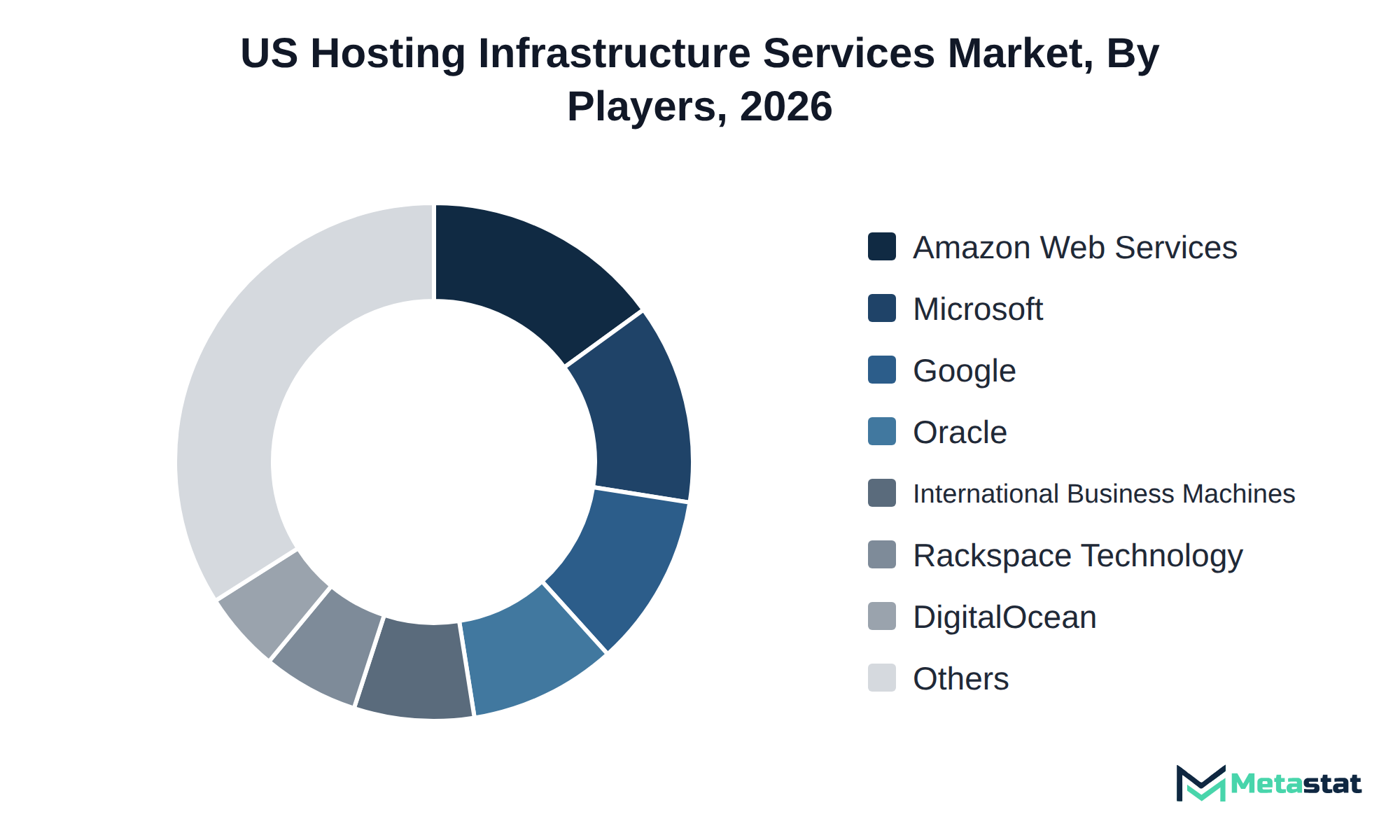
The US Hosting Infrastructure Services market features various players competing across distinct segments. Companies employ diverse service types, including public cloud infrastructure and platform hosting, hosted private cloud, dedicated server hosting, and VPS hosting. Public cloud services exhibit the highest growth potential, driven by increasing demand from large enterprises and small to medium-sized enterprises seeking scalable solutions. Provider-managed hosting has emerged as a preferred model, attracting buyers due to lower operational burden and comprehensive service offerings.
Buyers prioritize factors including price, service quality, customization, and the overall ecosystem of offerings when selecting hosting services. Amazon Web Services, Inc. distinguishes itself with a wide-ranging service portfolio, focusing on public cloud infrastructure, while Microsoft Corporation emphasizes integration within its existing software ecosystems. Google LLC targets developers and enterprises by providing robust tools and analytics capabilities, appealing to tech-savvy customers seeking innovative solutions in the market.
The expansion of Provider-Managed Hosting, anticipated to reach USD 160.2 billion by 2033, further supports this forecast. However, potential risks including regulatory changes or economic downturns hinder growth rates in several segments, particularly impacting smaller enterprises that face increased operational costs. Such constraints could limit their investment in hosting infrastructure, affecting overall market penetration. The US Hosting Infrastructure Services market is well-positioned for significant growth, driven by technological advancements and evolving customer needs, provided that key developments proceed as anticipated.
By Service Type: Public Cloud Infrastructure & Platform Hosting, Hosted Private Cloud, Dedicated Server Hosting, VPS Hosting, Shared Web Hosting
By Organization Size: Large Enterprises, Small & Medium-Sized Enterprises
By End-Use Industry: IT & Telecommunications, BFSI, Retail & E-commerce, Healthcare & Life Sciences, Government & Defense, Manufacturing, Media & Entertainment, Energy & Utilities, Transportation & Logistics, Others (Education, Professional Services, Hospitality)
The report strategically identifies and profiles the key market players and analyses their core competencies in each sub-segment of the Hosting Infrastructure Services market.
Report Attributes | Details |
Study Period | 2021-2033 |
Base Year | 2025 |
Estimated Year | 2026 |
Forecast Period | 2026-2033 |
Historical Period | 2021-2025 |
Growth Rate | CAGR 14.5% from 2026 to 2033 |
Revenue Unit | USD billion |
Segmentation | By Service Type, Management Model, Organization Size, End-Use Industry, and Region |
Find answers to common questions about this report
The Hosting Infrastructure Services market size was valued at USD 124.6 billion in 2025.
The market is projected to grow at a CAGR of 14.5% during the forecast period from 2026 to 2033.
Public Cloud Infrastructure & Platform Hosting leads the Hosting Infrastructure Services market with a projected value of USD 350.4 billion by 2033. This segment demonstrates the highest growth rate among the service types, with a compound annual growth rate of 15.1 percent.
Rising investments in digital infrastructure among small and medium-sized enterprises drive increased demand for hosting services. The shift towards cloud-native solutions enhances performance and scalability, enabling organizations to quickly adapt to changing market conditions and customer expectations.
Price sensitivity among small and medium-sized enterprises presents a significant restraint within the market. Talent shortages create challenges for hosting service providers, as the increasing complexity of hosting solutions requires highly skilled professionals.
The Hosting Infrastructure Services market is estimated to reach a valuation of USD 368 billion by 2033.
Key players operating in the Hosting Infrastructure Services market include Amazon Web Services, Inc., Microsoft Corporation, Google LLC, Oracle Corporation, International Business Machines Corporation, and Rackspace Technology, Inc.
Public cloud infrastructure and platform hosting is projected to expand from USD 131.1 billion in 2026 to USD 350.4 billion by 2033, reflecting a compound annual growth rate of 15.1 percent.
Digital transformation initiatives among large enterprises drive spending on hosting infrastructure, leading to increased demand for scalable solutions and cloud services.
Price sensitivity among small and medium-sized enterprises leads to a preference for cost-effective hosting options, which restrict access to more advanced services and impact overall market growth.
The analysts below cover Information & Technology research at Metastat Insights.
LEAD ANALYST
Utkarsh Khirodkar is a Lead Market Research Analyst at MetaStat Insight, specializing in market intelligence, technology sector assessments, and competitive strategy.

PRINCIPAL CONSULTANT - ENTERPRISE AI & EMERGING TECHNOLOGIES
Banking & Finance · Electronics and Semiconductor · Energy and Power · Healthcare IT · Information & Technology · Professional Services
Vijay Gunti is a Principal Consultant at MetaStat Insight, bringing over two decades of experience across enterprise digital transformation, technology strategy, and intelligent systems.

LEAD CONSULTANT - COMMUNICATION, TELECOM, AND IT
Electronics and Semiconductor · Information & Technology · Machinery & Equipment · Professional Services
Ravindra Sathe Consultants for Communication, Telecom, and IT at MetaStat Insight. He leads the firm's industry research initiatives across telecommunications infrastructure, digital connectivity, enterprise networking, and emerging information technology domains.
Most industry reports on warehouse automation bundle autonomous mobile robots and fixed conveyor installations into the same top-level numbers, which complicates advisory work. This study split the market cleanly by payload tiers, navigation technology, and fleet management software layers. The regional forecast for Western Europe gave our team defensible adoption benchmarks when evaluating capital allocation for logistics clients, saving us days of secondary data scrubbing.
Standard industry briefs frequently blur the operational distinctions between isobaric pressure exchangers and centrifugal turbines. In this study, MetaStat Insight categorized mega-scale desalination tenders across the GCC and Mediterranean basins by membrane replacement frequencies and salinity tolerances. Their primary research helped us evaluate local content requirements in Saudi Arabia and the UAE without relying on marketing literature. We found the segment-level equipment replacement estimates grounded and well-reasoned throughout.
The technical breakdown of ISO 20022 migration readiness across correspondent banking corridors was remarkably thorough. Rather than treating cross-border corporate payments as a single block, the report drew a useful distinction between multilateral netting platforms and domestic instant payment rails across ASEAN economies. MetaStat Insight highlighted regulatory constraints on foreign exchange liquidity management that many publications gloss over. The research material offered practical clarity for our platform development roadmap.
Explore related market intelligence reports worth reading alongside this one.