
LEAD ANALYST
Utkarsh Khirodkar is a Lead Market Research Analyst at MetaStat Insight, specializing in market intelligence, technology sector assessments, and competitive strategy.

Global 3D Point Cloud Processing Software Market Size, Share, By Deployment Model (On-Premises, Cloud-Based, Hybrid), By Point Cloud Source (LiDAR Point Clouds, Image-Based Point Clouds), By Application (Registration and Preprocessing, Classification and Feature Extraction, Surface and Mesh Reconstruction, CAD and BIM Reconstruction, Measurement and Inspection), By End-Use Industry (Architecture, Engineering and Construction, Surveying and Geospatial Services, Manufacturing, Energy and Utilities, Mining, Transportation and Logistics, Forestry and Agriculture), Industry Analysis, Growth, Trends, and Forecast, 2026-2033
Report ID
MSI-2447
Published
November, 2026
Pages
257 Pages
Format
Historical
Base year
Forecast
Forecast period
Report Details
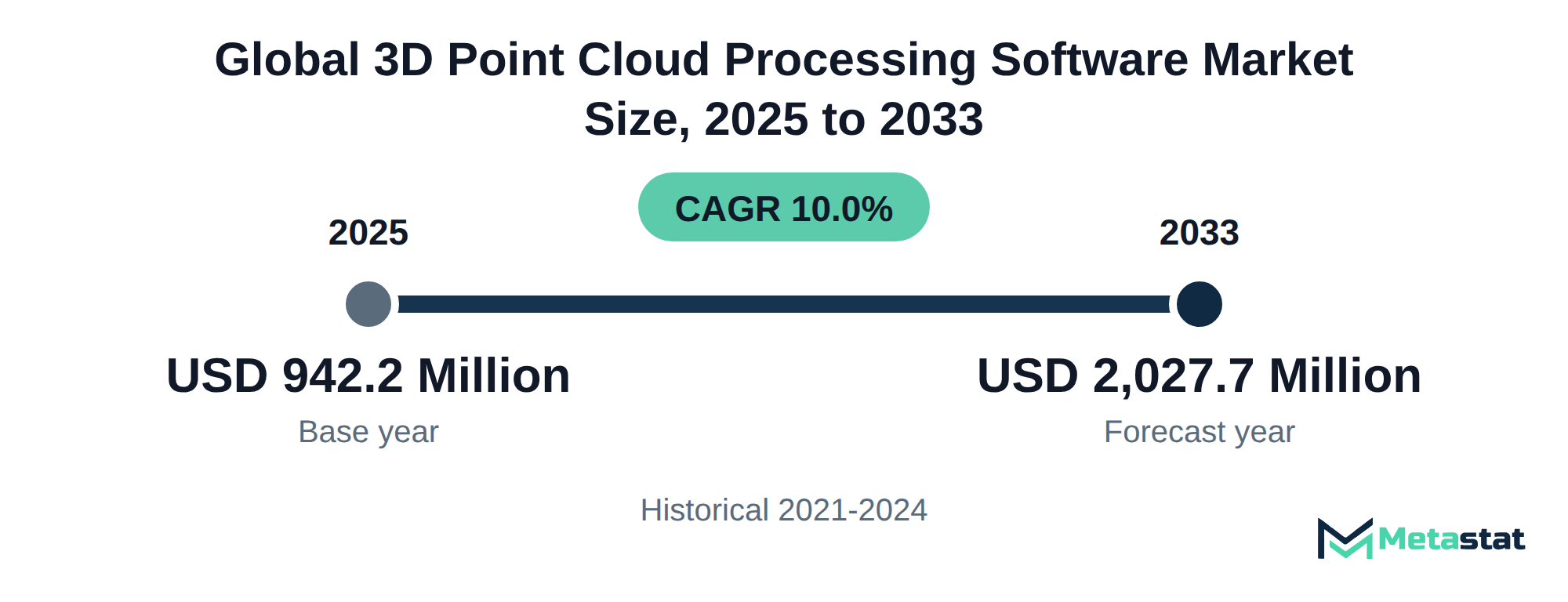
Market Valuation: Valued at $942.2 Million in 2025, projected to reach $2,027.7 Million by 2033 at a 10.0% CAGR.
Dominant Segment: The cloud-based deployment model leads the market, driven by its scalability and flexibility, appealing to industries seeking efficient data processing solutions.
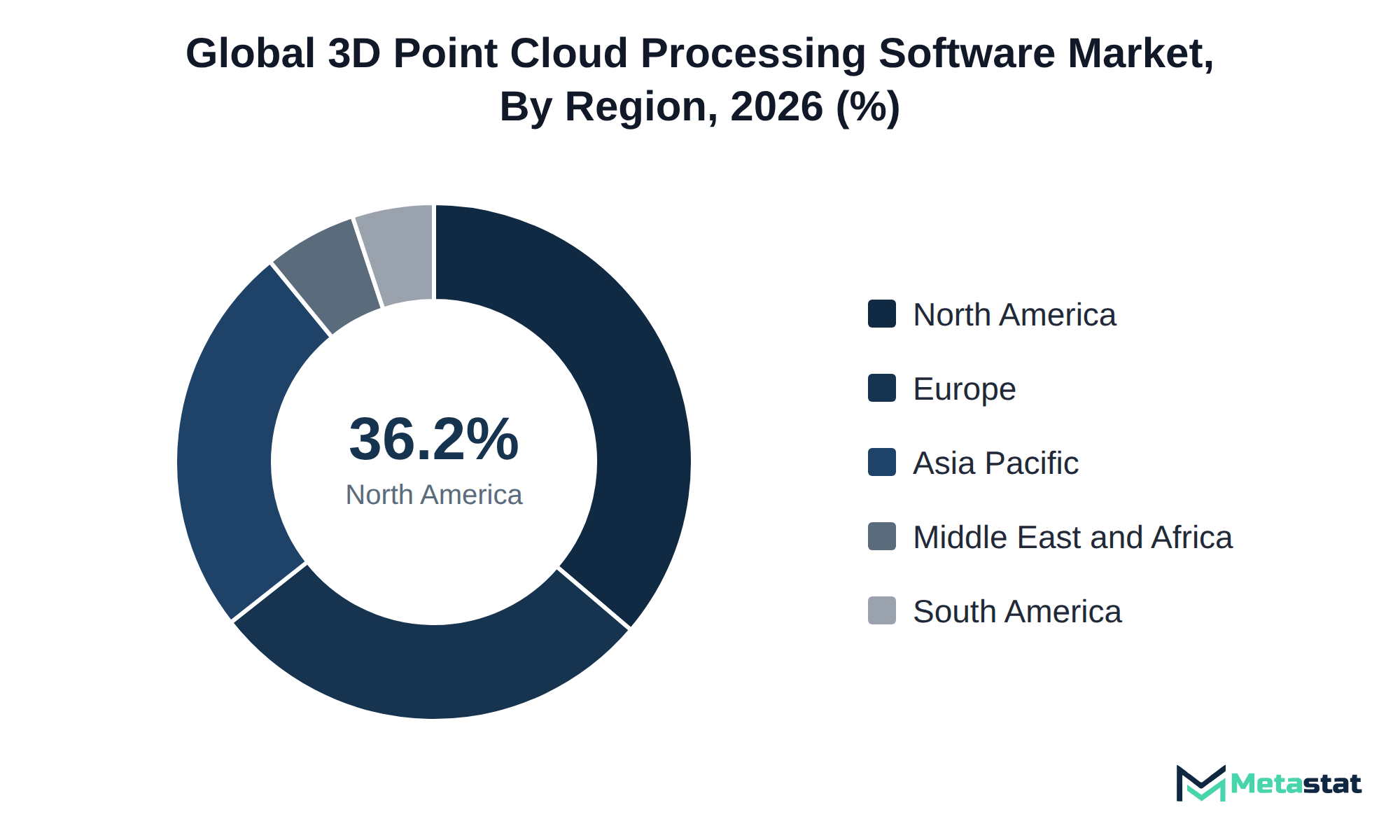
Geographic Lead: North America is the leading region, accounting for 36.2% of the market in 2025, supported by strong investments in advanced technologies and infrastructure development.
What's Inside: The report provides a comprehensive analysis of market dynamics, competitive landscape, and detailed forecasts for various deployment models, point cloud sources, applications, and end-use industries.
Emerging Trends: Technological advancements in AI and automation are reshaping the market, enhancing processing speeds and accuracy while driving demand for innovative solutions.
Market Dynamics: Increasing investments in infrastructure projects and a shift toward digitization in construction are significant factors fueling market growth.
Choose Your License
Global 3D Point Cloud Processing Software Market
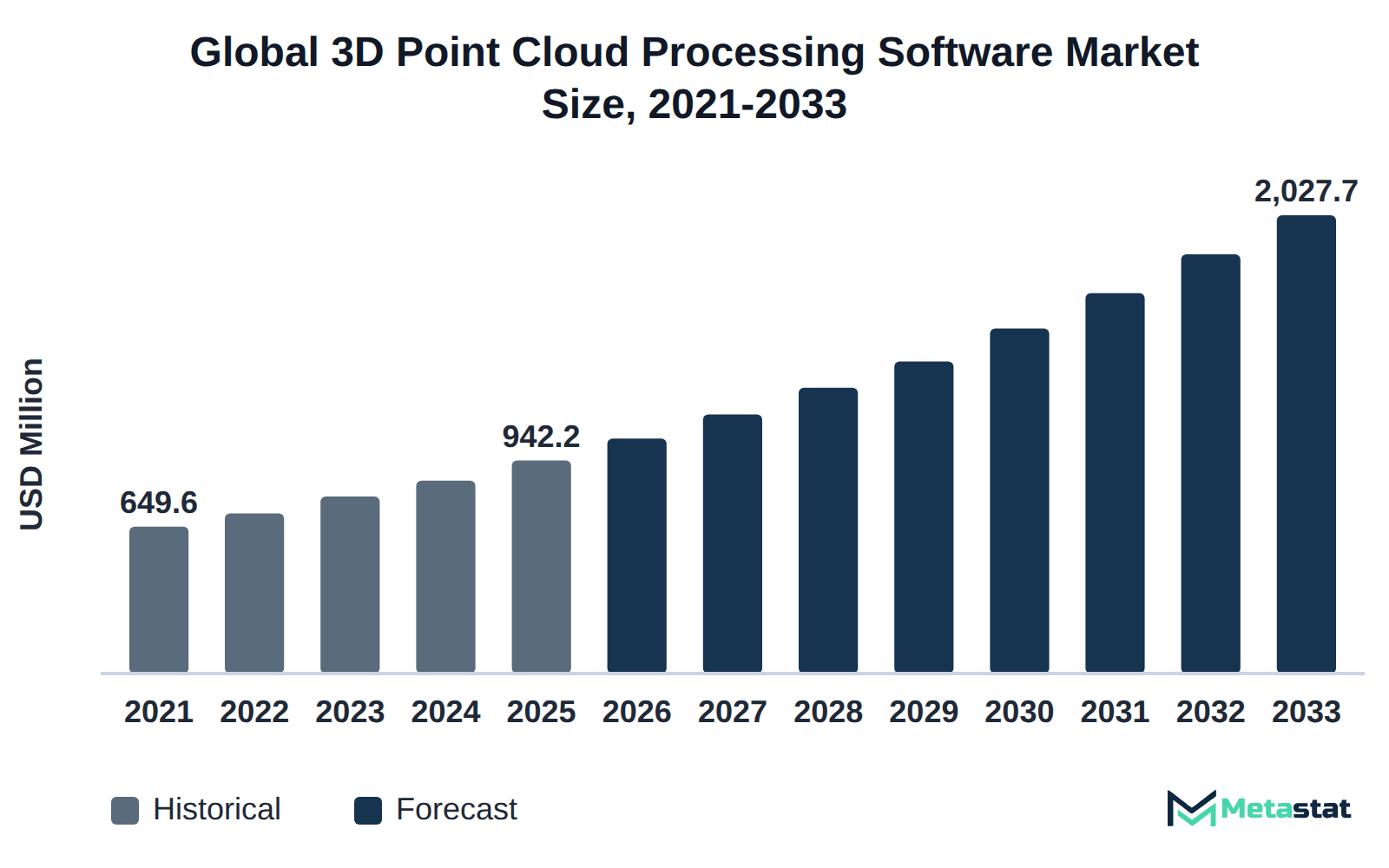
The global 3D Point Cloud Processing Software market was valued at USD 942.2 million in 2025 and is projected to reach USD 2,027.7 million by 2033, growing at a CAGR of 10.0% over the forecast period.
The 3D Point Cloud Processing Software market encompasses software solutions designed to analyze and process three-dimensional point cloud data generated from various sources. Buyers invest in these solutions to enhance the accuracy and efficiency of their projects in industries including architecture, engineering, construction, and surveying and geospatial services. The need for precise data representation and visualization drives spending in this market, enabling companies to streamline workflows and improve project outcomes.
Growth in the market is supported by increasing adoption of LiDAR technology, which provides high-resolution point cloud data for various applications. The largest segment by value is the deployment model for cloud-based solutions, which offers scalability and flexibility compared to traditional on-premises options. North America holds 36.2% of the market in 2025, with the US leading in 2026. This region benefits from strong investment in advanced technologies and infrastructure development.
Forecasts indicate a compound annual growth rate of 10% during the forecast period, driven by rising demand for automation and digitalization across multiple sectors. Continuous advancements in point cloud processing capabilities enhance the software's appeal, attracting new users and increasing overall market participation. Technological innovation and growing industry needs position the market for significant expansion in the coming years.
The 3D Point Cloud Processing Software market serves various industries, including architecture, engineering, and construction, by enhancing data visualization and enabling precise modeling. Buyers invest in these solutions to improve efficiency and accuracy in project execution. Demand for high-quality 3D models drives spending, particularly in sectors where precise spatial representation matters for decision-making and planning.
Growth in the market is fueled by the increasing adoption of LiDAR technology, which generates detailed point cloud data essential for applications ranging from mapping to construction. The cloud-based deployment model emerges as the most valuable segment, encouraging flexibility and scalability in processing capabilities, appealing to companies aiming to optimize operations.
Technological advancements continue to reshape the market, enhancing data processing speeds and accuracy. Emerging trends in automation and artificial intelligence integration further support the market's expansion. A growing focus on sustainability and efficient resource management in construction and surveying sectors also lifts demand for 3D Point Cloud Processing Software.
The integration of AI classification and feature extraction technology significantly reduces manual processing times associated with LiDAR data. Advances in machine learning algorithms let software automate the identification and classification of point clouds, improving efficiency on large datasets. In the 3D Point Cloud Processing Software market, the demand for solutions that streamline this aspect is expected to grow, driven by the increasing volume of data generated by LiDAR systems.
Forecast figures indicate that LiDAR point clouds will generate a market value of USD 1,347.4 million by 2033, reflecting the rising reliance on this technology across various industries. Using AI, firms minimize errors and accelerate project timelines, which improves project delivery outcomes. The transition toward more automated workflows enables professionals in architecture, engineering, and construction to focus on higher-level analysis rather than time-consuming data preparation.
Adopting AI for classification and feature extraction raises productivity and strengthens companies' competitive positions in the market. Organizations that incorporate these innovations into their processes stand to benefit from greater accuracy and faster turnaround times, enabling a more agile response to client demands and evolving project requirements.
Increasing adoption of Scan-to-BIM workflows significantly influences the 3D Point Cloud Processing Software market. These workflows enable integration of point cloud data into Building Information Modeling (BIM) systems. In 2023, the market reached USD 783.1 million, reflecting the growing emphasis on digitization and efficiency in construction processes. Key players, including Autodesk, focus on enhancing their software to support this integration, ensuring users benefit from real-time updates and accurate representations of physical environments.
Buyers typically engage in subscription-based pricing models or one-time licensing agreements when acquiring 3D Point Cloud Processing Software. Subscription models offer flexibility and lower upfront costs, appealing to several small and medium enterprises. In contrast, large firms opt for perpetual licenses, allowing for long-term investment without ongoing fees. This pricing diversity caters to various buyer needs and financial strategies across industries, including architecture and engineering, and contributes to market expansion.
Integrating Scan-to-BIM workflows with point cloud data improves project coordination and the accuracy of construction deliverables, and it reduces rework costs. Advancements lead to more efficient project timelines, ultimately driving further demand within the market.
The 3D Point Cloud Processing Software market experiences a significant shift in operational efficiency due to the adoption of cloud processing solutions. Cloud-based models enable users to handle large datasets without the need for substantial on-premises infrastructure, leading to lower operational costs. The cloud-based deployment model is projected to reach USD 784.1 million by 2033, reflecting a compound annual growth rate of 14.3%. This growth points to strong demand for scalable solutions that process complex point cloud data.
Businesses in industries including architecture and engineering increasingly favor cloud processing to enhance collaboration and streamline workflows. Accessing and manipulating large datasets remotely allows teams to work simultaneously without geographical limitations. This approach supports real-time data sharing, which is critical in projects requiring immediate updates and adjustments. Organizations adopting cloud-based solutions gain a competitive advantage through improved efficiency and cost savings.
Cloud processing changes the economics of the 3D Point Cloud Processing Software market, helping firms make the most of their resources when handling extensive point cloud datasets.
Selecting the right 3D Point Cloud Processing Software involves evaluating deployment models, which significantly impact operational efficiency. This model offers advantages including flexibility, scalability, and reduced upfront costs, making it attractive for firms looking to optimize resources without significant capital investment. In contrast, on-premises solutions are expected to reach USD 949.4 million by 2033 with a CAGR of 6.3%. These solutions provide greater control over data security but often require substantial initial investments and ongoing maintenance costs.
Buyers in industries including architecture, engineering, and construction prioritize cloud-based solutions for their project management capabilities and collaboration features, which enhance productivity. Organizations assessing their needs benefit from understanding the differences in deployment models, allowing for better alignment of software capabilities with business objectives, impacting overall project timelines and costs. The choice of deployment model significantly influences the cost structure and operational impact of the selected 3D Point Cloud Processing Software, ultimately shaping the competitive positioning of organizations in their respective markets.
Growing investments in infrastructure projects drive demand for 3D Point Cloud Processing Software. Key buyers, including firms in architecture, engineering, and construction, seek efficient solutions for large-scale projects. Recent shifts in government policies favoring infrastructure development enhance overall spending in this sector, leading to increased project volume and complexity. This uptick in infrastructure initiatives results in higher consumption of point cloud processing software, essential for accurate modeling and visualization. The market is expected to reach USD 1,039.7 million by 2026, reflecting significant growth fueled by these developments.
In addition, the trend toward digitization within the construction industry supports software adoption. Companies aim to streamline workflows and reduce delays in project timelines. Better accuracy and lower operating costs make a clear case for integrating advanced point cloud processing solutions into everyday practices.
Increased demand for cloud-based solutions
Cloud-based deployment models emerge as a prominent driver in the 3D Point Cloud Processing Software market. Organizations increasingly favor cloud solutions due to the scalability and accessibility they provide. This shift is particularly evident among mid-sized and large enterprises, which require effective data management across multiple locations. The remote accessibility and collaborative capabilities of cloud-based platforms facilitate real-time data analysis, enhancing project efficiency. With an anticipated market value of USD 784.1 million by 2033 for cloud-based solutions, this segment demonstrates strong growth potential.
The transition to cloud infrastructure enables companies to reduce costs associated with on-premises hardware and maintenance. This cost efficiency incentivizes broader adoption, further stimulating growth within the market.
Cloud-based solutions enhance accessibility and scalability for users in the 3D Point Cloud Processing Software market. This shift allows companies to utilize advanced processing capabilities without significant upfront investments in hardware. The ability to access software tools through the cloud supports collaboration among project teams, particularly in sectors including architecture and construction, where remote work and real-time data sharing are vital. Remote collaboration becomes more prominent, prompting organizations to seek flexible solutions capable of accommodating multiple users and large datasets. Cloud-based systems provide substantial cost savings by reducing the need for extensive on-premises infrastructure. This trend is expected to drive higher adoption rates across various industries that rely on efficient data processing and analysis. Enhanced processing speeds and reduced latency further contribute to improved project outcomes, increasing competition among software providers. Ultimately, these technological advancements strengthen the market's growth trajectory through 2033.
Price sensitivity significantly limits adoption within the 3D Point Cloud Processing Software market, particularly among small to medium-sized enterprises (SMEs). High costs associated with licenses and implementation deter many potential buyers from investing in these solutions. This situation creates a slower uptake in market penetration, particularly in the architecture, engineering, and construction sectors where budget constraints are prevalent. These SMEs face challenges in justifying the return on investment for expensive software, especially when lower-cost alternatives exist. Consequently, smaller orders and delayed replacement cycles result, impacting overall market growth and reducing competitive dynamics. Addressing these price considerations could enhance accessibility for SMEs and stimulate demand across various applications.
Rising input costs present significant challenges for suppliers within the market. Increased prices for raw materials and components directly impact profitability, forcing companies to reassess their pricing strategies. These pressures particularly affect small to medium-sized enterprises (SMEs) that struggle to absorb costs compared to larger competitors. In response, suppliers are investing in automation technologies to enhance operational efficiency and reduce reliance on manual labor. This shift allows for better cost management while maintaining competitive pricing structures. Collaborations with strategic partners help optimize supply chains and mitigate fluctuations in material costs. Such strategies reflect an industry-wide effort to manage financial constraints while keeping products competitive in the market. Supplier adaptability is essential for sustaining growth amid these economic pressures.
Significant growth opportunities exist within the LiDAR Point Clouds segment of the 3D Point Cloud Processing Software market. This segment is projected to grow from USD 729.4 million in 2026 to USD 1,347.4 million by 2033, reflecting a compound annual growth rate of 9.2%. This growth is driven by increasing adoption in sectors including architecture, engineering, and construction, where precise data capture and modeling capabilities enhance project outcomes. Users in these industries benefit from improved accuracy and efficiency in data analysis, directly contributing to operational success.
The rise of advanced LiDAR technologies supports this growth, enabling more detailed and efficient data collection. Industries recognize the value of high-quality point cloud data, and investments in LiDAR technology are expected to accelerate. This trend highlights the importance of targeting solutions that optimize LiDAR data processing and management, ultimately enhancing productivity across the market.
The Global 3D Point Cloud Processing Software market is segmented based on Deployment Model, Point Cloud Source, Application, and End-Use Industry.
On-Premises segment is valued at USD 617.7 million in 2026 and is projected to reach USD 949.4 million by 2033, at a CAGR of 6.3% during the forecast period. This segment primarily serves industries requiring robust data processing capabilities for point cloud data, including architecture, engineering, and construction. Demand for On-Premises solutions stems from organizations seeking control over their infrastructure, security, and data management. Compared to cloud-based offerings, which are projected to grow at a CAGR of 14.3%, the On-Premises segment experiences slower growth. Organizations with stringent data security requirements typically prefer On-Premises solutions, allowing for customized configurations tailored to specific operational needs. The market's overall expansion is driven by increasing investments in infrastructure and advancements in processing technologies, which support further adoption of On-Premises systems.
Cloud-Based solutions in the 3D Point Cloud Processing Software market are estimated to reach USD 784.1 million by 2033, at a CAGR of 14.3% during the forecast period. These solutions provide users with flexible, scalable options for processing and analyzing point cloud data, catering to diverse applications across industries, including architecture, engineering, and construction. Increasing demand from businesses seeking efficient data management and processing capabilities drives growth in this segment. Compared to On-Premises solutions, which exhibit a CAGR of 6.3%, Cloud-Based services present a more attractive option due to lower upfront costs and reduced infrastructure requirements. The ability to access powerful computing resources remotely enhances the appeal for users, particularly in large projects requiring extensive data handling. The rising focus on real-time collaboration and cloud accessibility positions this segment for robust expansion in the coming years.
Hybrid deployment models in 3D Point Cloud Processing Software are expected to reach USD 294.2 million by 2033. This model combines on-premises and cloud-based solutions, providing flexibility and scalability for organizations. Users primarily include architecture, engineering, and construction firms that require efficient data management and processing capabilities. The demand for hybrid solutions is driven by the increasing need for real-time data access while maintaining control over sensitive information. Compared to on-premises models, which grow at a CAGR of 6.3%, hybrid models benefit from a broader appeal due to their adaptability, supporting a diverse range of applications. The market has shifted toward hybrid models due to changing technological landscapes and the growing importance of remote collaboration, enhancing operational efficiency and project outcomes.
This segment finds applications in various fields, including surveying, construction, and autonomous vehicle navigation, where high-precision 3D mapping is essential. Increasing requirements for accurate geospatial data in infrastructure projects drive demand in this segment. The growth rate of LiDAR Point Clouds is slower than that of Cloud-Based solutions, which are projected to grow at a CAGR of 14.3%, reflecting a shift toward more flexible processing options. However, LiDAR technology remains a preferred choice for industries requiring detailed spatial information, ensuring significant market presence and profitability.
Image-Based Point Clouds segment is estimated to reach USD 500.2 million by 2033, at a CAGR of 11.6% during the forecast period. This segment primarily focuses on processing point clouds derived from images rather than LiDAR data. Architects and engineers typically apply image-based point clouds for tasks that require visual data interpretation, including site analysis and project planning. The increasing demand for photogrammetry techniques, which convert photographs into 3D models, drives growth in this segment. Compared to the LiDAR Point Clouds segment, which is projected to achieve a CAGR of 9.2%, image-based point clouds experience faster growth, reflecting rising accessibility of camera technology and improvements in image processing software. The market benefits from these advancements, enhancing quality and efficiency in applications including mapping and modeling.
Others (Structured-Light and RGB-D Point Clouds) segment is expected to reach USD 180.1 million by 2033. This segment supports applications in industries including healthcare and public safety, where high-resolution imaging and depth data improve spatial analysis and object recognition. The use of structured-light and RGB-D technologies enables enhanced visualization and data capture compared to traditional methods, leading to increased adoption among professionals requiring precise and detailed information. Growth in this segment is driven by advancements in imaging technology and rising demand for accurate data in various applications. While LiDAR Point Clouds are projected to grow at a CAGR of 9.2%, this segment's growth aligns closely with the overall market, reflecting a strong trend toward more accessible and detailed data collection techniques. Differences in buyer preferences and specific application areas distinguish this segment from others, particularly concerning the types of projects and industries served.
Registration and Preprocessing segment is valued at USD 246.1 million in 2026 and is projected to reach USD 418.3 million by 2033, at a CAGR of 7.9% during the forecast period. This segment focuses on aligning and preparing point cloud data for further analysis, serving architecture, engineering, and construction professionals who rely on accurate data representation. Demand for advanced registration techniques drives growth, with users seeking improved accuracy and efficiency in project workflows. The segment's growth rate is slower than that of Classification and Feature Extraction, which is projected to reach USD 510.8 million by 2033, at a CAGR of 12.6%. Higher precision requirements in registration and preprocessing place it at a different pricing tier than surface and mesh reconstruction applications, impacting buyer selection and investment strategies in the 3D Point Cloud Processing Software market.
This segment is essential in analyzing and interpreting point cloud data, often used by industries including architecture, engineering, and construction. Demand is driven by the increasing need for precise data analysis and growing reliance on automated processes for feature recognition and classification. Compared to other application segments, this segment exhibits faster growth due to its integration in advanced technologies like machine learning and artificial intelligence. The ability to extract features efficiently from point clouds offers significant operational benefits, allowing users to streamline workflows and enhance productivity in various projects. Investment in this segment is expected to expand as organizations seek to adopt advanced technologies for improved accuracy and efficiency in operations.
Surface and Mesh Reconstruction segment is expected to reach USD 349 million by 2033. This segment focuses on creating detailed and accurate 3D models from point cloud data, primarily applied in industries including architecture, engineering, and construction. Professionals in these fields leverage this technology for applications that require precise geometrical representations and design elements. Demand drives this segment due to increasing project complexity, necessitating advanced reconstruction capabilities. Compared to other application segments, Surface and Mesh Reconstruction experiences a slower growth rate, with a CAGR of 7.9%. The distinctions in growth rates highlight varying industry needs and technological adoption levels within the 3D Point Cloud Processing Software market.
CAD and BIM Reconstruction segment is projected to grow at a CAGR of 11.4% during the forecast period. This segment integrates design and construction processes and is primarily used by architects, engineers, and contractors. Increasing demand for efficient project management and collaboration drives growth in this area. Users leverage advanced software to create accurate models, enhancing design quality and reducing errors. Compared to other applications, this segment typically experiences faster growth due to its ability to meet the evolving needs of the construction industry. The emphasis on Building Information Modeling (BIM) and Computer-Aided Design (CAD) technologies supports higher investments, distinguishing this segment through its strong association with digital transformation in the construction sector. The market requires continuous innovation to address emerging challenges, driven by the need for improved interoperability among various software platforms.
Measurement and Inspection involves the use of 3D Point Cloud Processing Software to ensure precision and accuracy in various applications, particularly in construction and engineering projects. Professionals in these fields employ this technology for tasks including quality control, verification of dimensions, and compliance with design specifications. The growing complexity of infrastructure projects drives demand for advanced measurement tools, facilitating better outcomes for stakeholders. This sub-segment differs from others by catering primarily to industries focused on strict quality standards, leading to higher price points compared to areas like Classification and Feature Extraction. The push for enhanced regulatory compliance influences adoption, with organizations looking toward technology to meet stringent inspection requirements. The market is expected to evolve with innovations that enhance measurement capabilities, ensuring users achieve the accuracy necessary for successful project execution.
Visualization and format conversion involves processes that allow users to transform raw point cloud data into visually interpretable formats and applications. This segment serves industries including architecture, engineering, and construction, where effective presentation of data enhances project planning and execution. Demand for this segment increases due to the rising emphasis on data visualization tools that improve stakeholder engagement and decision-making. Compared to other application segments, this segment focuses on enhancing user interaction with data rather than processing it for technical analysis. The broader trend toward adopting user-friendly software solutions drives growth, positioning this segment as essential for organizations seeking to maximize the utility of 3D point cloud data. In contrast to surface and mesh reconstruction, which has a more technical focus, visualization and format conversion is vital for broader accessibility among various users.
The Architecture, Engineering and Construction segment is valued at USD 329.5 million in 2026 and is projected to reach USD 654.1 million by 2033, at a CAGR of 10.3% during the forecast period. This segment serves professionals in architecture, engineering, and construction who use 3D point cloud processing software for tasks including building design, site analysis, and project visualization. The demand for precision in construction projects drives growth, with increasing focus on efficiency and reducing errors in project execution. This segment differentiates itself from others by its significant growth rate, supported by advancements in technology and the rising need for digital transformation in construction processes. While other segments exhibit varying growth rates, the Architecture, Engineering and Construction segment maintains a steady rise, reflecting its critical role in modern infrastructure development. The market anticipates sustained interest in this segment due to ongoing investments in construction and urban development projects.
The Surveying and Geospatial Services segment is estimated to reach USD 452.8 million by 2033, at a CAGR of 9% during the forecast period. This segment serves professionals in surveying, mapping, and geographic information systems, delivering precise spatial data essential for project planning and execution. Growth is driven by increasing demand for accurate mapping solutions and advancements in 3D scanning technologies. Compared to other segments, this one experiences moderate growth, influenced by regulatory requirements for land and resource management. Its CAGR of 9% indicates steady expansion, positioning it behind faster-growing areas including Classification and Feature Extraction, which is projected to reach USD 510.8 million by 2033. Increased investments in geospatial technologies from both public and private sectors enhance overall market dynamics, thereby supporting the expansion of this segment. The market shows strong adoption of 3D Point Cloud Processing Software, driven by its detailed spatial analysis and visualization capabilities.
Manufacturing segment is expected to reach USD 311.9 million by 2033. This segment serves various industries that require precision in production processes, including automotive and electronics manufacturing. The demand for 3D Point Cloud Processing Software in manufacturing is driven by the need for enhanced accuracy in quality control and design analysis. Compared to other segments, this area experiences moderate growth, with a CAGR of 11.2%, supported by ongoing advancements in automation and smart manufacturing technologies. While manufacturers increasingly adopt digital transformation strategies, solutions for measurement and inspection are vital for maintaining competitive advantages. Integration of point cloud processing technologies enables manufacturers to streamline workflows, reduce errors, and improve overall productivity, making this segment a critical component in the market.
The Energy and Utilities segment is projected to grow at a CAGR of 11.2% during the forecast period. This segment serves various energy producers, utility companies, and infrastructure developers by enabling efficient mapping, monitoring, and management of energy assets. Growing emphasis on renewable energy and the digital transformation of utility operations drives demand in this segment. Companies increasingly adopt 3D point cloud processing software for tasks including site assessments and maintenance inspections, enhancing operational efficiency and safety. Compared to other segments, this one exhibits significant growth, differentiating itself with a unique focus on energy production and distribution. The market supports innovations in energy infrastructure, reflecting a commitment to modernize utilities and improve service delivery.
Mining involves the application of 3D Point Cloud Processing Software to enhance operations through precise measurement and mapping. This segment serves professionals in the mining sector, facilitating site surveys, terrain mapping, and volumetric calculations for materials. Adoption of advanced technologies, particularly LiDAR, drives growth within this segment, allowing for improved efficiency and safety in operations. Compared to other segments, mining experiences a unique combination of rigorous data requirements and regulatory oversight, which influences software selection and investment. The demand for accurate and timely data has increased significantly, prompting investments in mining software solutions that enable real-time analysis and decision-making. Mining differs from segments including Architecture and Construction, where the focus leans more toward design and planning, making the software's application context distinct.
Transportation and Logistics involves the application of 3D Point Cloud Processing Software for optimizing supply chain management, route planning, and facility management. This segment attracts interest from logistics companies, transportation agencies, and freight operators seeking to enhance operational efficiency. Adoption accelerates due to increasing demand for real-time data analysis and visualization, enabling stakeholders to make informed decisions quickly. The segment distinguishes itself from others, including Architecture, Engineering and Construction, by focusing on workflow optimization and asset management. While the latter segment experiences significant growth driven by infrastructure projects, Transportation and Logistics emphasizes logistics efficiency and operational cost savings, appealing to a unique set of buyers seeking high-value insights. The market continues to evolve, supported by technological advancements and industry requirements for sophisticated data handling.
Forestry and Agriculture benefits from the application of 3D Point Cloud Processing Software for tasks including land surveying, vegetation analysis, and crop monitoring. Professionals in this sector, including agronomists and forestry managers, apply this technology to enhance productivity and optimize land use. Demand for accurate data and insights drives growth in this segment, significantly impacting decision-making processes. Adoption of advanced analytics tools and integration with precision agriculture systems improves efficiency and sustainability in agricultural practices. Compared to other segments, this sector experiences unique challenges, including the seasonal nature of agricultural activities, which influences technology deployment timelines. Continuous advancements in sensor technology and data processing capabilities equip stakeholders with improved tools for monitoring and managing resources effectively. The market for these solutions reflects a growing emphasis on sustainable practices in both forestry and agriculture, promoting environmentally responsible strategies.
Healthcare, heritage, and public safety use 3D Point Cloud Processing Software for various applications, including medical imaging, historical preservation, and emergency response planning. Professionals within these fields leverage detailed point cloud data to enhance precision and analysis. The growing emphasis on accurate documentation and visualization in these industries drives demand. Technological advancements in imaging and scanning methods enhance users' capabilities, allowing for more sophisticated data collection. Unlike segments focused on traditional industries, this sub-segment experiences varied growth dynamics due to differing budgets and project scopes. Regulatory considerations, particularly in healthcare, impact adoption rates, establishing a unique trajectory for this segment in the market.
Based on geography, the Global 3D Point Cloud Processing Software market is divided into North America, Europe, Asia-Pacific, South America, Middle East, and Africa.
Demand for 3D Point Cloud Processing Software in North America focuses on industries including architecture, engineering, construction, and surveying. The region benefits from advanced technological infrastructure that supports the integration of this software into workflows. By 2033, North America is projected to reach USD 676.8 million. The market share in 2025 stands at 36.2%, highlighting substantial adoption within this region. The increasing trend toward automation and precision drives investment in 3D point cloud technologies, enabling enhanced project outcomes and operational efficiencies. Companies in this region invest in research and development to improve software capabilities, ensuring competitiveness in the global market.
Demand in Europe for the 3D Point Cloud Processing Software market derives from various industries, prominently including architecture, engineering, and construction, and surveying and geospatial services. The region's robust infrastructure supports advanced applications, contributing to market growth and adoption rates. Countries including Germany, France, the UK, Italy, and Spain play significant roles, driven by their investments in technology and innovation. Regulatory frameworks focusing on digitalization in construction and urban planning enhance the need for precision tools in these sectors. By 2025, Europe holds a market share of 28.1%, with projected growth expected to reach USD 2,027.7 million by 2033. This trajectory reflects a growing emphasis on efficiency and accuracy in project execution, reinforcing the region's position in this market.
In the Asia-Pacific region, demand for the 3D Point Cloud Processing Software market is driven by industries including architecture, engineering, and construction, where precise modeling and analysis are critical. Countries like China and India, with their rapid urbanization and infrastructure development, contribute significantly to market expansion. The prevalence of LiDAR technology in this region supports the increasing need for LiDAR Point Clouds, projected to reach USD 1,347.4 million by 2033, at a CAGR of 9.2% during the forecast period. Cloud-based solutions, projected to grow at a CAGR of 14.3%, enhance accessibility and collaboration across projects. With a market share of 24.7% in 2025, Asia-Pacific stands out as a vital region for the growth of the 3D Point Cloud Processing Software market.
In South America, the market experiences significant demand primarily from the architecture, engineering, and construction sectors. Brazil and Argentina contribute to this demand, driven by infrastructure development and urbanization efforts. Increased investments in smart city projects and sustainable building practices further enhance the market's growth prospects in these countries. The local availability of technologies including LiDAR and image-based point clouds facilitates efficient surveying and geospatial services. The market share in South America reflects a growing interest in advanced 3D modeling and visualization techniques. The 3D Point Cloud Processing Software market is expected to expand in this region due to the increasing adoption of digital technologies across various industries.
In the Middle East and Africa, the market experiences demand driven by sectors including architecture, engineering, and construction, alongside surveying and geospatial services. The growing emphasis on urbanization and infrastructure development in countries like Saudi Arabia and the UAE enhances demand for 3D Point Cloud Processing Software. South Africa contributes to this growth, fueled by investments in smart city projects and mining operations. The region's share of the global market is 5.8% in 2025, reflecting a structured approach to adopting advanced technologies. Companies operating in this market focus on integrating local innovations with international standards, which supports the expansion of applications across various industries. The market's growth trajectory hinges on infrastructure initiatives and the increasing necessity for accurate data collection and analysis in urban planning and environmental monitoring.
Companies in the 3D Point Cloud Processing Software market adopt various strategies to capture market share and meet buyer needs. Competition centers on deployment models, with offerings classified as on-premises, cloud-based, or hybrid solutions. Buyers evaluate options based on factors including pricing, customization, service levels, and ecosystem compatibility.
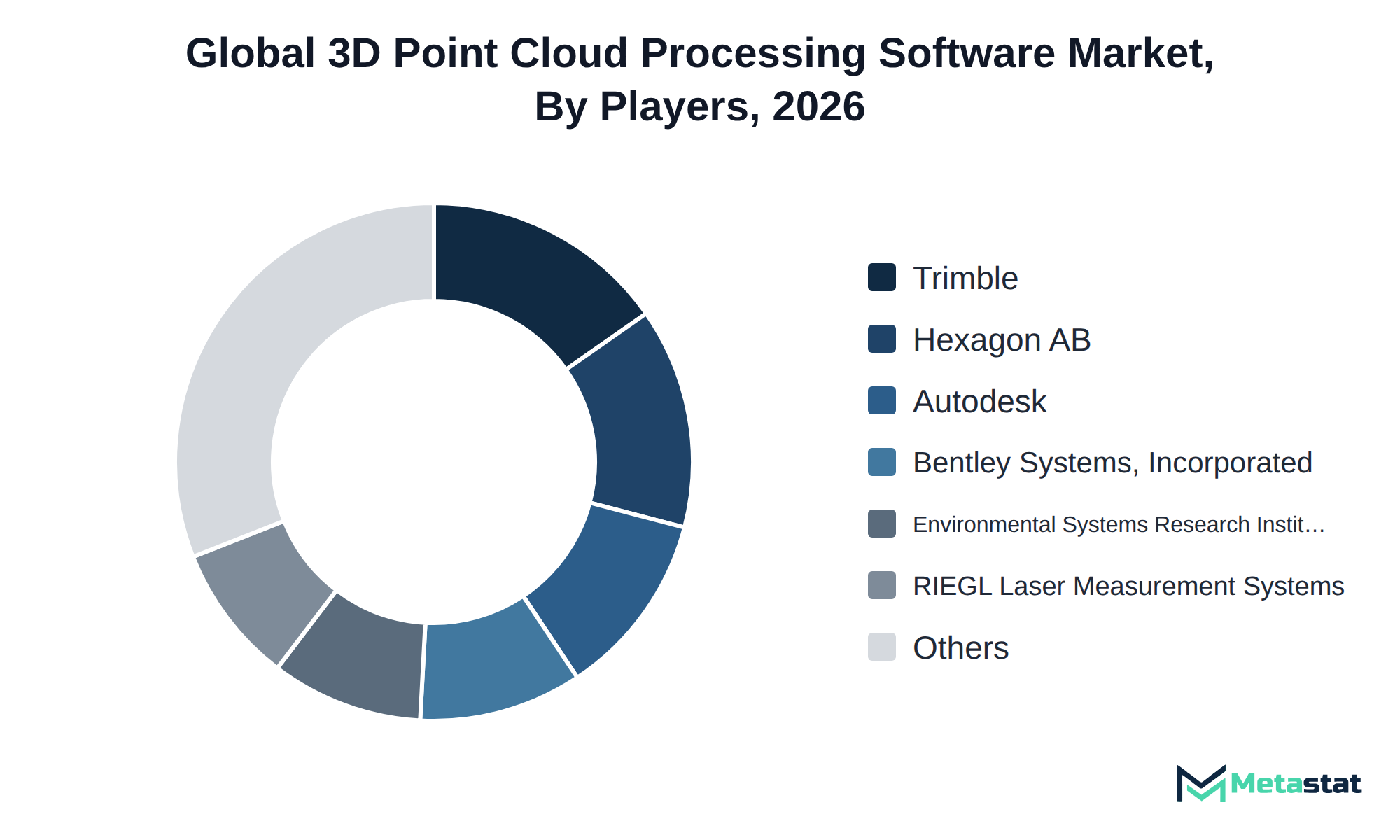
Trimble Inc. focuses on delivering solutions tailored for architecture, engineering, and construction, demonstrating capabilities in CAD and BIM reconstruction. Autodesk, Inc. emphasizes cloud-based offerings, enhancing accessibility and collaboration for users. RIEGL Laser Measurement Systems GmbH specializes in LiDAR point clouds, addressing the growing demand for precise measurement and mapping solutions in various industries.
Achieving this growth relies on several key developments within the 3D Point Cloud Processing Software market. The expansion of cloud-based deployment models is expected to drive significant adoption, supported by a projected CAGR of 14.3%. This shift towards cloud solutions particularly benefits the manufacturing and architecture, engineering and construction sectors, where flexibility and scalability enhance operational efficiency. Advancements in LiDAR point cloud technology, slated for a CAGR of 9.2%, will further support market growth. This segment serves critical industries including surveying and geospatial services, which increasingly rely on high-resolution data for precise mapping and analysis.
Challenges remain that could impede progress towards the forecasted value. Regulatory hurdles and data privacy concerns slow the uptake of cloud-based solutions, particularly in regions like Europe, where stringent regulations exist. Addressing these issues will be essential for maintaining momentum in the market. Technological advancements and strategic adoption across key industries will shape the 3D Point Cloud Processing Software market over the next several years.
By Deployment Model: On-Premises, Cloud-Based, Hybrid
By Point Cloud Source: LiDAR Point Clouds, Image-Based Point Clouds, Others (Structured-Light and RGB-D Point Clouds)
By Application: Registration and Preprocessing, Classification and Feature Extraction, Surface and Mesh Reconstruction, CAD and BIM Reconstruction, Measurement and Inspection, Others (Visualization and Format Conversion)
By End-Use Industry: Architecture, Engineering and Construction, Surveying and Geospatial Services, Manufacturing, Energy and Utilities, Mining, Transportation and Logistics, Forestry and Agriculture, Others (Healthcare, Heritage and Public Safety)
The report strategically identifies and profiles the key market players and analyses their core competencies in each sub-segment of the 3D Point Cloud Processing Software market.
|
Report Attributes |
Details |
|
Study Period |
2021-2033 |
|
Base Year |
2025 |
|
Estimated Year |
2026 |
|
Forecast Period |
2026-2033 |
|
Historical Period |
2021-2025 |
|
Growth Rate |
CAGR 10.0% from 2026 to 2033 |
|
Revenue Unit |
USD million |
|
Segmentation |
By Deployment Model, Point Cloud Source, Application, End-Use Industry, and Region |
|
By Region |
North America (By Deployment Model, Point Cloud Source, Application, End-Use Industry, and Country)
|
|
Europe (By Deployment Model, Point Cloud Source, Application, End-Use Industry, and Country)
|
|
|
Asia Pacific (By Deployment Model, Point Cloud Source, Application, End-Use Industry, and Country)
|
|
|
South America (By Deployment Model, Point Cloud Source, Application, End-Use Industry, and Country)
|
|
|
Middle East and Africa (By Deployment Model, Point Cloud Source, Application, End-Use Industry, and Country)
|
Find answers to common questions about this report
The 3D Point Cloud Processing Software market size was valued at USD 942.2 million in 2025.
The market is projected to grow at a CAGR of 10.0% during the forecast period from 2026 to 2033.
The North America 3D Point Cloud Processing Software market size is estimated to reach USD 676.8 million by 2033.
The leading segment in the 3D Point Cloud Processing Software market is LiDAR Point Clouds, with a projected value of USD 1,347.4 million by 2033. This segment surpasses others in terms of revenue growth and market share.
Growing investments in infrastructure projects drive demand for 3D Point Cloud Processing Software, particularly in architecture, engineering, and construction. Increased adoption of cloud-based solutions enhances accessibility and scalability, facilitating real-time data analysis and collaboration among project teams.
North America holds the dominant share of the 3D Point Cloud Processing Software market, with a value of USD 676.8 million projected for 2033, representing 36.2 percent of the total market. This region surpasses others in market share, reflecting its strong adoption and investment in advanced technologies.
Price sensitivity significantly limits growth in the 3D Point Cloud Processing Software market. High costs for licenses and implementation deter small to medium-sized enterprises (SMEs) from adopting these solutions. Rising input costs further challenge suppliers, impacting profitability and forcing reassessment of pricing strategies.
Significant growth opportunities arise from the LiDAR Point Clouds segment, projected to increase from USD 729.4 million in 2026 to USD 1,347.4 million by 2033. This expansion is driven by heightened adoption in architecture, engineering, and construction, where precise data capture enhances operational success.
The 3D Point Cloud Processing Software market is estimated to reach a valuation of USD 2,027.7 million by 2033.
Key players operating in the 3D Point Cloud Processing Software market include Trimble Inc., Hexagon AB, Autodesk, Inc., Bentley Systems, Incorporated, AMETEK, Inc., Environmental Systems Research Institute, Inc. (Esri), and YellowScan.
The analysts below cover Information & Technology research at Metastat Insights.
LEAD ANALYST
Utkarsh Khirodkar is a Lead Market Research Analyst at MetaStat Insight, specializing in market intelligence, technology sector assessments, and competitive strategy.

PRINCIPAL CONSULTANT - ENTERPRISE AI & EMERGING TECHNOLOGIES
Banking & Finance · Electronics and Semiconductor · Energy and Power · Healthcare IT · Information & Technology · Professional Services
Vijay Gunti is a Principal Consultant at MetaStat Insight, bringing over two decades of experience across enterprise digital transformation, technology strategy, and intelligent systems.

LEAD CONSULTANT - COMMUNICATION, TELECOM, AND IT
Electronics and Semiconductor · Information & Technology · Machinery & Equipment · Professional Services
Ravindra Sathe Consultants for Communication, Telecom, and IT at MetaStat Insight. He leads the firm's industry research initiatives across telecommunications infrastructure, digital connectivity, enterprise networking, and emerging information technology domains.
The technical breakdown of ISO 20022 migration readiness across correspondent banking corridors was remarkably thorough. Rather than treating cross-border corporate payments as a single block, the report drew a useful distinction between multilateral netting platforms and domestic instant payment rails across ASEAN economies. MetaStat Insight highlighted regulatory constraints on foreign exchange liquidity management that many publications gloss over. The research material offered practical clarity for our platform development roadmap.
Our group needed clearer visibility into out-of-autoclave processing timelines for high-temperature thermoplastic composites. MetaStat Insight delivered an objective assessment that contrasted automated fiber placement scrap rates with traditional thermoset prepreg layup cycles. The supplier landscape mapped out primary resin suppliers and tape slitting capacity across France, Germany, and Japan with solid technical accuracy. Their analyst handled our questions on precursor supply risks during an unscheduled inquiry call, providing clear, unembellished context.
Evaluating sensor fusion reliability across harsh operating environments can be tricky without field-validated data. The study on agricultural autonomous guidance systems clearly separated stereo vision setups from automotive-grade solid-state LiDAR. We appreciated the regional infrastructure analysis, specifically around RTK network density across North America and South America. During our follow-up consultation, the MetaStat Insight team walked through tier-two perception software partnerships, giving our engineering leads a practical basis for vendor shortlisting.
Explore related market intelligence reports worth reading alongside this one.