
LEAD ANALYST
Utkarsh Khirodkar is a Lead Market Research Analyst at MetaStat Insight, specializing in market intelligence, technology sector assessments, and competitive strategy.

Global Enterprise Application Software Market Size, Share, By Deployment Model (Cloud, On-Premises, Hybrid), By Application Type (Enterprise Resource Planning, Customer Relationship Management and Customer Experience, Supply Chain Management, Human Capital Management, Enterprise Performance Management and Financial Close, Procurement and Spend Management, Enterprise Asset Management and Field Service Management, Product Lifecycle Management, Others (Governance, Risk and Compliance Software)), By Organization Size (Large Enterprises and Small and Medium-Sized Enterprises), By End-Use Industry (Banking, Financial Services and Insurance, Manufacturing, Retail and Consumer Goods, Healthcare and Life Sciences, Information Technology and Telecommunications, Government and Public Sector, Energy and Utilities, Transportation and Logistics, Others (Education, Media, Hospitality)), Industry Analysis, Growth, Trends, and Forecast, 2026-2033
Report ID
MSI-5821
Published
November, 2026
Pages
303 Pages
Format
Historical
Base year
Forecast
Forecast period
Report Details
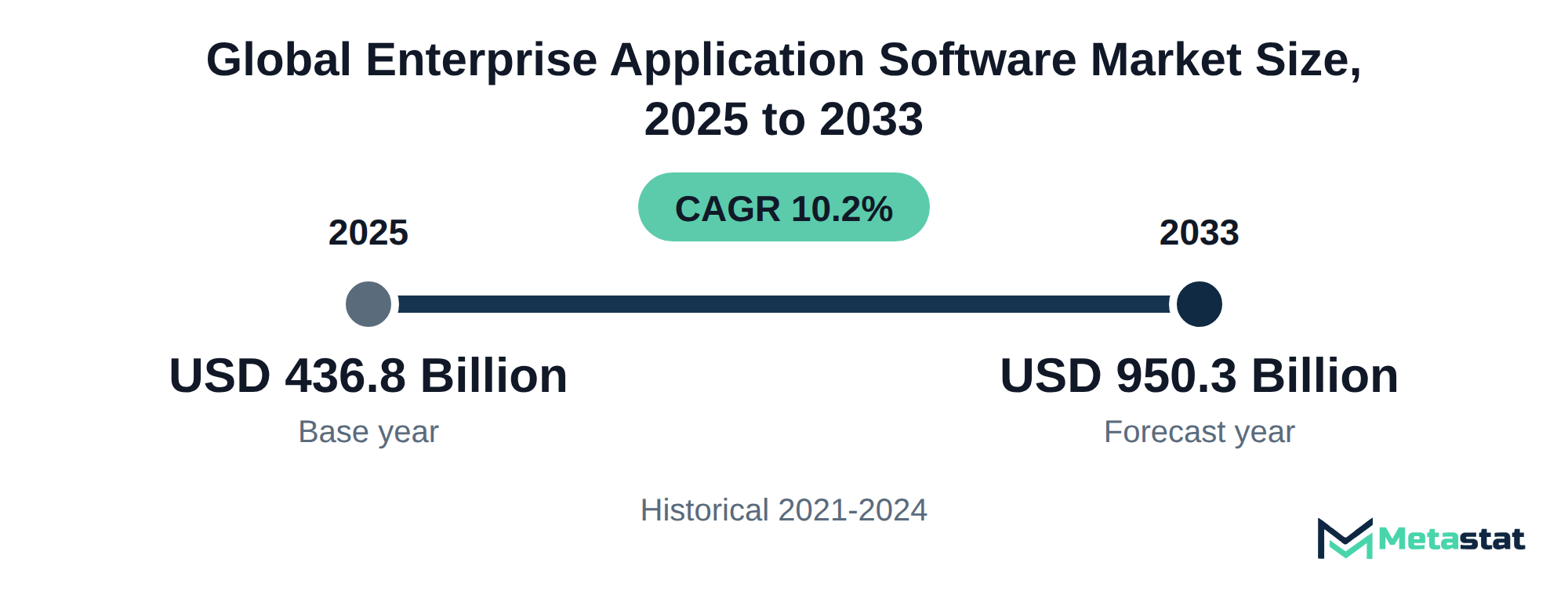
Market Valuation: Valued at $436.8 Billion in 2025, projected to reach $950.3 Billion by 2033 at a 10.2% CAGR.
Dominant Segment: The Cloud deployment model leads the market, driven by a significant shift towards flexible and scalable solutions that enhance operational efficiency.
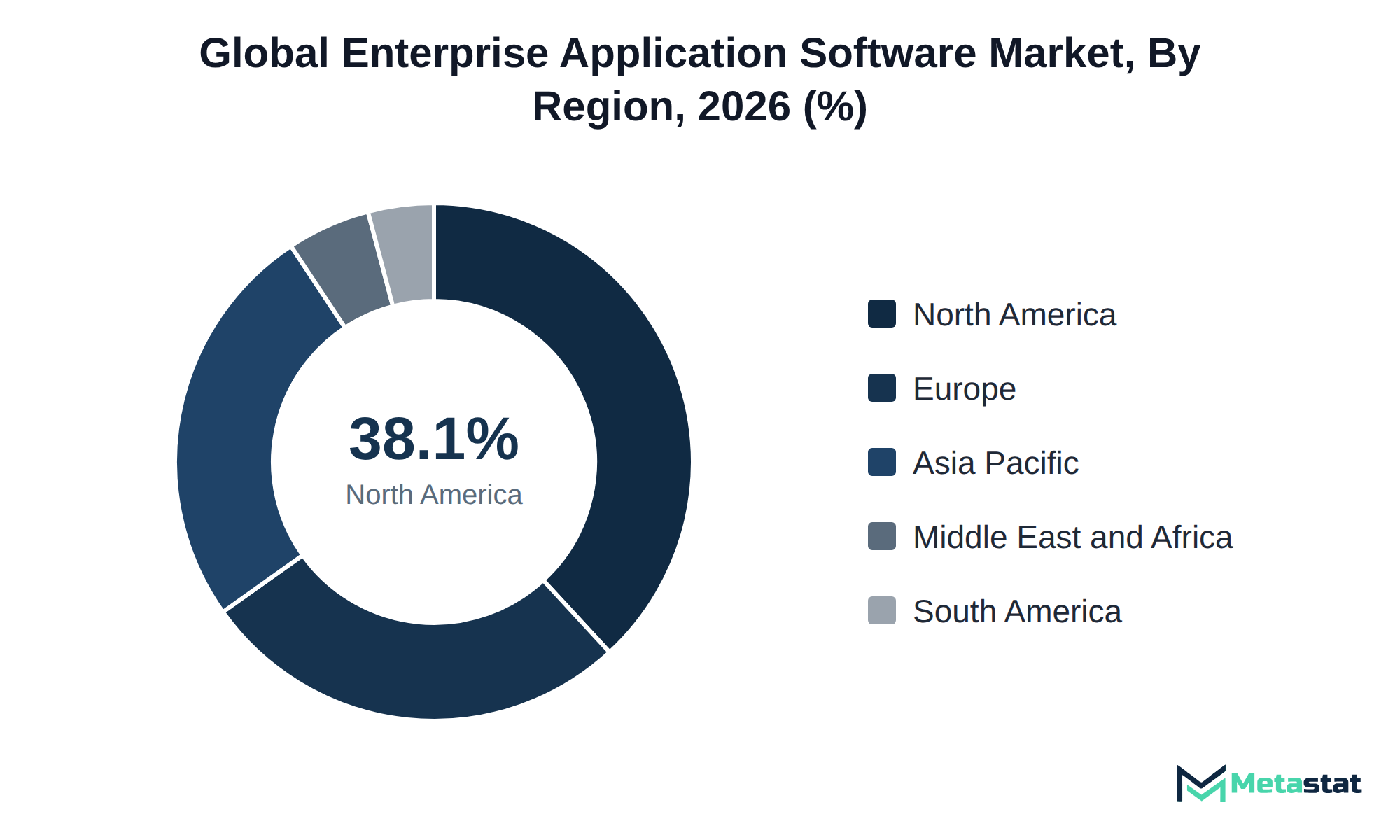
Geographic Lead: North America dominates the market with a 38.1% share in 2025, primarily due to its strong technological infrastructure and high demand for innovative business applications.
What's Inside: The report provides comprehensive competitive coverage, detailed analyses of market dynamics, and forecasts from 2026 to 2033, ensuring a thorough understanding of the market landscape.
Industry-Specific Growth: The Banking, Financial Services, and Insurance (BFSI) sector is projected to grow significantly, expanding from USD 93 billion in 2026 to USD 178.3 billion by 2033, driven by the need for tailored software solutions.
Adoption of AI Technologies: The integration of AI capabilities into enterprise applications enhances operational efficiency, driving demand for sophisticated tools that improve decision-making and customer engagement.
Choose Your License
Global Enterprise Application Software Market
The global Enterprise Application Software market was valued at USD 436.8 billion in 2025 and is projected to reach USD 950.3 billion by 2033, growing at a CAGR of 10.2% over the forecast period.
The Enterprise Application Software market encompasses a range of solutions designed to streamline business processes, enhance operational efficiency, and improve decision-making capabilities across various industries. Buyers invest in these software solutions to address the growing demand for digital transformation, data management, and integration of disparate systems. The ability to leverage advanced technologies, including cloud computing and enterprise artificial intelligence, further supports the adoption of these applications, ensuring organizations remain competitive in a changing environment.
Growth in the market is driven by increasing investment in digitalization, with enterprises seeking to optimize resources and improve customer experiences. The segment generating the highest value is the Cloud deployment model, reflecting a significant shift toward flexible and scalable solutions. North America holds 38.1% of the market in 2025, with the US leading in 2026. This substantial share highlights the region's strong technological infrastructure and high demand for innovative business applications.
Among the various application types, Enterprise Resource Planning stands out for its role in managing core business functions, which further drives demand for integrated solutions. The competitive landscape intensifies as organizations prioritize efficiency and agility, leading to sustained growth in the market. As reliance on data-driven insights grows, enterprise applications become more important to long-term business success.
The Enterprise Application Software market includes various solutions that help organizations optimize their operations and achieve better business outcomes. Buyers invest in these software applications to enhance productivity, improve customer engagement, and facilitate data-driven decision-making. The ongoing digital transformation across industries drives the need for integrated software solutions that address complex business requirements.
Growth in the market is propelled by the increasing adoption of cloud services, which allow organizations to scale their operations efficiently and reduce infrastructure costs. Among the segments, Cloud deployment represents the most significant share, with a projected value of USD 545.7 billion by 2033. North America holds 38.1% of the market in 2025, with the US leading in 2026, highlighting the region's important role in the expansion of enterprise application software.
Demand for enterprise resource planning systems continues to rise because they help organizations standardize processes and enhance operational efficiency. This trend indicates strong growth potential for the Enterprise Application Software market, particularly among large enterprises that need full-scale solutions to manage complex operations.
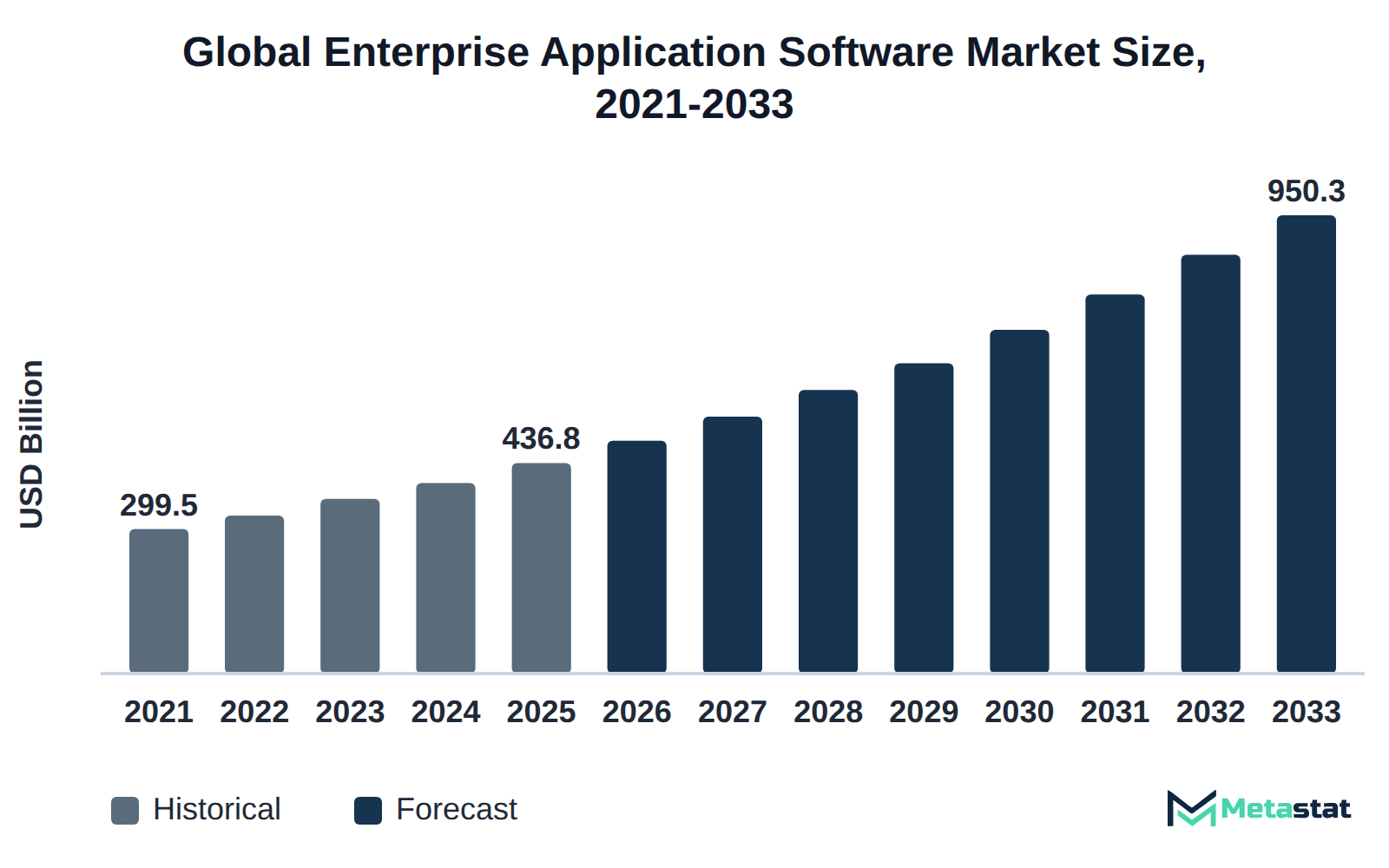
Cloud-native enterprise applications are changing how organizations adopt Enterprise Resource Planning (ERP), Customer Relationship Management (CRM), and Human Capital Management (HCM) solutions. This transformation arises from the rising adoption of cloud deployment models, with the cloud segment projected to achieve a value of USD 545.7 billion by 2033, reflecting a compound annual growth rate (CAGR) of 12.2%. Such growth indicates a strong movement toward solutions that provide scalability, flexibility, and cost-efficiency.
Businesses increasingly prioritize cloud-native solutions, facilitating integration and real-time data access. This shift aligns particularly well with large enterprises, which are expected to reach USD 544.1 billion by 2033 in their adoption of these applications. Enhanced operational efficiency resulting from cloud-native adoption drives competitive advantages across industries.
The demand for cloud-based ERP, CRM, and HCM systems indicates a significant evolution in how organizations manage their processes. The Enterprise Application Software market is embracing this trend, and companies use modern technologies to accelerate digital transformation, improve customer engagement, and strengthen overall business performance.
The integration of AI-driven automation and predictive analytics in the Enterprise Application Software market has reshaped purchasing and payment models. Organizations increasingly adopt subscription-based pricing strategies, allowing for flexibility and scalability. In 2026, the market is expected to reach USD 482.6 billion, reflecting a shift towards more dynamic purchasing arrangements that accommodate varying organizational needs.
By transitioning to subscription models such as enterprise software-as-a-service, buyers access updates and enhancements without the burden of large upfront costs associated with traditional licensing. This approach creates a more predictable budget for enterprises, enabling better financial planning and investment in other critical areas.
The shift towards AI-driven solutions and flexible pricing allows organizations to innovate and adapt, enhancing operational efficiency. Effective spending strategies combined with advanced technologies give businesses opportunities to optimize workflows and drive growth.
Adoption of industry-specific enterprise application software is accelerating in the Banking, Financial Services, and Insurance (BFSI), Manufacturing, and Healthcare sectors. This trend reflects the unique operational needs of these industries, driving demand for tailored solutions that enhance efficiency and compliance. For example, the BFSI sector is projected to expand from USD 93 billion in 2026 to USD 178.3 billion by 2033, corresponding to a compound annual growth rate (CAGR) of 9.8%. This growth indicates a strong shift toward specialized software designed to address regulatory requirements, risk management, and customer service enhancements.
Within Manufacturing, enterprises increasingly require software that streamlines processes and supports smart manufacturing through advanced technologies including IoT and AI. The sector's transition toward automation and data-driven decision-making necessitates solutions that offer real-time analytics and supply chain management capabilities. With the Manufacturing segment anticipated to reach USD 169.5 billion by 2033, companies prioritize investments in software that drive operational excellence and competitive advantage.
Healthcare and Life Sciences experience a significant uptick in software adoption, influenced by the need for improved patient care and regulatory compliance. Solutions that facilitate electronic health records, patient management, and billing processes are becoming critical. The demand for specialized healthcare software is reflected in the sector’s increasing focus on technology that enhances both operational efficiency and patient satisfaction. The Enterprise Application Software market is evolving to meet these needs and supporting growth and innovation across these industries.
Hybrid deployment models significantly influence investment decisions in the Enterprise Application Software market by offering flexibility and scalability. Organizations benefit from the ability to combine on-premises infrastructure with cloud solutions, addressing unique operational requirements while optimizing costs. The hybrid model allows businesses to manage sensitive data securely on-site while leveraging the cloud for applications that demand increased computational power.
In 2033, the hybrid deployment model is projected to reach USD 193.9 billion, reflecting a growing preference among enterprises for this flexible approach. The dual capability of hybrid models supports a tailored strategy, accommodating both immediate needs and long-term growth objectives. Organizations are more willing to invest in enterprise software that aligns with their specific operational frameworks.
The shift towards hybrid deployment models intensifies competition among software providers and pushes them to innovate and offer solutions that work across environments. This trend influences investment in advanced technologies that further streamline operations, ultimately positioning the market for growth.
Large enterprises increasingly adopt cloud-based solutions to enhance operational flexibility and scalability. This shift results from demands for improved remote access and collaboration tools, driving higher spending on Enterprise Application Software. The transition to cloud environments allows organizations to reduce their on-premises infrastructure costs while ensuring effective integration across various applications. The cloud deployment model reflects a compound annual growth rate of 12.2%, indicating significant growth potential within the market. Enterprises use cloud solutions to optimize resources, streamline processes, and respond faster to market changes. This trend boosts demand for cloud-based applications, leading to broader acceptance of digital transformation initiatives across industries.
The ongoing increase in remote work arrangements has accelerated the shift toward cloud adoption, with businesses recognizing the importance of agility and innovation in their operational strategies. The demand for enterprise applications that operate efficiently in cloud environments continues to reshape the Enterprise Application Software market.
The integration of artificial intelligence capabilities into enterprise application software improves operational efficiency and optimizes user experiences. These advancements streamline processes, enabling organizations to extract valuable insights from data, improve decision-making, and enhance overall performance. AI-driven technologies significantly enhance customer relationship management systems by providing predictive analytics that inform sales strategies and improve customer engagement. The financial services sector increasingly embraces these technologies, leading to heightened demand for sophisticated tools that automate routine tasks and enhance compliance. This focus on AI gives organizations that deploy these solutions effectively a competitive advantage. The ongoing development of AI functionalities within the market supports sustained growth, enabling firms to adapt quickly to changing consumer expectations and market dynamics. This strategic shift enhances investment in AI-enhanced solutions, propelling the market toward a forecasted value of USD 950.3 billion by 2033.
Price sensitivity poses a significant restraint on the Enterprise Application Software market, particularly affecting small and medium-sized enterprises (SMEs). These organizations operate with tighter budgets and face challenges in justifying the investment in comprehensive software solutions. High initial costs associated with many software deployments lead to slower uptake among SMEs, resulting in smaller orders and delayed replacement of legacy systems. Many SMEs prioritize cost-effective alternatives or basic functionalities, which further hinders the market's growth potential. This trend creates an environment where software providers consider pricing strategies that appeal to budget-conscious buyers while maintaining the quality and functionality of their offerings. Consequently, overall revenue growth in the market experiences constraints, particularly in segments focused on serving smaller businesses.
The increasing cost of talent presents a significant challenge for suppliers in the Enterprise Application Software market. Companies face higher salaries and competitive recruitment as skilled professionals become more sought after. This situation forces suppliers to adjust their operational strategies, including investing in employee training and development to improve productivity. Several firms implement automation technologies to reduce reliance on manual processes while improving service delivery efficiency. Remote work and flexible arrangements attract a wider talent pool, reducing the burden of local labor costs. Profit margins are affected due to wage pressures, leading to increased pricing for end-users. Suppliers seek innovative ways to balance these costs while remaining competitive. The demand for highly skilled professionals continues to grow, driving operational adjustments within the market. Strategic partnerships and educational programs help bridge skill gaps and build a more sustainable workforce.
Cloud deployment models represent a significant growth opportunity within the market, driven by an increasing preference for scalability, flexibility, and cost-effectiveness. This growth reflects ongoing digital transformation across various industries where organizations seek to streamline operations and enhance collaboration.
Large enterprises, in particular, show a strong inclination toward cloud solutions to optimize their processes and improve overall efficiency. By leveraging these models, companies reduce infrastructural costs, enhance security, and gain access to real-time data analytics. The urgency for remote work capabilities and improved business continuity has further accelerated the shift to cloud-based enterprise application software. This trend positions cloud solutions as a key driver of growth within the market, addressing the evolving needs of businesses worldwide.
The Global Enterprise Application Software market is segmented based on Deployment Model, Application Type, Organization Size, and End-Use Industry.
This segment serves organizations aiming to enhance operational flexibility, reduce overhead costs, and leverage scalable resources. Businesses across various industries, including large enterprises and small and medium-sized enterprises, adopt cloud solutions to streamline processes and improve overall efficiency. Increased demand for remote work capabilities and real-time data access significantly influences this segment. Compared to on-premises and hybrid models, cloud solutions demonstrate higher growth potential driven by an ongoing shift toward digital transformation. The cloud segment differentiates itself through its capacity for rapid scaling and enhanced collaboration features that appeal to various business sizes.
The On-Premises segment is estimated to reach USD 210.8 billion by 2033, at a CAGR of 6% during the forecast period. This deployment model serves businesses that require software hosted on their own servers, providing greater control over data and compliance. Large enterprises, particularly in regulated industries including banking and healthcare, often favor this model to maintain stringent security and data management standards. The slower growth rate of this segment reflects a shift toward cloud solutions, which offer scalability and lower upfront costs. However, several organizations remain committed to on-premises solutions due to high costs associated with transitioning to cloud-based systems. The On-Premises segment is expected to continue serving a niche market while overall demand for enterprise application software evolves.
Hybrid deployment models are expected to reach USD 193.9 billion by 2033. These models combine cloud and on-premises solutions, providing organizations with flexibility and scalability. Enterprises leverage hybrid models to balance control and accessibility, which is suitable for industries including healthcare and finance where data sensitivity is critical. Demand for hybrid solutions is driven by the need for customization and integration with existing systems, allowing companies to transition gradually without significant disruptions. Compared to cloud-only or on-premises segments, hybrid models experience slower growth, influenced by higher costs associated with infrastructure maintenance and integration complexities. The hybrid segment's growth trajectory is anticipated to remain robust due to increasing preference for flexibility in IT infrastructure, supporting various operational needs and promoting effective resource management across the market.
Enterprise Resource Planning segment is valued at USD 97.4 billion in 2026 and is projected to reach USD 182.8 billion by 2033, at a CAGR of 9.4% during the forecast period. This software segment aids organizations in managing and integrating core business processes, including finance, supply chain, and human resources. Large enterprises primarily adopt this segment to enhance efficiency and streamline operations. Demand for Enterprise Resource Planning software experiences upward momentum due to the increasing necessity for real-time data analysis and improved decision-making capabilities. Compared to other application types, this segment exhibits slower growth, driven by higher implementation costs and complexity. Nevertheless, its functionality and strategic importance to operational excellence make it a key investment for organizations aiming for sustained growth. The market continues to evolve, with a focus on integrating emerging technologies to address unique organizational challenges.
Customer Relationship Management and Customer Experience segment is estimated to reach USD 178.3 billion by 2033, at a CAGR of 10.5% during the forecast period. This segment focuses on enhancing customer interactions and experiences, primarily by businesses across various industries to build and maintain strong relationships with their clients. The ongoing digital transformation, driven by the need for personalized customer engagement, significantly influences this segment. Firms increasingly seek advanced tools that provide insights into customer behavior and preferences. Compared to other segments, this segment exhibits a faster growth trajectory, outperforming the Human Capital Management segment, which has a CAGR of 11.1%. This blend of customer analytics and engagement strategies sets it apart from other application types and supports better customer experiences and growth within the market.
Supply Chain Management segment is expected to reach USD 128.1 billion by 2033. This segment focuses on optimizing the flow of goods, services, and information throughout the supply chain, serving industries including manufacturing, retail, and logistics. Demand for enhanced visibility and control over supply chain processes drives growth in this segment. The increasing complexity of global supply chains necessitates advanced solutions that facilitate real-time tracking and analytics. Compared to other application types, Supply Chain Management exhibits significant growth, supported by a growing emphasis on efficiency and cost reduction strategies. This segment typically experiences faster adoption rates among large enterprises that prioritize integration and automation, distinguishing it from the Human Capital Management segment, which experiences a lower growth trajectory.
Human Capital Management segment is projected to grow at a CAGR of 11.1% during the forecast period. This segment focuses on software solutions that assist organizations in managing their workforce, including recruitment, onboarding, performance management, and employee engagement. Companies across various industries employ these tools to enhance their talent management strategies, aiming to improve employee productivity and retention rates. The increasing emphasis on workforce analytics drives demand, enabling organizations to make data-driven decisions regarding human resources. This segment differentiates itself from others by experiencing a faster growth rate compared to alternatives like Supply Chain Management, which does not match its 11.1% CAGR. Pricing pressure influences adoption, particularly among several small and medium-sized enterprises seeking cost-effective solutions within the Enterprise Application Software market.
Enterprise Performance Management and Financial Close encompasses solutions designed to streamline and enhance the financial planning, analysis, and reporting processes within organizations. This segment finds extensive use among finance departments across various industries, enabling businesses to improve accuracy, compliance, and decision-making. Key demand drivers for this segment include increasing regulatory requirements and a growing emphasis on real-time financial insights. In comparison to other application types, this segment attracts a more specialized buyer group, often involving larger enterprises that require advanced functionalities. The focus on regulatory compliance and performance optimization differentiates it from segments like Supply Chain Management, which experiences faster growth due to broader applicability across diverse industries. Overall, the dynamics within the Enterprise Application Software market reflect a strong inclination toward enhancing financial operations through specialized software solutions.
Procurement and Spend Management focuses on streamlining purchasing processes and optimizing expenditure across organizations. This segment serves large enterprises and small and medium-sized enterprises, enabling them to enhance visibility into spending patterns and supplier performance. Demand for advanced analytics and real-time insights drives growth within this segment, promoting informed decision-making in procurement strategies. Unlike other segments, including Customer Relationship Management, which experience faster growth rates, Procurement and Spend Management maintains steady demand due to its essential role in ensuring cost efficiency. Organizations prioritize this segment to manage resources effectively and respond to changing market conditions, balancing operational costs while achieving procurement objectives.
Enterprise Asset Management and Field Service Management focuses on optimizing the utilization of an organization's assets and streamlining field operations. This application type serves industries including manufacturing, utilities, and transportation, where efficient asset management directly correlates with operational effectiveness. Demand for this segment arises from organizations seeking to minimize downtime and extend asset lifespan, reflecting a critical investment in technology that enhances productivity. Compared to other application types, including Customer Relationship Management, this segment experiences slower growth, driven by complex implementation processes and specific industry requirements. The need for specialized skills and the integration of advanced technologies, including IoT and predictive analytics, further influences adoption rates. This segment stands out within the Enterprise Application Software market due to its focus on operational efficiency and asset optimization.
Product Lifecycle Management (PLM) encompasses the processes and tools that support the entire lifecycle of a product, from inception through engineering design and manufacturing to service and disposal. PLM solutions enhance collaboration across various departments, including engineering, manufacturing, and marketing, ensuring that all stakeholders have access to the most current product data. Industries including manufacturing and retail rely on PLM to streamline operations and improve product quality.
Demand for PLM solutions is driven by the increasing complexity of products and the need for greater collaboration across global teams. Tightening regulations in product safety and environmental standards further increase the importance of effective lifecycle management. Compared to other segments within application types, PLM often sees slower growth rates due to the substantial investment required for implementation and integration. Organizations prioritize effective PLM solutions to remain competitive in the marketplace, using these tools to promote innovation and reduce time to market.
Governance, Risk and Compliance Software encompasses a range of tools designed to help organizations manage and adhere to regulations, mitigate risks, and maintain compliance with industry standards. This segment is used by various sectors, including finance, healthcare, and manufacturing, where regulatory adherence and risk management are critical. Demand for these solutions is driven by increasing regulatory requirements and the need for organizations to protect their data and operational integrity. Compared to other application types, this segment often experiences slower growth due to complexities surrounding regulatory environments and the need for ongoing updates to software in line with changing regulations. Market dynamics in this segment differ from enterprise resource planning and customer relationship management, which typically exhibit higher growth rates and broader adoption across various organizational sizes.
Large Enterprises segment is valued at USD 295.8 billion in 2026 and is projected to reach USD 544.1 billion by 2033, at a CAGR of 9.1% during the forecast period. This segment targets large organizations, which often require robust and scalable solutions to manage complex operational processes. Enterprises actively invest in applications that enhance efficiency, streamline operations, and support strategic decision-making. The rising need for integrated systems drives demand in this segment, particularly in industries including banking, financial services, and manufacturing. Compared to small and medium-sized enterprises, Large Enterprises face higher pricing due to the customization and support required. Consequently, this segment experiences strong growth, with a higher CAGR of 9.1% compared to the slower growth rates observed in smaller organizations. The increasing emphasis on digital transformation fuels the expansion of the Enterprise Application Software market, particularly in the Large Enterprises segment.
Small and Medium-Sized Enterprises segment is estimated to reach USD 406.2 billion by 2033, at a CAGR of 11.7% during the forecast period. This segment serves various industries, including retail, healthcare, and hospitality, providing essential software solutions that enhance operational efficiency and streamline business processes. Growing awareness of the benefits of digital transformation drives demand, while budget constraints influence purchasing decisions. Unlike large enterprises, small and medium-sized enterprises prioritize cost-effective solutions and rapid implementation. The increasing focus on cloud-based solutions presents significant opportunities for suppliers targeting this demographic, reflecting broader trends observed in the Enterprise Application Software market.
The Banking, Financial Services and Insurance segment is valued at USD 93 billion in 2026 and is projected to reach USD 178.3 billion by 2033, at a CAGR of 9.8% during the forecast period. This segment primarily serves financial institutions, insurance companies, and banking organizations, focusing on streamlining operations, enhancing customer experiences, and ensuring compliance with regulatory requirements. Regulatory pressures and the demand for improved digital services, including banking software that supports compliance and customer service, drive growth in this sector. Compared to other segments, this segment exhibits a moderate growth rate, with a CAGR of 9.8%, distinguishing it from faster-growing sectors like Customer Relationship Management and Customer Experience, which anticipate a CAGR of 10.5%. The adoption of innovative technologies, including artificial intelligence and advanced analytics, supports operational efficiency and improves risk management strategies, contributing to the segment’s growth trajectory in the Enterprise Application Software market.
The manufacturing segment is estimated to reach USD 169.5 billion by 2033, at a CAGR of 10.6% during the forecast period. This segment includes various applications that facilitate production planning, scheduling, and quality control essential for manufacturing firms. Key players in this segment include manufacturers of consumer goods, automotive, and electronics, focusing on improving operational efficiency and reducing costs. The growing demand for automation and data-driven insights drives the adoption of enterprise application software in this sector. This segment experiences higher growth compared to others due to the increasing need for advanced technologies, including IoT and AI, which transform manufacturing processes. Manufacturers face challenges integrating new systems with existing infrastructure, influencing decision-making regarding software investments. Manufacturing represents a vital area of focus in the Enterprise Application Software market, reflecting ongoing technological advancements and evolving industry needs.
The Retail and Consumer Goods segment is expected to reach USD 138.9 billion by 2033. This segment serves retailers and consumer goods manufacturers by providing solutions that manage operations, inventory, customer relationships, and sales processes. Strong demand for data analytics and real-time insights drives adoption in this sector, enabling businesses to enhance decision-making and customer engagement. With a CAGR of 10.6%, this segment experiences faster growth compared to several counterparts, driven by the increasing emphasis on e-commerce and digital transformation strategies. Unlike other segments, the Retail and Consumer Goods sector faces unique challenges related to rapidly changing consumer preferences, necessitating agile solutions tailored to meet diverse market demands. This segment significantly influences overall trends within the Enterprise Application Software market.
The Healthcare and Life Sciences segment is projected to grow at a CAGR of 11.1% during the forecast period. This segment caters to hospitals, pharmaceuticals, and healthcare organizations, focusing on solutions that enhance patient care, streamline operations, and ensure regulatory compliance. Key demand drivers include the increasing need for digital transformation and the urgency for improved patient outcomes. Enhanced data analytics capabilities and cloud-based solutions drive adoption, enabling organizations to offer personalized healthcare services. Compared to other segments, this segment experiences a faster growth rate, reflecting a shift towards technology-driven healthcare solutions. The rising complexity of regulatory requirements and the necessity for effective integration between systems further influence the investment decisions of stakeholders in this industry. By 2033, the market for this segment is expected to reach a significant value, highlighting its importance within the broader market.
The Information Technology and Telecommunications segment encompasses the technologies and services that facilitate communication and data management for businesses and individuals. Organizations engaged in sectors including internet services, software development, and telecommunications apply these applications to enhance operational efficiency and customer interaction. Key demand drivers include ongoing digital transformation across industries and increasing demand for integrated communication solutions. This segment experiences rapid growth compared to others due to its critical role in supporting emerging technologies, including cloud computing and artificial intelligence. Organizations prioritize these solutions for their ability to streamline operations and improve user experience, which distinguishes this segment within the Enterprise Application Software market.
This segment encompasses solutions tailored for governmental functions and public administration. Its applications address the specific requirements of public sector entities, including regulatory compliance, public safety, and community services. A significant force impacting this segment involves increasing governmental demand for transparency and accountability, driving technology adoption to enhance operational efficiency. Regulatory requirements influence procurement decisions, necessitating solutions that ensure compliance and facilitate data management. This segment exhibits different dynamics compared to others, focusing on security and compliance, which leads to longer decision-making processes. The market faces unique challenges due to budget constraints and the need for robust security measures, distinguishing it from faster-growing segments driven by consumer demand.
Energy and Utilities focuses on managing and optimizing resources in the energy sector, including electricity, gas, and water services. This segment serves utilities companies that operate in generation, transmission, and distribution, allowing them to enhance operational efficiency and regulatory compliance. One critical factor influencing this segment involves the transition toward renewable energy sources, which increases demand for advanced software solutions to integrate and manage these resources effectively. Unlike other segments, Energy and Utilities faces unique regulatory challenges, necessitating specialized applications that address compliance requirements and operational complexities. The market emphasizes leveraging technology to improve service delivery and asset management, distinguishing this segment from others that prioritize different operational goals.
Transportation and Logistics focuses on the movement of goods and services from suppliers to consumers, playing a critical role in global trade. Companies in this sector employ enterprise application software to enhance supply chain management, streamline operations, and improve shipment tracking. Key drivers include the increasing demand for efficient logistics solutions and the growing emphasis on digital transformation. Organizations seek to optimize their operations, leading to heightened interest in software that enhances visibility and accuracy in logistics processes. Compared to other segments, Transportation and Logistics faces unique challenges related to regulatory compliance and fluctuating fuel costs, which impact operational expenses. Given its focus on efficiency and cost savings, this segment remains a vital area for investment in the enterprise application software market.
This segment includes solutions for educational institutions, media companies, and hospitality businesses, focusing on enhancing operations, improving customer engagement, and managing resources effectively. Educational institutions leverage enterprise application software for student management systems, learning management systems, and administrative processes. Media companies employ software to manage content distribution, advertising, and analytics. The hospitality sector employs these solutions for reservation systems, customer relationship management, and operational efficiency. Demand for this segment is driven by increasing digital transformation initiatives across these industries, requiring integrated systems to streamline operations and enhance customer experiences. Unlike other segments, including banking or manufacturing, the growth rate in this category reflects a diverse set of applications and user needs, resulting in unique challenges and opportunities. The Enterprise Application Software market is anticipated to see continued interest in these tailored solutions, aligning with industry-specific requirements.
Based on geography, the Global Enterprise Application Software market is divided into North America, Europe, Asia-Pacific, South America, Middle East, and Africa.
Demand for enterprise application software in North America derives primarily from large enterprises, particularly in the banking, financial services and insurance, manufacturing, and healthcare sectors. The presence of advanced technological infrastructure supports rapid adoption of cloud-based solutions. North America represents a significant portion of the global market share in 2025, reflecting the region's substantial investment in digital transformation initiatives. Regulations focused on data security and compliance drive organizations to implement robust enterprise application solutions, enhancing operational efficiency. The market is projected to reach USD 350.1 billion by the end of 2033, indicating strong growth potential driven by increasing demand for integrated software solutions.
The European market exhibits a strong focus on sectors including banking, manufacturing, and healthcare, which drive demand for advanced software solutions. Countries including Germany, France, and the UK demonstrate robust investments in digital transformation initiatives, enhancing operational efficiency and customer engagement. The integration of regulatory standards across Europe contributes to the need for comprehensive software solutions that ensure compliance and streamline processes. By 2025, the region represents 27.0% of the global market. Growth opportunities arise from the increasing adoption of cloud-based deployment models, facilitating remote work and improving accessibility for organizations of various sizes. The Enterprise Application Software market is expected to evolve, reflecting the region's commitment to technological advancement and innovation.
The Asia-Pacific region accounts for 25.5% of the global market in 2025. Strong demand arises from industries including banking, manufacturing, and retail, driven by ongoing digital transformation initiatives across countries. In particular, China and India exhibit rapid adoption of cloud-based solutions, enhancing operational efficiencies and customer interactions. Infrastructure investment in technology and telecommunications supports this growth, creating a competitive environment for various applications. Regulatory frameworks encourage innovation and compliance, which further stimulates the market. Australia and Southeast Asia are notable for their increasing focus on Human Capital Management solutions, reflecting a broader trend of prioritizing workforce management and development. The Enterprise Application Software market in this region is projected to grow steadily, influenced by evolving buyer requirements and industry dynamics.
In South America, significant demand for the Enterprise Application Software market arises from key industries including banking, manufacturing, and retail. Brazil and Argentina serve as primary markets, with rising digital transformation initiatives influencing purchasing decisions. The focus on enhancing operational efficiency drives the adoption of advanced software solutions. Ongoing developments in infrastructure and technology create opportunities for integration across various sectors. The region reflects a growing recognition of the importance of enterprise software. Investment in cloud-based applications continues to rise, facilitating greater flexibility and scalability for businesses. Overall, the market for enterprise application software in South America is projected to experience steady growth, supported by increasing demand for innovation and efficiency.
In the Middle East and Africa, the market experiences growth driven by increased adoption among large enterprises and rising demand for advanced technology solutions. The banking, financial services, and insurance sector, particularly in Saudi Arabia and the UAE, contributes to market expansion. South Africa emerges as a key player, with substantial investments in technology infrastructure supporting software implementation. The region's share of the global market reflects a steady upward trend. Challenges including regulatory complexities and varying technological maturity levels across countries influence adoption rates. The enterprise application software market continues to evolve, presenting opportunities for vendors to tailor solutions that meet diverse regional requirements.
The Enterprise Application Software market features intense competition among various players, each adopting distinct strategies to capture market share. Companies differentiate themselves based on deployment models, application types, organization size, and end-use industries. Cloud solutions demonstrate significant growth potential, driven by flexibility and scalability, while on-premises models continue to serve traditional sectors requiring stringent data control.
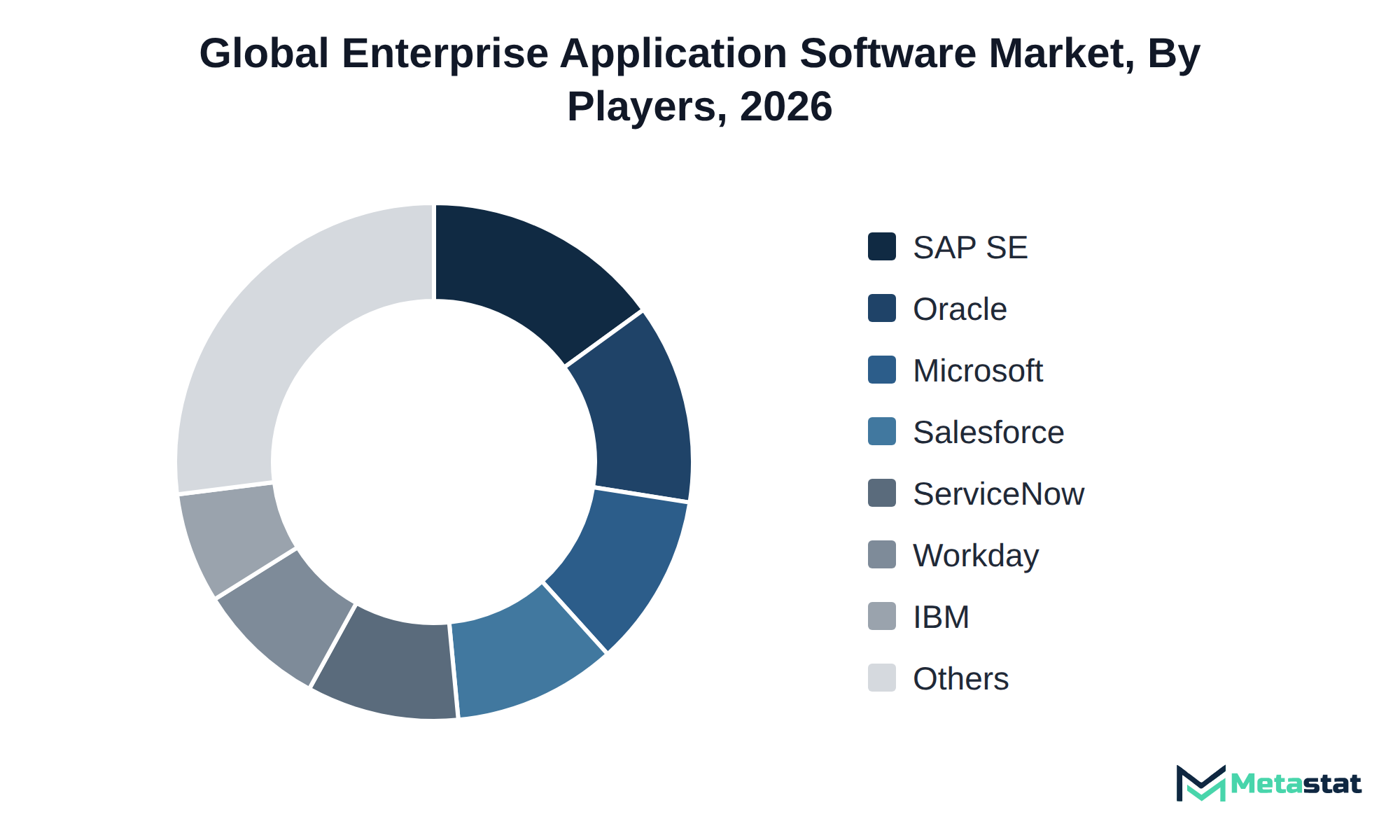
Buyers prioritize factors including price, customization, service quality, and ecosystem compatibility when selecting software solutions. SAP SE excels in Enterprise Resource Planning, focusing on robust integration capabilities. Salesforce, Inc. emphasizes Customer Relationship Management and Customer Experience, providing tailored solutions that enhance client interactions. Microsoft Corporation leverages its extensive ecosystem to integrate applications across various organizational needs.
In the Enterprise Application Software market, companies like Oracle Corporation and Workday, Inc. enhance their competitive positioning through innovative solutions tailored to specific industries, ensuring they meet the dynamic demands of clients.
This growth relies on several key developments within the Enterprise Application Software market. First, the adoption of cloud-based solutions is expected to surge, with a projected market value increase driven by efficiencies and scalability. This trend particularly benefits large enterprises seeking agile solutions to enhance operations.
Second, expanding demand in the Banking, Financial Services and Insurance sector signals substantial market growth. Continued investment in digital transformation and regulatory compliance drives this demand further.
A key risk to achieving the forecasted market size involves potential economic downturns that could restrict IT spending across industries. Such events could particularly impact adoption rates in small and medium-sized enterprises, which contribute significantly to overall demand for enterprise applications.
By Deployment Model: Cloud, On-Premises, Hybrid
By Application Type: Enterprise Resource Planning, Customer Relationship Management and Customer Experience, Supply Chain Management, Human Capital Management, Enterprise Performance Management and Financial Close, Procurement and Spend Management, Enterprise Asset Management and Field Service Management, Product Lifecycle Management, Others (Governance, Risk and Compliance Software)
By Organization Size: Large Enterprises, Small and Medium-Sized Enterprises
By End-Use Industry: Banking, Financial Services and Insurance, Manufacturing, Retail and Consumer Goods, Healthcare and Life Sciences, Information Technology and Telecommunications, Government and Public Sector, Energy and Utilities, Transportation and Logistics, Others (Education, Media, Hospitality)
The report strategically identifies and profiles the key market players and analyses their core competencies in each sub-segment of the Enterprise Application Software market.
Report Attributes | Details |
Study Period | 2021-2033 |
Base Year | 2025 |
Estimated Year | 2026 |
Forecast Period | 2026-2033 |
Historical Period | 2021-2025 |
Growth Rate | CAGR 10.2% from 2026 to 2033 |
Revenue Unit | USD billion |
Segmentation | By Deployment Model, Application Type, Organization Size, End-Use Industry, and Region |
By Region | North America (By Deployment Model, Application Type, Organization Size, End-Use Industry, and Country)
|
Europe (By Deployment Model, Application Type, Organization Size, End-Use Industry, and Country)
| |
Asia Pacific (By Deployment Model, Application Type, Organization Size, End-Use Industry, and Country)
| |
South America (By Deployment Model, Application Type, Organization Size, End-Use Industry, and Country)
| |
Middle East and Africa (By Deployment Model, Application Type, Organization Size, End-Use Industry, and Country)
|
Find answers to common questions about this report
The Enterprise Application Software market size was valued at USD 436.8 billion in 2025.
The market is projected to grow at a CAGR of 10.2% during the forecast period from 2026 to 2033.
The North America Enterprise Application Software market size is estimated to reach USD 350.1 billion by 2033.
The Cloud deployment model leads the Enterprise Application Software market with a projected value of USD 545.7 billion by 2033, significantly surpassing the On-Premises and Hybrid models.
Key drivers for the Enterprise Application Software market include the increasing adoption of cloud-based solutions by large enterprises to enhance operational flexibility and scalability. The integration of artificial intelligence capabilities into enterprise application software improves operational efficiency and optimizes user experiences.
North America holds the dominant share of the Enterprise Application Software market, with a projected value of USD 350.1 billion in 2033, representing 38.1 percent of the total market.
Price sensitivity poses a significant restraint on market growth, particularly affecting small and medium-sized enterprises that operate with tighter budgets. The increasing cost of talent presents a challenge, as higher salaries and competitive recruitment raise operational costs for suppliers.
The increasing preference for cloud deployment models enhances scalability, flexibility, and cost-effectiveness, driving adoption in the Enterprise Application Software market. This trend reflects the ongoing digital transformation across industries, where organizations seek to streamline operations and improve collaboration.
The Enterprise Application Software market is estimated to reach a valuation of USD 950.3 billion by 2033.
Key players operating in the Enterprise Application Software market include SAP SE, Oracle Corporation, Microsoft Corporation, Salesforce, Inc., Workday, Inc., ServiceNow, Inc., and IBM Corporation.
The analysts below cover Information & Technology research at Metastat Insights.
LEAD ANALYST
Utkarsh Khirodkar is a Lead Market Research Analyst at MetaStat Insight, specializing in market intelligence, technology sector assessments, and competitive strategy.

PRINCIPAL CONSULTANT - ENTERPRISE AI & EMERGING TECHNOLOGIES
Banking & Finance · Electronics and Semiconductor · Energy and Power · Healthcare IT · Information & Technology · Professional Services
Vijay Gunti is a Principal Consultant at MetaStat Insight, bringing over two decades of experience across enterprise digital transformation, technology strategy, and intelligent systems.

LEAD CONSULTANT - COMMUNICATION, TELECOM, AND IT
Electronics and Semiconductor · Information & Technology · Machinery & Equipment · Professional Services
Ravindra Sathe Consultants for Communication, Telecom, and IT at MetaStat Insight. He leads the firm's industry research initiatives across telecommunications infrastructure, digital connectivity, enterprise networking, and emerging information technology domains.
Tracking capacity expansion in single-use bioprocessing requires dependable data on raw material availability and cleanroom-grade polymer supply chains. The competitive landscape chapter gave a grounded evaluation of secondary component suppliers across North America and Asia-Pacific rather than simply reprinting press releases. Having that level of supplier benchmarking helped clarify dual-sourcing considerations for our clinical pipeline planning.
When evaluating distributed energy resource management systems, standard research summaries tend to gloss over the operational differences between front-of-the-meter utility deployments and behind-the-meter industrial sites. The MetaStat Insight report addressed those distinctions directly, especially regarding software interoperability standards and grid interconnection backlogs. The five-year market sizing across regional transmission organizations provided actionable context for our grid modernization strategy.
Most industry reports on warehouse automation bundle autonomous mobile robots and fixed conveyor installations into the same top-level numbers, which complicates advisory work. This study split the market cleanly by payload tiers, navigation technology, and fleet management software layers. The regional forecast for Western Europe gave our team defensible adoption benchmarks when evaluating capital allocation for logistics clients, saving us days of secondary data scrubbing.
Explore related market intelligence reports worth reading alongside this one.