
LEAD ANALYST
Utkarsh Khirodkar is a Lead Market Research Analyst at MetaStat Insight, specializing in market intelligence, technology sector assessments, and competitive strategy.

Global Pension Administration Outsourcing Market Size, Share, By Pension Plan Type (Defined Benefit (DB) Plans, Defined Contribution (DC) Plans, Hybrid Pension Plans, Cash Balance Plans, Collective Defined Contribution (CDC) Plans, Others (Multi-Employer Pension Arrangements, Executive Pension Plans)), By Service Type (Pension Recordkeeping and Member Data Management, Pension Benefit Calculation and Payment Administration, Pension Compliance and Regulatory Reporting, Pension Payroll Administration, Member Communication and Engagement Services, Pension Data Migration and Transition Services, Others (Pension Tracing and Data Rectification)), By Plan Sponsor Type (Private-Sector Corporate Employers, Public-Sector and Government Employers, Multi-Employer and Union-Based Pension Schemes, Financial Institutions and Insurance Companies, Master Trusts and Pension Scheme Trustees), By Outsourcing Model (Fully Outsourced Pension Administration, Co-Sourced Pension Administration, Partial or Function-Specific Outsourcing, Third-Party Pension Administration (TPA)), Industry Analysis, Growth, Trends, and Forecast, 2026-2033
Report ID
MSI-5705
Published
November, 2026
Pages
282 Pages
Format
Historical
Base year
Forecast
Forecast period
Report Details
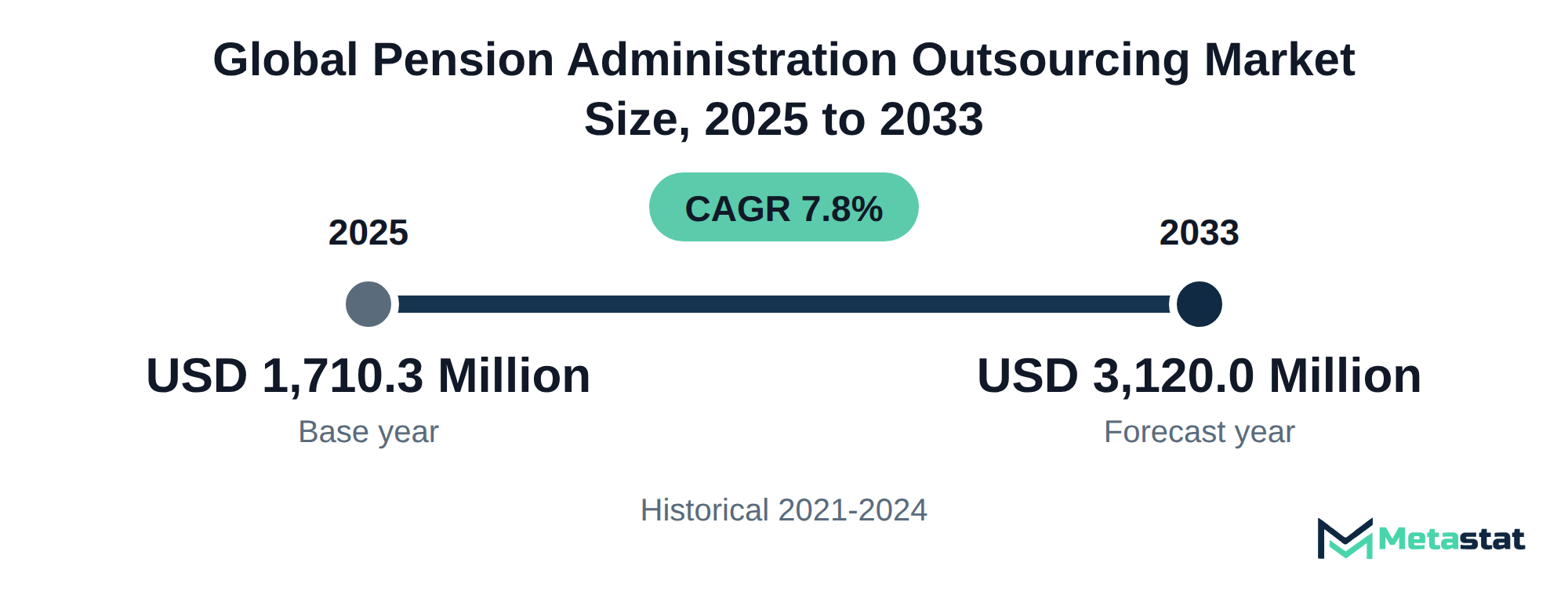
Market Valuation: Valued at $1,710.3 Million in 2025, projected to reach $3,120 Million by 2033 at a 7.8% CAGR.
Dominant Segment: Defined Contribution (DC) Plans lead the market, driven by a shift towards more flexible retirement solutions that cater to evolving workforce demographics.
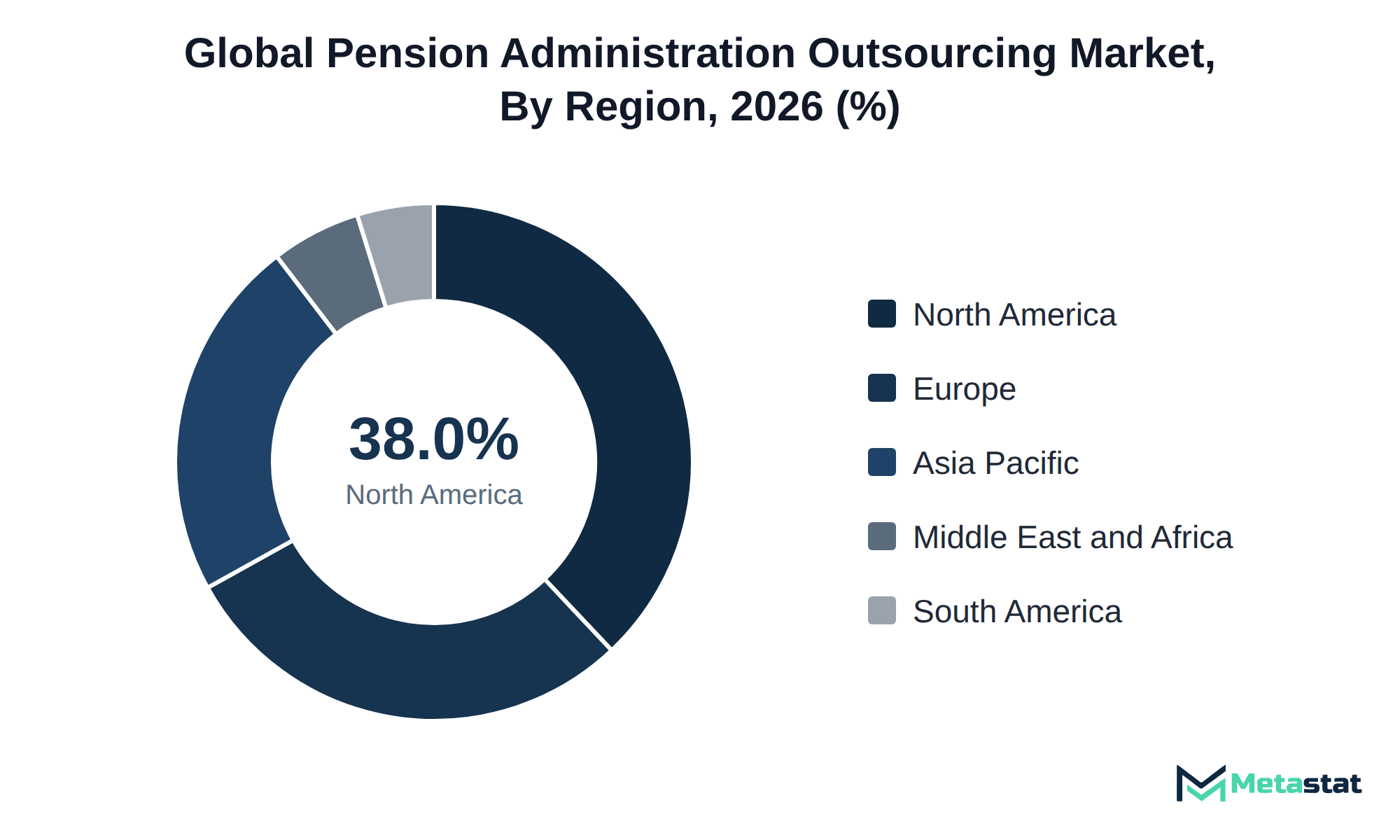
Geographic Lead: North America is the leading region, holding 38.0% of the market in 2025, with the US projected to maintain this lead due to its mature market infrastructure and increasing employer demand for streamlined pension administration.
What's Inside: The report provides comprehensive coverage of market dynamics, competitive analysis, and detailed forecasts for various segments and service types, spanning the period from 2026 to 2033.
Automation and AI Adoption: The integration of automation and AI is reshaping pension recordkeeping and benefit processing, enhancing operational efficiency and accuracy, with a projected CAGR of 7.8%.
Increased Demand from Defined Contributi: The growing interest in DC plans is significantly influencing market spending, with projected revenue reaching USD 992.8 million by 2033, reflecting a broader trend away from traditional defined benefit plans.
Choose Your License
Global Pension Administration Outsourcing Market
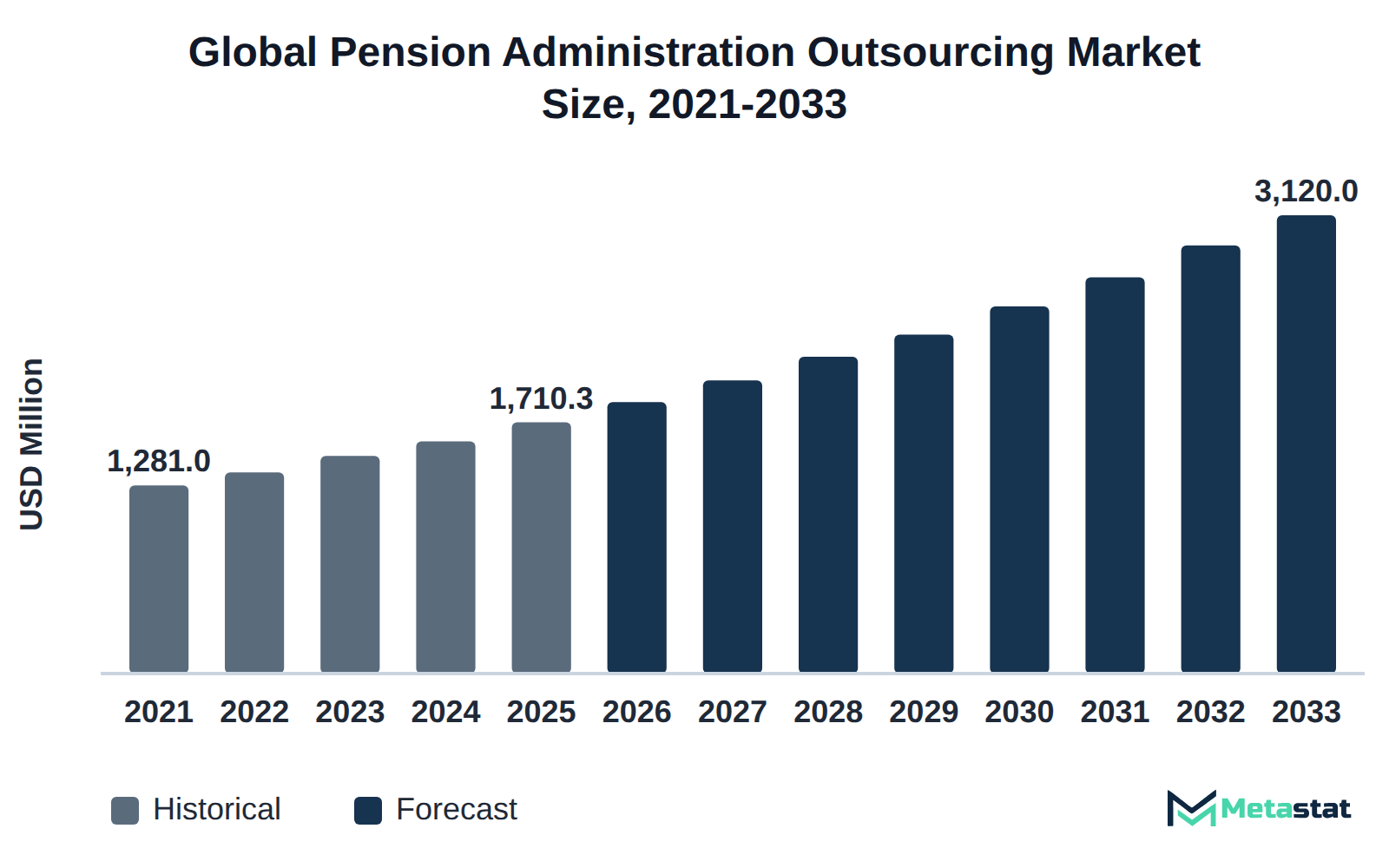
The global Pension Administration Outsourcing market was valued at USD 1,710.3 million in 2025 and is projected to reach USD 3,120 million by 2033, growing at a CAGR of 7.8% over the forecast period.
The Pension Administration Outsourcing market encompasses a range of services designed to assist organizations in managing pension plans efficiently. Buyers invest in these services to improve operational efficiency, ensure compliance with regulations, and enhance member satisfaction. The need for accurate recordkeeping and timely benefit disbursements drives organizations to seek outsourcing solutions, allowing them to focus on their core business activities while minimizing administrative burdens.
Growth in the market is propelled by the increasing complexity of pension regulations and the rising demand for tailored pension solutions. Defined Contribution (DC) Plans represent the segment with the highest value, reflecting a shift in focus from traditional Defined Benefit (DB) Plans to more flexible and adaptable retirement solutions. North America holds 38.0% of the market in 2025, with the US leading in 2026. This region benefits from a mature market infrastructure and a growing number of employers looking to streamline pension administration processes.
Technological advancements drive growth in the Pension Administration Outsourcing market. The integration of digital tools and platforms facilitates more efficient data management and enhances the ability to deliver personalized member services. These innovations support providers in meeting the evolving expectations of clients and their employees, ultimately creating a competitive edge in the market.
The Pension Administration Outsourcing market covers various services, facilitating the management of pension plans through recordkeeping, regulatory compliance, and payment administration. Organizations invest in these services to streamline operations and ensure compliance with evolving regulations, enhancing overall efficiency. Demand for such outsourcing is driven by the growing complexity of pension regulations and the necessity for accurate data management.
Among the segments, Defined Benefit (DB) Plans represent the largest share of the market, reflecting significant investment from organizations aiming to secure obligations to their employees. Demand for pension plan management in this region stems from several established pension funds and a strong focus on compliance and risk management.
One main growth driver includes increasing adoption of technology solutions that enhance the efficiency of pension administration processes. Organizations seek innovative tools that improve data accuracy and reduce manual workload, contributing to the growth of the Pension Administration Outsourcing market. This trend is expected to continue, driven by ongoing digital transformation across various sectors.
The trend in the Pension Administration Outsourcing market indicates a notable shift towards co-sourced pension administration solutions. This preference stems from employers seeking greater control and flexibility over their pension management processes. Co-sourcing allows organizations to maintain oversight while leveraging specialized expertise from outsourcing partners. This hybrid approach supports a balance between operational efficiency and strategic decision-making.
In the context of the market, co-sourced pension administration is projected to reach USD 877.3 million by 2033, reflecting a compound annual growth rate (CAGR) of 8.1%. This growth signals increasing acceptance among employers who prioritize collaboration with service providers. The desire for tailored solutions and the ability to adapt to evolving regulatory requirements drive businesses towards co-sourced options, which offer a blend of in-house and outsourced capabilities.
Organizations embracing co-sourced pension administration benefit from enhanced agility and responsiveness to changes in the regulatory landscape. This adaptability promotes a proactive approach to compliance and risk management, ultimately leading to improved member satisfaction and retention. The shift toward co-sourced models continues to shape employer strategies and the future of pension administration.
Automation and artificial intelligence (AI) increasingly influence the Pension Administration Outsourcing market, particularly in pension recordkeeping and benefit processing. Organizations prioritize streamlined operations and enhanced accuracy to improve overall efficiency. The market reflects this shift, with a projected compound annual growth rate (CAGR) of 7.8% from 2025 to 2033. Integration of automation and AI reduces operational costs and enhances the customer experience through timely and accurate service delivery.
Contract models in the market typically feature a range of pricing structures that vary by service type. For instance, the Pension Recordkeeping and Member Data Management segment is set to grow significantly, from an initial value of USD 497.3 million in 2026 to USD 785.6 million by 2033, reflecting a CAGR of 6.7%. Pricing strategies include fixed fees, variable fees based on usage, and gain-sharing arrangements, enabling clients to select models that align with their financial objectives and operational needs.
Flexibility is a key expectation for buyers entering contracts, with many seeking terms that allow for scalability in service usage. The emergence of hybrid pricing models supports organizations in managing costs effectively while accessing advanced automation technologies. Enhanced contract terms and pricing strategies improve customer satisfaction and retention rates, reinforcing the competitive positioning of service providers within the Pension Administration Outsourcing market.
Compliance requirements in the Pension Administration Outsourcing market are growing more complex, and organizations must keep up with changing rules. Private-Sector Corporate Employers, which hold significant stakes in the market, face substantial pressure to ensure adherence to pension-related legislation. For instance, the projected revenue for this group is expected to reach USD 1,159.4 million by 2033, reflecting a compound annual growth rate (CAGR) of 7.1%. This growth correlates directly with heightened scrutiny on regulatory compliance and the need for robust data security measures.
Organizations that prioritize regulatory compliance enhance their operational resilience and potentially reduce the risk of costly penalties. Some organizations also assess governance, risk and compliance platforms to manage these obligations. Data security is a core part of this framework, and protecting sensitive member data is essential. Failure to address these compliance and security issues leads to significant financial repercussions and reputational damage. In this context, the Pension Administration Outsourcing market presents an opportunity for Private-Sector Corporate Employers to leverage outsourcing solutions that streamline operations and fortify compliance structures.
Digital transformation plays an important role in the Pension Administration Outsourcing market, particularly for Public-Sector and Government Employers. With anticipated revenue growth to USD 805.6 million by 2033 and a CAGR of 7.1%, these organizations seek innovative solutions to enhance their pension administration processes. The integration of advanced technologies, including automation and data analytics, facilitates more efficient handling of pension records and member communications.
This shift toward digital solutions directly addresses the increasing demand for transparency and accountability in public pensions. By embracing these technologies, organizations improve service delivery and strengthen their compliance efforts. Digital transformation gives public-sector and government employers a competitive edge, helping them meet regulatory expectations and deliver value to stakeholders. The growth trajectory of the market highlights the importance of adopting such initiatives to remain relevant and efficient in a changing regulatory environment.
Pension Administration Outsourcing significantly enhances retirement plan management for employers by streamlining operations and reducing administrative burdens. This expansion indicates a strong trend towards outsourcing, enabling organizations to focus on strategic goals while maintaining compliance with regulatory requirements.
The Defined Contribution (DC) Plans segment illustrates this trend well, projected to reach USD 992.8 million by 2033, growing at a CAGR of 8.7%. Employers adopting these outsourced solutions benefit from enhanced efficiency, lower operational costs, and improved member engagement, allowing them to allocate resources more effectively. By leveraging the expertise of specialized providers, employers navigate complex regulatory environments and ensure accurate plan administration, resulting in greater employee satisfaction and retention. The Pension Administration Outsourcing market supports employers in adapting to evolving workforce needs while enhancing their competitive position.
Growing interest in defined contribution (DC) plans significantly influences spending within the market. Private-sector corporate employers and government entities increasingly shift towards these plans, driven by a need for flexible retirement solutions that align with changing workforce demographics. This transition reflects a broader trend of moving away from traditional defined benefit plans, creating a surge in demand for pension administration outsourcing services. The projected value of defined contribution plans is expected to reach USD 992.8 million by 2033, emphasizing the growing significance of this segment in driving market expansion. Increased investment in these plans enhances service offerings within the market, promoting further growth opportunities while employers seek to streamline operations and improve member engagement.
The integration of advanced data analytics into pension administration processes enhances decision-making capabilities for organizations. Improved access to real-time data allows for more informed responses to changing market conditions and regulatory requirements. This shift attracts private-sector corporate employers seeking to optimize plan performance and enhance member engagement through personalized services. In particular, employers apply analytics to identify trends in participant behavior and tailor offerings accordingly, promoting greater satisfaction and retention among plan members.
These analytical tools streamline compliance processes, reducing the risk of errors and enhancing reporting accuracy. The Pension Administration Outsourcing market benefits from this trend, with providers investing in technology that supports these data-driven strategies. The focus on analytics contributes to overall market growth, with organizations prioritizing solutions that offer better insights into their pension plans' operational performance and member needs.
Price sensitivity remains a significant restraint for the Pension Administration Outsourcing market, particularly affecting private-sector corporate employers. Higher service costs associated with outsourcing pension administration lead to slower uptake among these buyers, resulting in smaller orders and delayed decisions regarding service implementation. Organizations often weigh the potential benefits against the financial implications of outsourcing, leading to hesitation in decision-making. The trend of rising costs for pension administration services contributes to this cautious approach, creating a barrier for firms looking to streamline operations while managing budgets. In an environment where operational efficiency is critical, price concerns hinder broader adoption of these services, impacting overall growth trajectories in the market.
Competition for skilled professionals in the Pension Administration Outsourcing market intensifies, resulting in increased talent costs. Organizations struggle to attract and retain qualified personnel, which directly affects service quality and delivery timelines. Employers facing these hiring pressures can also review recruitment and staffing services. This situation arises from a limited pool of experienced individuals, particularly in specialized areas including regulatory compliance and data management.
Suppliers address these challenges through strategic investments in training and development programs aimed at upskilling existing employees. Enhanced recruitment initiatives focus on appealing to a broader talent base, including recent graduates and professionals seeking career transitions. By creating a more inclusive workplace, organizations improve their chances of securing needed expertise. Many firms adopt flexible work arrangements, appealing to candidates seeking work-life balance.
Such responses generate operational efficiencies, helping to mitigate rising costs while maintaining service quality. Consequently, sustained efforts in talent management contribute to a more resilient workforce, positioning suppliers for growth within a competitive market.
The hybrid pension plans segment presents a significant growth opportunity within the Pension Administration Outsourcing market. This segment is projected to reach USD 350.7 million by 2033, demonstrating strong interest among employers seeking flexible retirement solutions that combine features of both defined benefit and defined contribution plans. Organizations increasingly adopt hybrid pension plans to balance financial predictability with employee engagement, leading to greater demand for specialized administration services. The need for tailored solutions drives investments in technology and expertise, ultimately enhancing service offerings in this area. Growth in hybrid pension plans reflects changing workforce demographics, with employers adapting to new expectations from employees regarding retirement planning. The market is expected to benefit from this trend, supporting sustained growth and driving innovation in service delivery.
The Global Pension Administration Outsourcing market is segmented based on Pension Plan Type, Service Type, Plan Sponsor Type, and Outsourcing Model.
Defined Benefit (DB) Plans segment is valued at USD 779.8 million in 2026 and is projected to reach USD 1,190.6 million by 2033, at a CAGR of 6.2% during the forecast period. These plans provide a guaranteed benefit to retirees based on a formula considering factors including salary history and duration of employment. Employers, particularly large corporations and government entities, primarily adopt DB plans for employee retirement benefits. The rising focus on employee retention drives demand for these plans, contributing to their steady growth. Compared to the Defined Contribution (DC) Plans segment, which exhibits a higher CAGR of 8.7%, DB Plans grow at a slower rate, reflecting the complexities involved in managing and funding guaranteed benefits. This slower growth results from increasing regulatory requirements and a shift in employer preferences toward more flexible retirement solutions.
This segment involves retirement plans where the employer, employee, or both contribute to an individual account. Private-sector corporate employers and financial institutions frequently apply this segment to provide retirement benefits. Growing participant engagement and the push for better retirement savings options drive demand within this segment. Compared to other pension plan types, DC plans experience faster growth due to their flexibility and appeal to younger workers. While Defined Benefit (DB) Plans focus on guaranteed payouts, DC plans rely on investment performance, leading to differences in financial management and risk exposure for both plan sponsors and participants.
Hybrid Pension Plans segment is expected to reach USD 350.7 million by 2033. This segment combines elements from both defined benefit and defined contribution plans, allowing flexibility for both employers and employees. It typically serves private-sector corporate employers and public-sector organizations looking for a balanced approach to retirement funding. Increasing regulatory requirements drive the demand for enhanced management of these plans, pushing organizations to consider outsourcing. Compared to other segments, including Defined Contribution Plans, which exhibit a CAGR of 8.7%, Hybrid Pension Plans show slower growth with a CAGR of 6.2%. The unique structure of hybrid plans attracts organizations seeking to mitigate risk while providing competitive retirement options, differentiating it from traditional plan types.
Cash Balance Plans segment is projected to grow at a CAGR of 9% during the forecast period. This type of pension plan blends features of both defined benefit and defined contribution plans, offering a guaranteed balance at retirement. Employers and employees benefit from predictable contributions and an assured return on investments. Increasing corporate focus on employee retention drives demand for innovative pension solutions, thereby enhancing interest in cash balance plans. Compared to other pension plan types, this segment exhibits faster growth, appealing to private-sector corporate employers who seek to attract talent with competitive retirement benefits. With a projected value reaching USD 600.3 million by 2033, growth in this segment reflects the shift toward more flexible and employee-centric pension offerings, differentiating it from defined benefit and contribution plans.
Collective Defined Contribution (CDC) Plans offer a unique approach to pension funding, enabling participants to share the investment risks and benefits. This segment attracts employers seeking a flexible retirement solution that balances defined benefits with defined contributions. Public-sector organizations and multi-employer schemes frequently adopt CDC plans, responding to the demand for more sustainable pension models. The growing focus on retirement security drives interest in this segment, compelling organizations to explore options that reduce individual risks while providing stable retirement outcomes. Compared to Defined Benefit (DB) and Defined Contribution (DC) plans, CDC plans present a different value proposition, appealing to employers prioritizing shared risk and collective investment strategies. This shift aligns with evolving workforce demographics and expectations, influencing the overall dynamics of the Pension Administration Outsourcing market.
Multi-employer pension arrangements and executive pension plans involve collective contributions from multiple employers, providing retirement benefits to employees in specific sectors or organizations. This segment serves various industries, particularly those with labor unions or consortiums that establish pension plans for their members. Demand for these plans derives from the necessity of managing complex contributions and ensuring compliance with regulatory requirements. Unlike defined benefit or defined contribution plans, this sub-segment focuses on collaborative arrangements that offer unique benefits tailored to specific employee groups. Growth in these plans reflects a strategic approach among employers seeking to enhance employee retention and satisfaction while sharing the financial responsibilities associated with pension promises.
This segment encompasses the systems and processes used to maintain accurate records of pension plan participants and manage member data effectively. Organizations including private-sector corporate employers and public-sector entities employ these services to ensure compliance, manage records efficiently, and enhance member engagement. The growing demand for streamlined data management and regulatory compliance drives growth in this segment, outpacing other service types within the market. The shift toward digital solutions and data analytics enhances operational efficiency and decision-making. This segment's growth rate is slower compared to the Pension Payroll Administration segment, which has a CAGR of 8.2%, indicating varying demand dynamics between service types.
Pension Benefit Calculation and Payment Administration segment is estimated to reach USD 678.9 million by 2033, at a CAGR of 7.4% during the forecast period. This segment focuses on delivering accurate calculations and ensuring timely payments of pension benefits to participants. Buyers that also manage wider employee benefit programs may review benefits administration outsourcing services. Primarily employed by pension plan sponsors, including both private-sector corporations and public-sector entities, this service is essential for maintaining compliance with regulatory standards. Growth in this segment is driven by increasing complexities in pension regulations and the demand for precise benefit calculations. Compared to other service types, including Pension Recordkeeping and Member Data Management, which have a CAGR of 6.7%, this segment exhibits a stronger growth trajectory. The specific needs of plan sponsors, including the necessity for enhanced accuracy in benefits management, differentiate this segment and highlight its strategic importance in the Pension Administration Outsourcing market.
Pension Compliance and Regulatory Reporting segment is expected to reach USD 494.2 million by 2033. This segment addresses the critical aspects of ensuring compliance with laws and regulations governing pension plans, appealing primarily to plan sponsors, including private-sector corporations and public-sector entities. The increasing complexity of regulatory frameworks drives demand, compelling organizations to engage specialized services for accurate reporting and compliance management. Compliance teams may also evaluate regulatory reporting platforms to support this work. Unlike other segments, this category tends to exhibit moderate growth, with a projected compound annual growth rate (CAGR) of 7.4%, reflecting a steadier pace compared to more rapidly expanding segments, including Pension Benefit Calculation and Payment Administration, which grows at a CAGR of 7.4%. Regulatory pressures accelerate the adoption of compliance solutions to mitigate risks associated with non-compliance, positioning this segment as a critical component within the overall Pension Administration Outsourcing market.
Pension Payroll Administration segment is projected to grow at a CAGR of 8.2% during the forecast period. This segment focuses on managing payroll processes for pension plans, ensuring accurate calculation and timely distribution of benefits to retirees. Organizations across various sectors, including private-sector corporate employers and public-sector agencies, apply these services to streamline payroll operations and maintain compliance with regulations. The demand for efficient payroll management systems drives the growth of this segment. Compared to other service types, including Pension Recordkeeping and Member Data Management, which has a projected CAGR of 6.7%, the Pension Payroll Administration segment exhibits faster growth, highlighting its essential role in improving operational efficiency and reducing administrative burdens for organizations. These dynamics support overall market growth.
Member Communication and Engagement Services focuses on enhancing communication between pension plan sponsors and their members. This segment improves member understanding and engagement through effective communication strategies. Private-sector corporate employers frequently use these services to ensure members are well-informed about their benefits and options. A key driver for this segment involves the growing demand for personalized communication, supporting member retention and satisfaction. Sponsors that want digital tools for these exchanges can also review community engagement platforms. Differentiating this segment from others in the Service Type category, it emphasizes direct interaction with members, contrasting with more operational services like recordkeeping. This focus on engagement positions it uniquely within the market, addressing the need for effective communication in an evolving regulatory environment prioritizing transparency and member satisfaction.
Pension Data Migration and Transition Services encompass the processes and technologies involved in transferring pension data from one system to another, ensuring accuracy and integrity during the transition. This service is essential for organizations undergoing system upgrades, mergers, or changes in pension administration providers. The growing emphasis on data security and compliance drives demand among private-sector corporate employers and public-sector organizations. Competition within the market drives advancements in technology that improve these migration processes, leading to enhanced efficiency and reduced operational disruptions. Unlike pension recordkeeping and member data management, which focuses on ongoing data maintenance, this segment addresses the critical phase of data transfer, reflecting a different set of challenges and requirements. The specific focus on secure and efficient data migration positions this service as integral to achieving effective transitions in pension administration.
Pension tracing and data rectification involves processes to locate and verify participant records, ensuring data integrity and compliance with regulations. Various organizations, including pension funds and plan sponsors, engage this segment to mitigate risks associated with lost or inaccurate information. Demand for these services increases due to the growing complexity of pension regulations and the need for accurate member data. This segment operates differently compared to others in the service type group, focusing on specialized solutions that address specific challenges in data management. While segments including pension recordkeeping and benefit calculation exhibit higher growth rates, tracing and rectification services address critical compliance aspects that support overall market integrity. The Pension Administration Outsourcing market reflects a significant shift toward enhanced data management solutions, emphasizing the importance of accurate record-keeping and participant engagement.
The Private-Sector Corporate Employers segment is valued at USD 718.2 million in 2026 and is projected to reach USD 1,159.4 million by 2033, at a CAGR of 7.1% during the forecast period. This segment typically engages corporate entities looking to streamline their pension administration processes, ensuring compliance with evolving regulations while enhancing efficiency. The increasing complexity of pension regulations drives demand among private-sector employers, compelling them to outsource administration tasks. Compared to other segments, including Public-Sector and Government Employers, which are estimated to reach USD 805.6 million by 2033, this segment exhibits a slightly slower growth trajectory. The need for cost-effective solutions and expertise in managing defined benefit plans significantly influences the segment's expansion, representing a critical aspect of the overall Pension Administration Outsourcing market.
Public-Sector and Government Employers segment is estimated to reach USD 805.6 million by 2033, at a CAGR of 7.1% during the forecast period. This segment serves public entities and government organizations that rely on effective pension administration to manage their employee benefits. Key drivers include regulatory compliance and the increasing complexity of pension plans, leading to heightened demand for specialized outsourcing solutions. Compared to the Private-Sector Corporate Employers segment, which grows at a CAGR of 7.1%, this segment experiences similar growth dynamics but typically involves larger and more complex pension schemes. The unique requirements of public-sector entities often involve stringent compliance standards, impacting pricing strategies and service offerings. Overall, demand for outsourcing in this segment reflects a strategic shift towards efficiency and risk management in the Pension Administration Outsourcing market, ensuring that public-sector employers meet their obligations while optimizing operational effectiveness.
Multi-Employer and Union-Based Pension Schemes segment is expected to reach USD 475.5 million by 2033. This segment caters primarily to unions and multi-employer organizations, offering retirement benefits to employees through collaborative contributions. Growth in this segment is driven by the increasing emphasis on collective bargaining agreements, which advocate for robust pension plans for workers. Compared to other segments, growth in this category is more modest, reflecting a CAGR aligned with broader market trends while demonstrating unique needs and characteristics. Demand in this segment stems from the ongoing regulatory focus on employee benefits, with organizations seeking to comply with evolving legislation while managing costs. In contrast to private-sector and public-sector employers, the financing structures in multi-employer schemes differ significantly, often resulting in lower administrative costs relative to the benefits provided. This dynamic shapes the competitive landscape within the pension administration outsourcing market.
Financial Institutions and Insurance Companies segment is projected to grow at a CAGR of 8.7% during the forecast period. This segment serves the needs of banks, investment firms, and insurance providers looking to efficiently manage pension plans and ensure compliance with regulatory standards. Driven by the increasing complexity of financial regulations and the demand for enhanced service quality, this segment attracts significant attention from institutional stakeholders. Compared to other plan sponsor types, this segment experiences a faster growth trajectory, reflecting its expanding role in the financial ecosystem. With a projected value of USD 475.5 million by 2033, the segment highlights a growing investment in outsourcing administrative functions, which alleviates operational burdens and enables firms to focus on core financial activities. The Pension Administration Outsourcing market continues to evolve, providing tailored solutions to meet the unique requirements of financial institutions.
Master Trusts and Pension Scheme Trustees encompass entities that manage pension funds on behalf of multiple employers, focusing on collective bargaining and providing a unified approach to pension administration. These entities serve a diverse range of clients, including employers seeking to streamline their pension management while ensuring compliance with regulatory requirements. Demand for this segment is driven by increased interest in cost-effective pension solutions and the desire to mitigate investment risks among employers. Compared to other plan sponsor types, this segment displays slower growth, influenced by a more complex decision-making process and the regulatory landscape affecting multi-employer schemes. The Pension Administration Outsourcing market benefits from these dynamics, with providers tailoring offerings to meet the unique needs of master trusts and trustees, enhancing operational efficiency and compliance.
Fully Outsourced Pension Administration segment is valued at USD 715.7 million in 2026 and is projected to reach USD 1,253 million by 2033, at a CAGR of 8.3% during the forecast period. This segment provides comprehensive management of pension plans, enabling organizations to delegate their administrative tasks to specialized providers. Typically used by large corporations and government entities, this model allows clients to focus on their core operations while ensuring compliance and efficiency in pension management. Growth in this segment is driven by the increasing complexity of pension regulations and the desire for cost-effective solutions. Compared to other outsourcing models, Fully Outsourced Pension Administration exhibits faster growth, supported by its scalability and the demand for tailored solutions, unlike Co-Sourced Pension Administration, which offers a more collaborative approach and experiences slower expansion at a CAGR of 8.1%. The market continues to evolve, with providers innovating to meet changing client needs.
This segment provides a collaborative approach where organizations work with service providers to manage pension-related tasks effectively. Primarily, private-sector corporate employers and public-sector entities adopt this model to balance control with external expertise, ensuring regulatory compliance and operational efficiency. Growth in this segment is driven by increasing complexities in pension management and a heightened focus on cost-efficiency. Compared to fully outsourced models, co-sourced administration offers greater flexibility and a lower price point, appealing particularly to organizations seeking to maintain a degree of control over their pension operations while accessing specialized knowledge. The market reflects a strong inclination towards co-sourced solutions, evidenced by its projected growth rate, which surpasses that of fully outsourced administration.
Partial or Function-Specific Outsourcing segment is expected to reach USD 600.3 million by 2033. This segment provides targeted pension administration services, allowing organizations to outsource specific functions rather than complete pension management. It primarily serves private-sector corporate employers and public-sector organizations seeking flexible operational solutions. Demand for this service is driven by the growing complexity of pension regulations, which requires specialized knowledge and resources. The flexibility offered by this model differentiates it from fully outsourced options, which commit organizations to comprehensive service agreements. The segment is anticipated to grow at a CAGR of 8.3%, reflecting strong demand for tailored solutions in the Pension Administration Outsourcing market. This growth highlights increasing preference for outsourcing specific functions to enhance operational efficiency and compliance.
Third-Party Pension Administration (TPA) segment is projected to grow at a CAGR of 7.1% during the forecast period. This segment offers specialized services for pension plan management, catering primarily to corporate entities and institutional investors seeking reliable outsourcing solutions. The increasing complexity of pension regulations drives demand for TPA, with organizations looking for expert support in compliance and administration. Compared to other outsourcing models, including Fully Outsourced Pension Administration, TPA often comes at a lower cost while providing essential services. With a projected value of USD 600.3 million by 2033, this segment continues to attract buyers seeking efficiency and risk management in their pension systems. The need for accurate data management and streamlined processes remains a key factor influencing growth, helping organizations navigate evolving regulatory landscapes and improve operational efficiency within the market.
Based on geography, the Global Pension Administration Outsourcing market is divided into North America, Europe, Asia-Pacific, South America, Middle East, and Africa.
Demand in the North American region for the Pension Administration Outsourcing market stems from a combination of private-sector corporate employers and public-sector entities seeking enhanced efficiency in pension management. The countries of the United States, Canada, and Mexico contribute significantly to the market, with a projected value of USD 1,111 million by the end of 2033. Regulatory requirements and the need for compliance drive organizations to adopt outsourcing solutions that streamline operations and reduce administrative burdens. The presence of advanced technology infrastructure supports the implementation of sophisticated pension administration systems, facilitating growth in this sector. The market's share of 38.00% in 2025 highlights its importance within the global landscape.
Demand in Europe for the Pension Administration Outsourcing market derives from the significant presence of established financial institutions and corporate employers. Countries including Germany, France, and the UK drive a large portion of market growth due to robust pension regulations and a strong emphasis on compliance. The regulatory environment in these nations encourages efficient pension management solutions, ensuring that companies maintain adherence to comprehensive reporting standards. Increased focus on defined contribution plans in the region further enhances the need for efficient pension recordkeeping services. By 2025, Europe holds a 29.0% share of the global market, reflecting its critical role in shaping industry trends and innovation in pension administration. Employers in the region can also review European pension software options.
Strong demand for the Pension Administration Outsourcing market in Asia-Pacific emerges from the increasing complexity of pension regulations and the growing need for efficient management solutions among corporations. Countries like China, Japan, and India experience significant growth in private-sector corporate employers, driven by expanding workforces and an increasing focus on employee benefits. The regulatory environment in these nations emphasizes compliance, particularly in China, where recent reforms necessitate improved reporting and data management for pension funds. South Korea and Australia contribute to market expansion through their well-established pension systems, which increasingly adopt outsourcing to improve operational efficiency. The region's projected share of the global market stands at 22.7%, reflecting its potential as a hub for pension administration services.
In South America, the Pension Administration Outsourcing market is driven by the increasing complexity of pension regulations and the demand for efficient pension management solutions. Brazil and Argentina represent key markets, with several private-sector corporate employers and public-sector entities actively seeking outsourcing options to enhance operational efficiency. The focus on regulatory compliance and accurate pension benefit administration aligns with the growth of the market, reflecting its significance within the global landscape in 2025. Infrastructure improvements and the need for advanced technology solutions will likely contribute to the adoption of outsourcing practices in these countries, further supporting market expansion. This market offers service providers a significant opportunity to develop tailored solutions for the evolving needs of pension plans in the region.
Demand within the Middle East and Africa for the Pension Administration Outsourcing market is influenced by a growing emphasis on regulatory compliance and efficient fund management practices. Countries including Saudi Arabia and the UAE increasingly focus on modernizing their pension frameworks, prompting employers to seek outsourcing solutions to ensure adherence to new regulations. South Africa's evolving pension landscape further drives demand for specialized services. The share of this region in the global market is projected at 5.6% in 2025, reflecting a steady growth trajectory while employers recognize the benefits of outsourcing pension administration functions. Enhanced technological infrastructure supports these changes, facilitating greater efficiency and accuracy in pension management. Market players respond to these trends by offering tailored services for clients in the region.
The competitive environment in the Pension Administration Outsourcing market features a variety of strategic behaviors. Companies differentiate based on service type, with offerings including Pension Recordkeeping and Member Data Management, Pension Benefit Calculation and Payment Administration, and Pension Compliance and Regulatory Reporting. This segmentation allows buyers to select providers that align with their specific requirements and priorities.
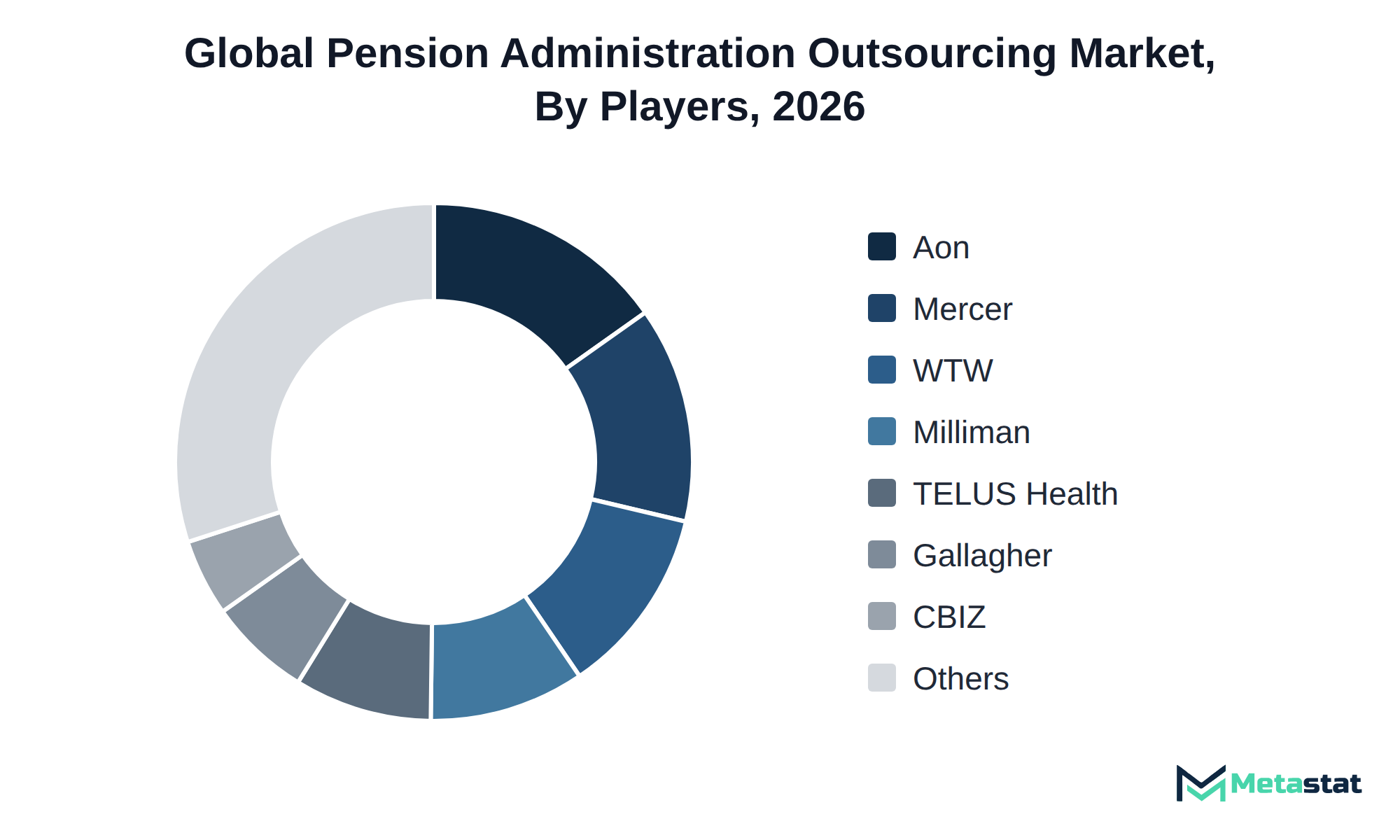
Buyers evaluate options based on factors including price, service quality, customization, and the ecosystem provided by vendors. Aon plc focuses on delivering comprehensive pension solutions, while Mercer LLC emphasizes innovative technology integration. WTW operates in the market by leveraging its extensive experience in regulatory compliance, appealing to organizations requiring robust management of pension regulations. These differentiators shape purchasing decisions within the market.
The expansion of the Pension Administration Outsourcing market relies on several key developments. First, the growth of Defined Contribution (DC) Plans is expected to drive demand, with a CAGR of 8.7% through 2033, contributing significantly to market size. In North America, which holds the largest market share at 38%, the shift towards more flexible retirement solutions supports this growth. Second, the adoption of Fully Outsourced Pension Administration services is projected to increase, with a CAGR of 8.3%, reflecting a trend among Private-Sector Corporate Employers seeking cost efficiency and improved service delivery. The rising complexity of regulatory requirements acts as another catalyst for market expansion, compelling organizations to outsource compliance functions. Potential economic downturns pose risks that could slow growth. If financial institutions and employers face budget constraints, these limitations restrict their outsourcing capabilities, impacting overall market performance.
By Pension Plan Type: Defined Benefit (DB) Plans, Defined Contribution (DC) Plans, Hybrid Pension Plans, Cash Balance Plans, Collective Defined Contribution (CDC) Plans, Others (Multi-Employer Pension Arrangements, Executive Pension Plans)
By Service Type: Pension Recordkeeping and Member Data Management, Pension Benefit Calculation and Payment Administration, Pension Compliance and Regulatory Reporting, Pension Payroll Administration, Member Communication and Engagement Services, Pension Data Migration and Transition Services, Others (Pension Tracing and Data Rectification)
By Plan Sponsor Type: Private-Sector Corporate Employers, Public-Sector and Government Employers, Multi-Employer and Union-Based Pension Schemes, Financial Institutions and Insurance Companies, Master Trusts and Pension Scheme Trustees
By Outsourcing Model: Fully Outsourced Pension Administration, Co-Sourced Pension Administration, Partial or Function-Specific Outsourcing, Third-Party Pension Administration (TPA)
The report strategically identifies and profiles the key market players and analyses their core competencies in each sub-segment of the Pension Administration Outsourcing market.
Report Attributes | Details |
Study Period | 2021-2033 |
Base Year | 2025 |
Estimated Year | 2026 |
Forecast Period | 2026-2033 |
Historical Period | 2021-2025 |
Growth Rate | CAGR 7.8% from 2026 to 2033 |
Revenue Unit | USD million |
Segmentation | By Pension Plan Type, Service Type, Plan Sponsor Type, Outsourcing Model, and Region |
By Region | North America (By Pension Plan Type, Service Type, Plan Sponsor Type, Outsourcing Model, and Country)
|
Europe (By Pension Plan Type, Service Type, Plan Sponsor Type, Outsourcing Model, and Country)
| |
Asia Pacific (By Pension Plan Type, Service Type, Plan Sponsor Type, Outsourcing Model, and Country)
| |
South America (By Pension Plan Type, Service Type, Plan Sponsor Type, Outsourcing Model, and Country)
| |
Middle East and Africa (By Pension Plan Type, Service Type, Plan Sponsor Type, Outsourcing Model, and Country)
|
Find answers to common questions about this report
The Pension Administration Outsourcing market size was valued at USD 1,710.3 million in 2025.
The market is projected to grow at a CAGR of 7.8% during the forecast period from 2026 to 2033.
The North America Pension Administration Outsourcing market size is estimated to reach USD 1,111 million by 2033.
Defined Contribution (DC) Plans lead the Pension Administration Outsourcing market, with a projected value of USD 992.8 million by 2033. This segment surpasses others in growth potential, reflecting an anticipated compound annual growth rate of 8.7 percent.
Growing interest in defined contribution plans significantly influences spending within the market, driven by a need for flexible retirement solutions. The hybrid pension plans segment presents a significant growth opportunity, reflecting changing workforce demographics and increasing demand for specialized administration services.
North America holds the dominant share of the Pension Administration Outsourcing market, with a projected value of USD 1,111 million in 2033, representing 38 percent of the total market.
Price sensitivity remains a significant restraint, particularly affecting private-sector corporate employers. Higher service costs associated with outsourcing lead to slower uptake and delayed decisions regarding service implementation.
Factors favoring adoption in the Pension Administration Outsourcing market include the growing interest in hybrid pension plans, projected to reach USD 350.7 million by 2033, and the increasing demand for specialized administration services. Organizations seek solutions that balance financial predictability with employee engagement, driving innovation in service delivery.
The Pension Administration Outsourcing market is estimated to reach a valuation of USD 3,120 million by 2033.
Key players operating in the Pension Administration Outsourcing market include Aon plc, Mercer LLC, WTW, Milliman, Inc., TELUS Health, Eckler Ltd., Gallagher, and CBIZ, Inc.
The analysts below cover Banking & Finance research at Metastat Insights.
LEAD ANALYST
Utkarsh Khirodkar is a Lead Market Research Analyst at MetaStat Insight, specializing in market intelligence, technology sector assessments, and competitive strategy.

PRINCIPAL CONSULTANT - ENTERPRISE AI & EMERGING TECHNOLOGIES
Banking & Finance · Electronics and Semiconductor · Energy and Power · Healthcare IT · Information & Technology · Professional Services
Vijay Gunti is a Principal Consultant at MetaStat Insight, bringing over two decades of experience across enterprise digital transformation, technology strategy, and intelligent systems.
Ambulatory surgical centers have very different purchasing cycles for robotic-assisted surgery platforms than major hospital networks. The MetaStat Insight study focused squarely on capital expenditure depreciation, procedural reimbursement pathways, and surgeon training overhead. That operational clarity made it much simpler to validate multi-year procedure growth forecasts against actual ambulatory center adoption patterns.
When planning edge sensor rollouts across refinery environments, generic IoT reports typically miss the harsh-environment certification bottlenecks. MetaStat Insight gave an objective evaluation of ATEX and Class 1 Division 2 hardware availability, along with realistic five-year maintenance cycle cost projections. The comparison of wireless mesh versus private cellular backhaul helped our team pressure-test network reliability models for remote processing facilities.
In the biological seed treatment space, registration timelines vary drastically between the European Union, Brazil, and North America. The MetaStat Insight research handled these cross-border regulatory barriers with genuine nuance, mapping commercialization pathways alongside historical field adoption rates. The segmentation between microbial strains and biochemical active ingredients was particularly well structured.
Explore related market intelligence reports worth reading alongside this one.
Starting from
$2950
Starting from
$2950