
LEAD ANALYST
Utkarsh Khirodkar is a Lead Market Research Analyst at MetaStat Insight, specializing in market intelligence, technology sector assessments, and competitive strategy.

Global Corporate Liquidity Management Market Size, Share, By Solution Type (Cash Pooling and Sweeping, Cash Forecasting and Positioning, In-House Banking and Netting, Virtual Account Management, Intraday Liquidity Management, Short-Term Investment and Cash Optimization, Liquidity Risk and Stress Analytics), By Offering Type (Software Platforms, Bank-Provided Liquidity Services, Consulting and Integration Services, Managed and Support Services), By Deployment Model (Cloud and SaaS, On-Premises, Hybrid), By End-Use Industry (Banking and Financial Services, Manufacturing, Retail and Consumer Goods, IT and Telecommunications, Energy and Utilities, Healthcare and Life Sciences, Transportation and Logistics), Industry Analysis, Growth, Trends, and Forecast, 2026-2033
Report ID
MSI-5674
Published
November, 2026
Pages
289 Pages
Format
Historical
Base year
Forecast
Forecast period
Report Details
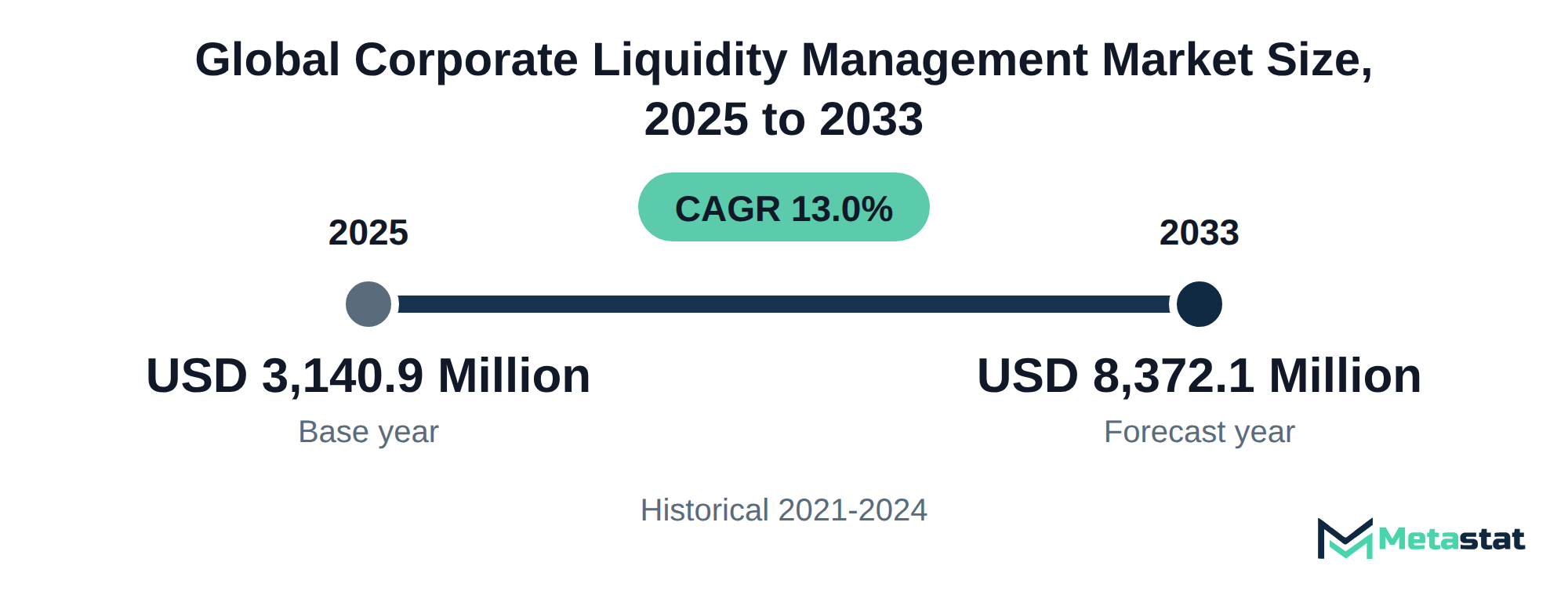
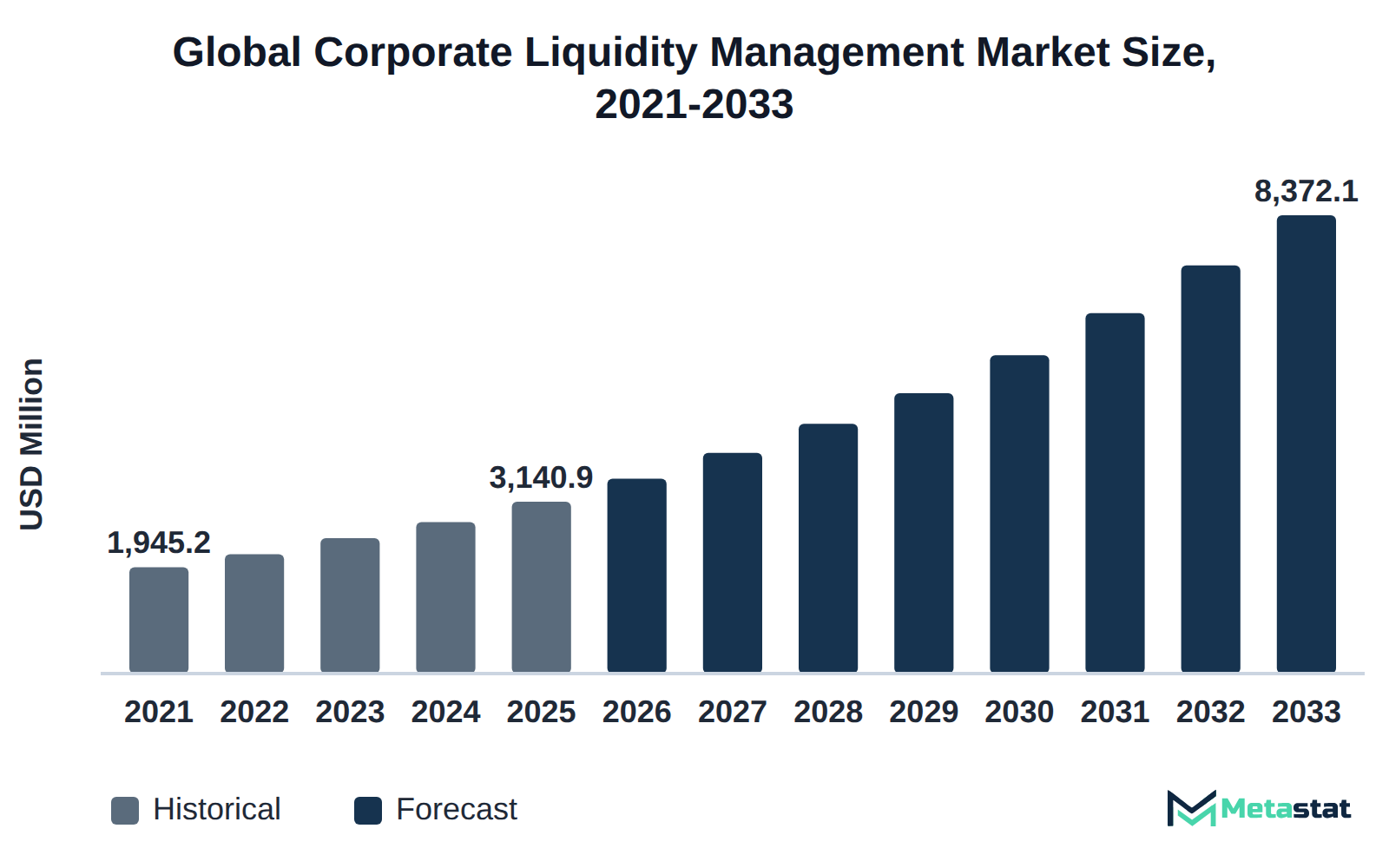
Market Valuation: Valued at $3,140.9 Million in 2025, projected to reach $8,372.1 Million by 2033 at a 13.0% CAGR.
Dominant Segment: Cash Forecasting and Positioning is the leading segment in the Corporate Liquidity Management market, driven by the increasing demand for enhanced cash visibility and effective liquidity optimization.
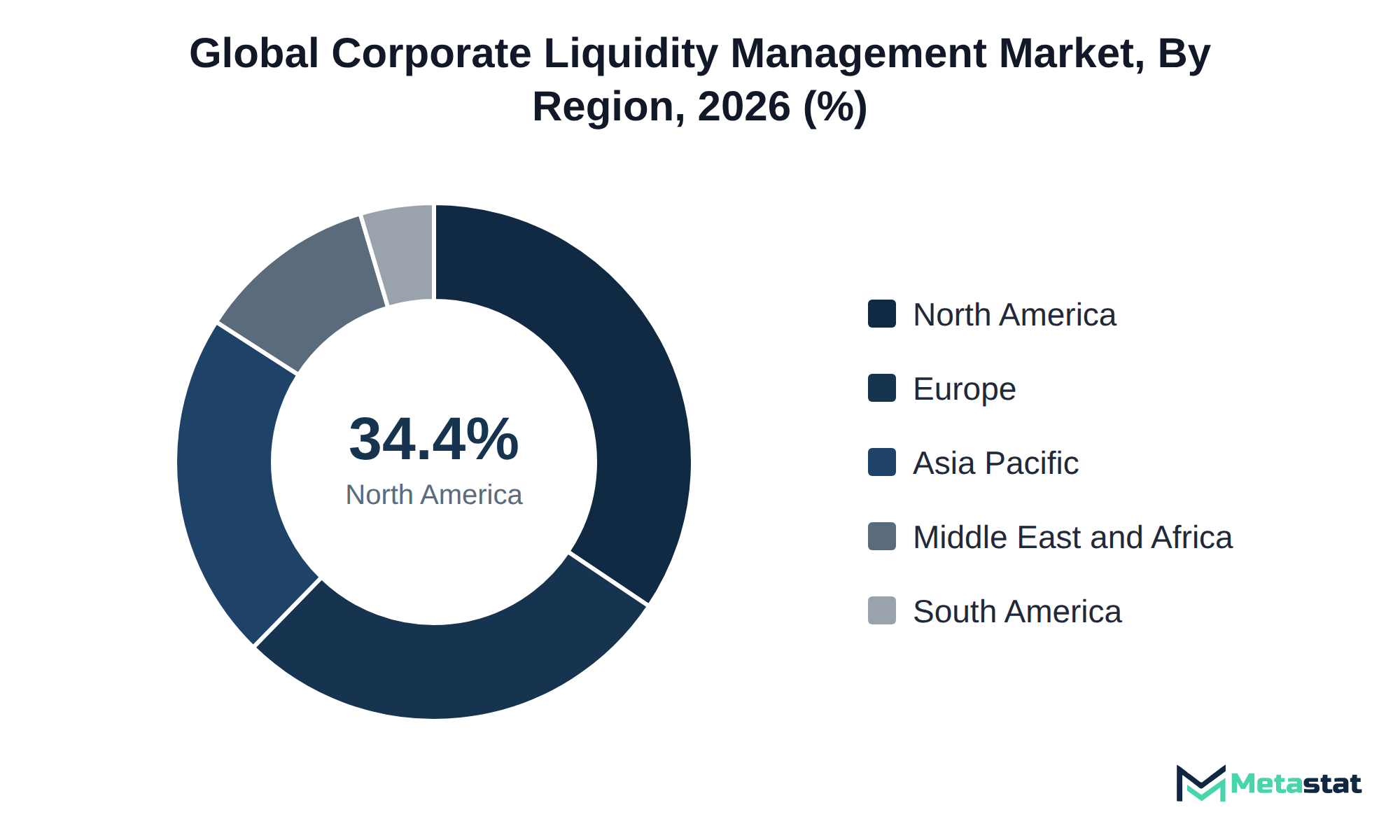
Geographic Lead: North America is the dominant region, holding 34.4% of the market in 2025, with the US projected to lead in 2026 due to its advanced financial infrastructure and high demand for liquidity management solutions.
What's Inside: The report provides a comprehensive analysis of the Corporate Liquidity Management market, including competitive coverage, detailed segmentations, and forecasts from 2026 to 2033.
Growth in Software Platforms: The Software Platforms segment is expected to grow significantly, reaching USD 1,524.9 million by 2026, as organizations increasingly seek scalable solutions that enhance liquidity management.
Emerging Trends: The adoption of AI-driven cloud platforms for cash forecasting is on the rise, reflecting a shift towards more accurate and efficient liquidity management practices in response to market volatility.
Choose Your License
Global Corporate Liquidity Management Market
The global Corporate Liquidity Management market was valued at USD 3,140.9 million in 2025 and is projected to reach USD 8,372.1 million by 2033, growing at a CAGR of 13.0% over the forecast period.
The Corporate Liquidity Management market encompasses solutions that enhance the management of cash flow and liquidity across organizations. Buyers invest in these solutions to optimize their financial operations, manage risks, and improve overall cash visibility. The need for effective liquidity management has grown significantly due to increasing market volatility and the intensifying demand for efficiency in financial processes.
Growth in the market is driven by the increasing adoption of advanced technologies and software platforms that facilitate better cash forecasting and positioning. Among the various segments, Cash Forecasting and Positioning stands out as the most valuable, contributing significantly to market revenue. North America holds 34.4% of the market in 2025, with the US leading in 2026. This region's advanced financial infrastructure and high demand for liquidity management solutions reinforce its prominent position.
The increasing complexity of global financial transactions demands effective liquidity strategies. Cross-border payments are one visible source of this complexity. Organizations across different industries recognize the value of integrating liquidity solutions to improve operational efficiency. The Corporate Liquidity Management market is projected to experience growth as businesses seek to address these challenges and capitalize on available opportunities for optimization.
The market includes various solutions that aid organizations in optimizing cash management and liquidity strategies. Buyers invest in this market to improve operational efficiency, reduce risks associated with liquidity shortages, and enhance financial forecasting capabilities. Demand for sophisticated liquidity solutions arises from the increasing complexity of financial markets and the need for organizations to maintain healthy cash flow during economic uncertainty.
Growth in the Corporate Liquidity Management market is driven by the rising adoption of software platforms that facilitate cash pooling, forecasting, and management. Among the segments, Cash Forecasting and Positioning holds significant value, reflecting the critical need for businesses to accurately predict their liquidity positions. Other regions, including Europe and Asia Pacific, contribute substantial shares, highlighting the widespread need for effective liquidity management solutions.
Investments in cloud and SaaS deployment models are increasing, emphasizing the shift toward digital transformation in financial management. Organizations seek scalable and flexible solutions that adapt to evolving needs. This trend is expected to strengthen long-term demand as companies adopt liquidity management approaches that align with their strategic goals.
Treasury teams increasingly prioritize AI-driven cloud platforms for cash forecasting due to their ability to enhance accuracy and efficiency. The market for cash forecasting and positioning is expected to reach USD 1,911.3 million by 2033, reflecting a compound annual growth rate (CAGR) of 15.1%. This growth is driven by the need to manage liquidity effectively amid volatility and uncertainty.
Enterprise AI solutions provide advanced analytics and real-time data integration, allowing treasury teams to make informed decisions and optimize cash flow management. Traditional cash forecasting methods rely on historical data and manual processes, leading to inefficiencies and inaccuracies. The shift to cloud-based platforms offers scalability and flexibility, which are essential for organizations adapting to changing market conditions.
Investing in AI-driven cloud platforms positions treasury teams to leverage predictive analytics and automation, ultimately supporting better financial outcomes. Teams comparing these options can also review the wider treasury management system category. Moving to these technologies helps organizations respond faster to market changes. The result is stronger liquidity management and a competitive advantage for organizations that adopt them.
The rise of virtual accounts and real-time payments significantly transforms corporate cash pooling strategies. Companies increasingly adopt these technologies to enhance liquidity management by allowing instant fund transfers and precise cash flow visibility. The Corporate Liquidity Management market is projected to reach USD 8,372.1 million by 2033, reflecting a compound annual growth rate (CAGR) of 13%. This growth highlights the urgent demand for efficient cash management solutions.
Virtual accounts streamline the management of cash across multiple entities, simplifying reconciliation and reporting. Organizations managing these accounts experience improved operational efficiency, driven by reduced costs associated with maintaining traditional bank accounts. In the cash pooling segment, the integration of real-time payments enhances the speed and flexibility of intra-group fund transfers, allowing businesses to respond swiftly to liquidity needs. For instance, the cash pooling and sweeping segment is expected to grow from USD 846.3 million in 2026 to USD 1,769.9 million by 2033, driven by demand for these innovative solutions.
As companies embrace these advancements, procurement and pricing models are shifting. Organizations explore subscription-based or tiered pricing structures for software platforms supporting virtual accounts, allowing for customization according to user needs and transaction volumes. This adaptability encourages greater adoption across sectors and reflects a proactive approach to managing corporate liquidity. The Corporate Liquidity Management market, in response to these changes, is projected to experience substantial growth.
Corporate treasuries increasingly explore the choice between bank-led and software-led liquidity models. Changing financial conditions drive this shift, with businesses seeking more control over their liquidity management processes. Software platforms, particularly those using cloud technology, are a popular alternative because of their scalability and integration capabilities. In 2026, the market for software platforms is projected to reach USD 1,524.9 million and expand to USD 4,006.9 million by 2033, reflecting a compound annual growth rate (CAGR) of 14.8%.
Bank-provided liquidity services remain significant, projected to achieve a value of USD 2,690.8 million by 2033, growing at a CAGR of 10.7%. Corporate clients typically access them through their commercial banking relationships. However, the distinct preferences of corporate treasuries shape their liquidity strategies. Organizations prioritizing agility and real-time insights gravitate towards software-led models that facilitate better cash forecasting and visibility. This shift lets treasuries manage liquidity more proactively, enhancing operational efficiency and potentially improving financial performance.
Corporates prioritize specific functionalities when selecting a liquidity management solution. This feature enables organizations to optimize cash utilization, ensuring efficient resource deployment across various operational areas.
Another vital consideration is the deployment model. The cloud and Software as a Service (SaaS) segment is anticipated to grow significantly, with a forecasted value of USD 5,309.6 million by 2033, driven by businesses seeking scalable and flexible solutions. By opting for cloud-based services, corporates streamline liquidity management processes, enhance collaboration, and reduce IT overhead costs.
In the Corporate Liquidity Management market, organizations that invest in solutions with strong cash forecasting and a flexible deployment model achieve better financial agility and decision-making capabilities. Such strategic choices support long-term growth and operational efficiency.
Organizations across various sectors increasingly adopt cloud-based solutions for liquidity management, driven by the need for enhanced agility and real-time data access. This shift supports finance teams in optimizing cash flow and improving financial decision-making. The adoption results in a notable increase in demand for software platforms, particularly those that facilitate cash forecasting and position management. This transition lowers operational costs and helps organizations respond more effectively to market changes, which benefits the corporate liquidity management market.
Increased focus on cash forecasting solutions
Organizations are directing greater attention towards advanced cash forecasting solutions, primarily driven by the necessity for improved cash visibility and risk management. Companies in the banking and financial services sector, manufacturing, and retail exhibit heightened interest in these solutions to enhance their liquidity management strategies. The growing complexity of financial operations increases the demand for accurate forecasting tools. This shift marks a significant change within the corporate liquidity management market, where businesses prioritize effective cash management to handle financial uncertainty.
The integration of automated solutions within Corporate Liquidity Management enhances cost efficiency for organizations. Streamlined processes reduce manual handling, lowering operational expenses and mitigating errors. The same reduction in manual handling applies to related finance workflows such as accounts payable automation. This transformation is particularly relevant in sectors where rapid financial transactions occur, including banking and financial services. Automation enables organizations to optimize cash flow management, ensuring funds are allocated efficiently and effectively across various business units.
Increased competition among liquidity service providers encourages the development of innovative technologies that drive down costs. Providers focus on developing more efficient software platforms that offer improved functionalities, ultimately leading to better pricing models for businesses. Such advancements contribute to growing demand for automated liquidity management solutions in the market, creating opportunities for businesses to improve financial performance and achieve higher returns on investment.
Inadequate infrastructure limits the adoption of advanced liquidity management solutions among organizations in various sectors. Many enterprises face challenges integrating these solutions into existing systems, resulting in slower uptake and smaller order sizes. The banking and financial services segment experiences delays in implementing innovative technologies that enhance cash management. This segment's reliance on legacy systems hinders the transition to more efficient practices. Consequently, organizations struggle to keep pace with competitors that leverage comprehensive liquidity strategies. The Corporate Liquidity Management market, driven by technological advancements, remains attractive. However, the lack of strong infrastructure continues to restrict widespread adoption. Overcoming these infrastructural barriers is vital for organizations seeking to optimize cash flow and liquidity management.
Operational costs present a significant challenge for suppliers in the Corporate Liquidity Management market. Rising expenses associated with talent acquisition and retention, alongside increasing billing pressures, directly impact profit margins. Suppliers respond by investing in training programs to improve staff competencies and streamline service delivery. Automation of routine tasks reduces reliance on specialized personnel, allowing firms to maintain service quality while managing costs effectively. Several suppliers explore partnerships with technology firms to leverage advanced solutions and improve their service offerings. By adopting more efficient operational models, suppliers aim to mitigate financial pressures while continuing to meet the evolving demands of clients in the market. Profitability and competitive positioning rely on these strategic adjustments, which keep suppliers viable amid rising costs.
The Cash Forecasting and Positioning segment emerges as a significant growth area within the Corporate Liquidity Management market. This segment exhibits a compound annual growth rate (CAGR) of 15.1% reflecting strong demand from organizations seeking enhanced cash visibility and liquidity optimization. The increasing complexity of cash flows across various industries contributes to this urgency, prompting firms to invest in advanced forecasting solutions that provide real-time insights into cash positions. Improved software platforms facilitate the implementation of precise forecasting methodologies, allowing companies to manage liquidity more effectively. The strategic focus on cash forecasting aligns with broader trends in financial management, further driving adoption across sectors including banking, manufacturing, and retail. This trend highlights the importance of tailored solutions that address specific liquidity challenges faced by organizations.
The Global Corporate Liquidity Management market is segmented based on Solution Type, Offering Type, Deployment Model, and End-Use Industry.
This segment focuses on consolidating funds from multiple accounts within an organization to optimize cash management and minimize excess balances. Corporations, particularly those with complex cash management needs, apply these solutions to enhance liquidity and streamline operations. Driving factors include increasing demand for efficient cash management strategies and reduced interest costs associated with idle cash. Compared to other segments, Cash Pooling and Sweeping exhibits a moderate growth rate, benefiting from its ability to provide organizations with greater control over their liquidity. Its projected CAGR of 11.1% indicates steady demand, distinguishing it from higher growth segments within the market for Corporate Liquidity Management.
This segment enables organizations to predict future cash flows and manage liquidity effectively, serving primarily treasury departments within large corporations. Demand for accurate cash forecasting has surged, driven by an increasing emphasis on financial transparency and operational efficiency. This segment's growth outpaces others in the same classification, including In-House Banking and Netting, which experience a slower growth rate. With ongoing digital transformation, businesses are shifting toward sophisticated forecasting tools, enhancing their ability to make informed decisions in response to market fluctuations. This transition signifies an evolution in how organizations approach liquidity management in the market.
The In-House Banking and Netting segment is expected to reach USD 942.7 million by 2033. This segment allows corporations to centralize their cash management operations, reducing reliance on external financial institutions. Enterprises frequently adopt this solution to optimize their liquidity positions and enhance cash utilization across subsidiaries. Strong demand for better internal financial management drives adoption, particularly in global organizations with complex cash flows. Compared to other segments, including Cash Pooling and Sweeping, this segment exhibits a slower growth rate, influenced by the ongoing shift towards cloud-based solutions that enhance real-time data accessibility and operational efficiency. The compound annual growth rate for In-House Banking and Netting stands lower at 12% compared to the more dynamic segments, highlighting distinct preferences among corporate buyers regarding liquidity management strategies.
Virtual Account Management segment is projected to grow at a CAGR of 14.2% during the forecast period. This solution enables organizations to manage multiple accounts under a single virtual account setup, enhancing liquidity visibility and efficiency. Corporates in sectors including banking, manufacturing, and retail adopt this solution to streamline cash management processes and reduce reliance on traditional banking systems. Increased demand for real-time payment systems drives the adoption of virtual account management, with organizations seeking to optimize cash flow and improve operational efficiency. Compared to other segments, including Cash Forecasting and Positioning, which has a higher growth rate of 15.1%, Virtual Account Management delivers a distinct advantage in cost-effectiveness and operational simplicity, appealing to several buyers looking for scalable liquidity solutions. The market continues to experience innovation, further expanding its application across diverse industries.
Intraday Liquidity Management focuses on optimizing cash flow within a single day, ensuring that organizations have the necessary liquidity to meet their immediate financial obligations. This segment is particularly relevant for financial institutions and large corporations that require real-time visibility into their cash positions. The growing emphasis on regulatory compliance and risk management drives demand for solutions that enhance intraday liquidity capabilities. These solutions differ from others in the group, including Cash Pooling and Sweeping, by specifically addressing short-term cash needs and offering rapid access to funds. Organizations employing intraday liquidity management tools facilitate efficient fund allocation and minimize idle cash, thereby maximizing interest earnings and reducing reliance on external financing. This proactive approach to liquidity aligns closely with evolving market demands, highlighting the importance of agility in financial management.
Short-Term Investment and Cash Optimization focuses on effectively managing surplus cash and maximizing returns through strategic investments. This approach is adopted by corporates and financial institutions aiming to enhance liquidity efficiency while minimizing risks associated with cash holdings. Demand for this segment is driven by increasing pressure on organizations to optimize capital allocation and achieve higher yields, particularly in a low-interest-rate environment. Compared to other segments, Short-Term Investment and Cash Optimization experiences relatively slower growth due to complexities involved in investment strategies and fluctuating market conditions. Companies exploring this segment emphasize a tailored approach that aligns with specific risk profiles and liquidity needs, differentiating it from broader liquidity management solutions. The Corporate Liquidity Management market, through this segment, enables organizations to pursue sustainable cash optimization strategies that align with financial objectives.
Liquidity Risk and Stress Analytics focuses on assessing and managing potential liquidity risks that organizations face during turbulent market conditions. This segment plays a critical role for financial institutions and large corporations that require robust risk management frameworks. Increasing regulatory pressures drive demand for such analytics, compelling firms to adopt more advanced solutions. Enhanced visibility into liquidity positions enables organizations to make informed decisions and mitigate potential financial crises. Compared to other segments, this area experiences slower growth due to complex integration processes and specialized expertise required for implementation. While segments like Cash Forecasting and Positioning see rapid expansion, Liquidity Risk and Stress Analytics emphasizes risk mitigation and compliance, appealing primarily to organizations prioritizing stability and resilience in their financial operations. The market continues to evolve, reflecting the growing importance of comprehensive risk assessment tools in corporate finance strategies.
The "Others" segment encompasses various specialized solutions tailored for unique liquidity management needs not covered by mainstream offerings. This segment caters to organizations seeking customized strategies to address specific challenges, including unique regulatory environments or operational requirements. Demand for these solutions often arises from complex financial structures or specific industry needs, prompting businesses to seek tailored approaches. The presence of diverse buyer profiles distinguishes this segment from others, which are generally more standardized. While segments like Cash Forecasting and Positioning exhibit rapid growth, the "Others" segment typically experiences steadier demand, reflecting a more niche market focus. Buyers in this segment include corporations with unconventional liquidity requirements, highlighting the ongoing evolution in the Corporate Liquidity Management market.
This segment includes software solutions that enhance liquidity management capabilities for organizations, particularly in banking and financial services, manufacturing, and retail sectors. Adoption is driven by increasing demand for real-time cash visibility and efficient cash flow management. The growth trajectory of this segment surpasses others, including Bank-Provided Liquidity Services, which shows a CAGR of 10.7%, highlighting the significance of advanced technology in enhancing operational efficiency. Decision-makers prioritize software platforms for their ability to integrate with existing systems and provide analytics that support strategic financial planning. Continuous technological advancements further fuel demand for these platforms, driven by firms seeking to optimize liquidity management processes through innovative software solutions.
This segment offers essential services that enable organizations to manage their liquidity effectively, allowing for better cash flow and financial planning. Financial institutions and corporations access these services to secure the necessary funds for operational needs and investment opportunities. The increasing focus on optimizing liquidity management drives demand for these services. Compared to other segments, Bank-Provided Liquidity Services experience slower growth, influenced by the established nature of these services and the preference of larger entities for in-house solutions. This segment's growth is primarily supported by the rising complexity of financial operations and the necessity for sophisticated liquidity management strategies that address evolving market conditions. The Corporate Liquidity Management market reflects these dynamics, with this segment supporting financial stability for organizations.
Consulting and Integration Services segment is expected to reach USD 1,085.9 million by 2033. This segment focuses on providing specialized expertise to organizations, helping them implement and integrate liquidity management solutions. Buyers primarily include large enterprises, financial institutions, and corporations looking to streamline their financial processes. The growing complexity of financial regulations and a push for enhanced operational efficiency drive demand in this segment. Consulting and Integration Services differ from other offerings due to their tailored approach and higher price point, reflecting the specialized knowledge required. The segment exhibits a CAGR of 12.1%, positioning it for steady growth compared to other segments that offer broader solutions without the same level of customization. In the evolving landscape, the market increasingly values expertise in navigating complex liquidity challenges.
Managed and Support Services segment is projected to grow at a CAGR of 12.1% during the forecast period. This segment focuses on providing expertise, operational support, and maintenance to enhance the efficiency of liquidity management processes. Organizations in sectors including banking and financial services apply these services to optimize their liquidity strategies. The increasing complexity of financial regulations and the pressure to enhance operational efficiency drive demand for these services. Compared to other segments, Managed and Support Services exhibit a moderate growth rate, reflecting steady demand from companies looking to streamline operations while navigating regulatory challenges. This segment is distinct from software platforms and other offerings, which tend to experience more rapid growth rates due to technological advancements in the Corporate Liquidity Management market.
Cloud and SaaS segment is valued at USD 1,816.9 million in 2026 and is projected to reach USD 5,309.6 million by 2033, at a CAGR of 16.6% during the forecast period. This segment provides solutions that enhance operational efficiency, enabling organizations to manage their liquidity requirements using scalable platforms. The growing demand for real-time visibility and control over cash positions drives adoption among enterprises across various sectors, particularly in banking and financial services. A significant driver for this segment centers on the increasing need for flexible deployment options that align with the rapid digital transformation of businesses. Compared to other deployment models, the Cloud and SaaS segment exhibits a higher growth rate, reflecting a shift in preferences toward more agile and cost-effective liquidity management solutions. The market continues to evolve, responding to technological advancements and changing regulatory landscapes.
The On-Premises segment is estimated to reach USD 1,703.7 million by 2033, at a CAGR of 5.3% during the forecast period. This segment primarily targets organizations that prefer to maintain their liquidity management solutions within their own infrastructure, allowing for greater control over data and security. Companies in industries including banking and financial services leverage On-Premises solutions to address compliance requirements and specific operational needs. A key driver influencing this segment is the desire for enhanced data security, which is essential for financial institutions. Compared to other deployment models, the On-Premises segment exhibits slower growth, reflecting a more traditional approach in contrast to the rapid adoption of cloud solutions. The growing emphasis on regulatory compliance and risk management increases demand for these solutions, while the need for significant upfront investment could hinder broader adoption among smaller businesses.
Hybrid deployment models encompass a blend of on-premises and cloud-based solutions, optimizing flexibility for organizations seeking tailored liquidity management. Businesses, particularly in industries including banking and financial services, benefit from hybrid solutions that allow for greater customization and scalability. Increasing demand for real-time data and analytics drives growth in this segment, alongside the ongoing transition to cloud-based platforms. Compared to other deployment models, the hybrid approach shows a slower growth rate, with a CAGR of 5.3%, reflecting a preference among certain firms for traditional on-premises solutions due to regulatory concerns or existing infrastructure investments. This segment's unique value lies in its ability to cater to diverse operational needs, facilitating a more comprehensive approach to liquidity management, which aligns with broader trends in the Corporate Liquidity Management market.
Banking and Financial Services segment is valued at USD 961.2 million in 2026 and is projected to reach USD 2,124.8 million by 2033, at a CAGR of 12% during the forecast period. This segment primarily serves financial institutions, including banks and investment firms, focusing on optimizing liquidity positions through various strategies. Increased regulatory scrutiny surrounding capital management drives demand within this segment, with firms seeking to comply with stringent regulations while enhancing operational efficiency. Compared to other segments, this area experiences stable growth due to its essential role in managing financial resources. Factors including the need for real-time cash flow forecasting and effective risk management differentiate this segment, emphasizing advanced technological solutions for effective liquidity management. The Corporate Liquidity Management market is expected to evolve as financial services adapt to changing market conditions and regulatory requirements.
Manufacturing segment is estimated to reach USD 1,399.8 million by 2033, at a CAGR of 12.2% during the forecast period. This segment serves manufacturers in managing their liquidity effectively, allowing them to optimize cash flow and ensure operational efficiency. Factors driving growth in this segment include increasing demand for efficient cash management solutions and the adoption of sophisticated financial technologies. Compared to other segments, manufacturing experiences a relatively higher growth rate due to the essential nature of cash management in maintaining production continuity. Manufacturers face unique challenges related to working capital management, necessitating tailored liquidity solutions. Supply chain finance is a related approach to easing working capital pressure across supplier networks. The Corporate Liquidity Management market continues to evolve, reflecting these specific needs of the manufacturing sector.
The Retail and Consumer Goods segment is expected to reach USD 1,127.7 million by 2033. This segment serves retail businesses and consumer goods manufacturers, focusing on effective cash management strategies to enhance liquidity. Factors influencing growth include increasing demand for efficient cash flow management and pressure to optimize working capital. Compared to other segments, this area experiences a moderate growth rate of 12.2% CAGR, which is relatively robust, yet lower than the Cash Forecasting and Positioning segment, projected to have a CAGR of 15.1%. Unique financial dynamics and consumer behavior trends in the retail and consumer goods sector contribute to specific liquidity management requirements, differentiating it from other segments within the Corporate Liquidity Management market.
IT and Telecommunications segment is projected to grow at a CAGR of 14.5% during the forecast period. This segment serves organizations within the IT and telecommunications sectors, focusing on managing liquidity efficiently and ensuring adequate cash flow. The increasing digitalization and the rising demand for real-time financial insights drive the need for advanced liquidity management solutions. This area experiences faster growth due to the sector's rapid evolution and reliance on technology. The necessity for robust cash forecasting and positioning analytics specifically caters to IT and telecommunications companies, which face unique operational challenges. By leveraging cash pooling and sweeping solutions, these companies optimize their liquidity management practices, significantly improving overall financial performance. The Corporate Liquidity Management market adapts to these trends, enhancing service offerings to meet the specific needs of this dynamic industry.
Energy and Utilities encompasses organizations responsible for the production and distribution of energy, including electricity, gas, and water. This segment is essential in financing operations and managing cash flow effectively. Entities within this sector employ corporate liquidity management solutions to optimize cash reserves and maintain operational efficiency during fluctuations in demand and supply. The shift towards renewable energy sources and regulatory compliance are significant forces influencing this segment's dynamics. Compared to other segments, Energy and Utilities experience slower growth due to capital-intensive projects and longer investment cycles. Nevertheless, the integration of advanced technologies and sustainability initiatives presents ongoing opportunities for enhancing liquidity management practices. This segment contributes significantly to the overall growth of the Corporate Liquidity Management market, reflecting the sector's increasing operational sophistication.
The Healthcare and Life Sciences segment encompasses a broad range of organizations, including hospitals, pharmaceutical companies, and biotechnology firms, all focused on managing liquidity efficiently. This segment addresses the financial complexities inherent in healthcare operations, enabling companies to maintain optimal cash flow for day-to-day operations, investments, and compliance with stringent regulations. Demand for liquidity management in this sector is driven by the increasing need for financial stability amid rising operational costs and regulatory requirements. Compared to other segments, Healthcare and Life Sciences face slower growth due to the highly regulated nature of the industry, which limits rapid adoption of new solutions. However, ongoing advancements in technology and software solutions present significant opportunities for improving financial management processes, providing organizations in this sector a competitive edge in the Corporate Liquidity Management market.
Transportation and Logistics involves the movement of goods and services across various channels, ensuring timely delivery and efficient supply chain management. Organizations within this segment apply liquidity management to optimize cash flow, improve forecast accuracy, and enhance operational efficiency. Increasing globalization drives demand for advanced liquidity management solutions in this sector. Companies face challenges related to fluctuating fuel prices and regulatory changes, influencing operational costs. Demand dynamics differ from other sectors, focusing on real-time cash visibility and swift decision-making processes. This segment features distinct financial management practices to navigate complex logistics environments, ensuring competitiveness in the evolving market.
This segment encompasses a diverse range of organizations not classified under the major industries, providing various liquidity management solutions tailored to their specific needs. Companies across sectors including non-profits, government agencies, and smaller enterprises apply these solutions to enhance their cash management capabilities. Increased focus on financial efficiency and risk management drives demand for this segment. Organizations seek to optimize their liquidity to navigate fluctuating market conditions, ensuring operational stability. Compared to traditional sectors like banking and financial services, this segment experiences slower growth, influenced by differing resource availability and investment capabilities. The unique requirements and challenges faced by these organizations set this segment apart, emphasizing the necessity for specialized solutions within the Corporate Liquidity Management market.
Based on geography, the Global Corporate Liquidity Management market is divided into North America, Europe, Asia-Pacific, South America, Middle East, and Africa.
By 2033, North America is projected to reach USD 2,713.4 million, representing 34.4% of the global market share in 2025. The region's demand is driven by the robust presence of banking and financial services, where organizations seek advanced liquidity management solutions to optimize cash flow and mitigate risks. This sector experiences significant adoption of software platforms designed to enhance cash forecasting and positioning. The focus on cloud and SaaS deployment models further supports the region's growth trajectory, aligning with the trend of digital transformation in financial operations. Companies in the United States, Canada, and Mexico increasingly invest in innovative solutions, reinforcing their competitive edge in the market. Investment in these technologies is vital for addressing evolving market challenges and achieving operational efficiencies.
Demand for corporate liquidity management solutions in Europe derives mainly from the banking and financial services sector, which emphasizes efficient liquidity management to optimize cash flow and minimize risks. Countries including Germany and France lead in adopting advanced cash forecasting and positioning technologies, driven by stringent regulatory requirements and the need for enhanced financial transparency. The region's solid infrastructure supports the integration of cloud and SaaS deployment models, facilitating streamlined access to liquidity management tools. By 2025, Europe is projected to hold a market share of 27.9% in the corporate liquidity management market, reflecting the growing emphasis on effective cash management strategies across multiple industries. Continued investment in technology and services is expected to enhance the competitive landscape, driving innovation and collaboration among key players in this evolving market.
Asia-Pacific accounts for 21.8% of the global Corporate Liquidity Management market in 2025. Rapid industrialization in countries including China, India, and South Korea drives demand from various sectors, particularly banking and financial services. Increasing digitization across these economies enhances the adoption of advanced liquidity management solutions. The cloud and SaaS deployment models emerge as popular choices among businesses seeking flexibility and scalability. Countries in this region, including Australia and Japan, focus on regulations that promote transparency and efficiency in financial operations. Investments in infrastructure development continue supporting the growth of liquidity management solutions, positioning the market for substantial expansion through 2033.
In South America, the Corporate Liquidity Management market experiences notable growth driven by the increasing focus on efficient cash management strategies within key industries. Brazil and Argentina serve as primary drivers of demand, particularly within banking and financial services, which prioritize liquidity optimization. Local businesses adopt advanced liquidity solutions to enhance their financial operations and reduce cash flow risks. The relatively high inflation rates in the region highlight the importance of robust liquidity management practices. By 2025, South America is projected to hold a 4.6% share of the global market, underlining its potential for growth. The market benefits from an evolving regulatory environment that promotes transparency and efficiency in financial transactions.
In the Middle East and Africa, the Corporate Liquidity Management market reflects distinct characteristics shaped by regional economic dynamics. Saudi Arabia and the UAE demonstrate robust investment in financial technologies, driving demand for liquidity management solutions. The region's financial institutions focus on enhancing efficiency and optimizing cash flows amid evolving market conditions. South Africa stands out with a diverse economy, necessitating effective liquidity strategies across various sectors. By 2025, the regional share of the market reaches 11.3%, indicating growing recognition of the importance of liquidity management in a competitive landscape. The market attracts investment from both local and international players, driving innovation and service diversification.
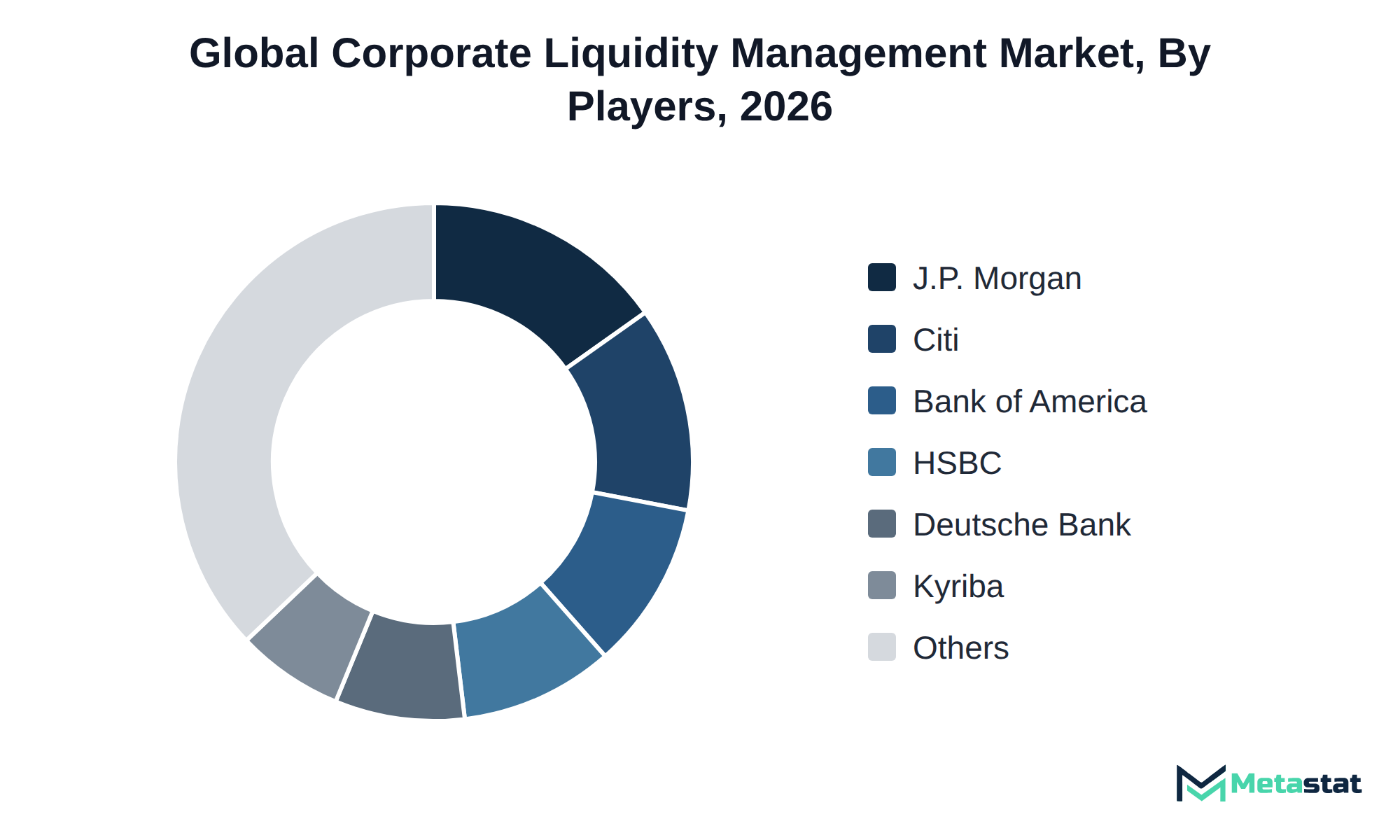
Companies in the Corporate Liquidity Management market employ various strategies to differentiate their offerings. Key players focus on specific service types, including J.P. Morgan, which emphasizes bank-provided liquidity services and software platforms. This strategic approach aligns with the growing demand for comprehensive cash management solutions among businesses.
Buyers select solutions based on factors including price, customization, and integration within existing ecosystems. For instance, Citi prioritizes consulting and integration services, catering to organizations seeking tailored liquidity management solutions. Meanwhile, Oracle and SAP focus on software platforms, providing robust technological solutions that enhance cash forecasting and liquidity positioning.
The competitive landscape experiences significant activity from both established banks and specialized software providers. HSBC and BNP Paribas leverage their extensive networks to deliver bank-provided liquidity services, while fintech companies like Kyriba and GTreasury concentrate on innovative software platforms, appealing to a tech-savvy clientele. This diversification in offerings allows buyers to choose solutions that best fit their operational requirements, enhancing overall market competitiveness.
Achieving this growth relies on several key developments in the Corporate Liquidity Management market. Significant adoption of cash forecasting and positioning solutions, projected to reach USD 1,911.3 million by 2033, will enhance liquidity accuracy and optimize cash flow management for businesses across multiple sectors. The expansion of cloud and SaaS deployment models, anticipated to grow to USD 5,309.6 million by 2033, supports scalability and flexibility, attracting a wider range of enterprises, particularly in North America and Europe. Conversely, potential risks including economic downturns or regulatory changes could hinder growth prospects. Adverse conditions particularly impact the banking and financial services sector, which relies heavily on effective liquidity management. Therefore, while the market outlook appears favorable, continuous monitoring of external factors will be essential to ensure sustained progress toward the projected market size.
By Solution Type: Cash Pooling and Sweeping, Cash Forecasting and Positioning, In-House Banking and Netting, Virtual Account Management, Intraday Liquidity Management, Short-Term Investment and Cash Optimization, Liquidity Risk and Stress Analytics, Others
By Offering Type: Software Platforms, Bank-Provided Liquidity Services, Consulting and Integration Services, Managed and Support Services
By Deployment Model: Cloud and SaaS, On-Premises, Hybrid
By End-Use Industry: Banking and Financial Services, Manufacturing, Retail and Consumer Goods, IT and Telecommunications, Energy and Utilities, Healthcare and Life Sciences, Transportation and Logistics, Others
The report strategically identifies and profiles the key market players and analyses their core competencies in each sub-segment of the Corporate Liquidity Management market.
Report Attributes | Details |
Study Period | 2021-2033 |
Base Year | 2025 |
Estimated Year | 2026 |
Forecast Period | 2026-2033 |
Historical Period | 2021-2025 |
Growth Rate | CAGR 13.0% from 2026 to 2033 |
Revenue Unit | USD million |
Segmentation | By Solution Type, Offering Type, Deployment Model, End-Use Industry, and Region |
By Region | North America (By Solution Type, Offering Type, Deployment Model, End-Use Industry, and Country)
|
Europe (By Solution Type, Offering Type, Deployment Model, End-Use Industry, and Country)
| |
Asia Pacific (By Solution Type, Offering Type, Deployment Model, End-Use Industry, and Country)
| |
South America (By Solution Type, Offering Type, Deployment Model, End-Use Industry, and Country)
| |
Middle East and Africa (By Solution Type, Offering Type, Deployment Model, End-Use Industry, and Country)
|
Find answers to common questions about this report
The Corporate Liquidity Management market size was valued at USD 3,140.9 million in 2025.
The market is projected to grow at a CAGR of 13.0% during the forecast period from 2026 to 2033.
The North America Corporate Liquidity Management market size is estimated to reach USD 2,713.4 million by 2033.
Cash Forecasting and Positioning leads the Corporate Liquidity Management market with a projected value of USD 1,911.3 million by 2033. This segment demonstrates the highest growth potential compared to others in the market.
Key drivers for the Corporate Liquidity Management market include increased adoption of cloud-based solutions, which enhance agility and real-time data access for organizations. A growing emphasis on advanced cash forecasting solutions drives demand for accurate forecasting tools, particularly in banking, manufacturing, and retail sectors.
North America holds the dominant share of the Corporate Liquidity Management market, with a value of USD 2,713.4 million projected for 2033, representing 34.4 percent of the total market.
Inadequate infrastructure limits the adoption of advanced liquidity management solutions among organizations, resulting in slower uptake and smaller order sizes. Rising operational costs present a significant challenge for suppliers, impacting profit margins and prompting investments in training and automation to manage expenses effectively.
Increased focus on cash forecasting solutions and the integration of automated technologies enhance liquidity management efficiency. Organizations prioritize these advancements to improve cash visibility and respond effectively to financial complexities, driving adoption across various sectors.
The Corporate Liquidity Management market is estimated to reach a valuation of USD 8,372.1 million by 2033.
Key players operating in the Corporate Liquidity Management market include J.P. Morgan, Citi, Bank of America, HSBC, BNP Paribas, Deutsche Bank, and Standard Bank.
The analysts below cover Banking & Finance research at Metastat Insights.
LEAD ANALYST
Utkarsh Khirodkar is a Lead Market Research Analyst at MetaStat Insight, specializing in market intelligence, technology sector assessments, and competitive strategy.

PRINCIPAL CONSULTANT - ENTERPRISE AI & EMERGING TECHNOLOGIES
Banking & Finance · Electronics and Semiconductor · Energy and Power · Healthcare IT · Information & Technology · Professional Services
Vijay Gunti is a Principal Consultant at MetaStat Insight, bringing over two decades of experience across enterprise digital transformation, technology strategy, and intelligent systems.
Evaluating secondary resin quality across post-consumer packaging streams requires reliable technical segmentation. MetaStat Insight delivered an objective assessment that distinguished between extrusion-grade flake pricing and optical sorting throughput limitations across Western Europe. The competitive positioning breakdown for licensed depolymerization technology providers answered several questions during our feedstock feasibility audit. Their team clarified regional trade restrictions on mixed plastic scrap quickly when our team submitted follow-up requests.
Evaluating sovereign cloud deployments for core banking platforms demands a clear view of data residency regulations and migration exit strategies. MetaStat Insight delivered an exhaustive review of regional latency tolerances, mainframe decommission milestones, and third-party vendor concentration risk. The regulatory compliance mapping across European and Asian financial jurisdictions gave our team a dependable baseline for multi-cloud infrastructure discussions.
Replacing petrochemical surfactants with bio-based alternatives requires realistic timelines on industrial precision fermentation scaling. The market research broke down commercialization timelines, feedstock sugar price sensitivities, and regional cosmetic ingredient regulatory approvals in Europe and East Asia. That supplier readiness mapping gave our formulations team reliable context when comparing renewable chemical sourcing roadmaps.
Explore related market intelligence reports worth reading alongside this one.
Starting from
$2950